


Taiwan’s first-ever “immediate combat readiness drills” entered the second day yesterday, with the army simulating anti-landing combat to keep Chinese forces from reaching Taipei, the country’s capital, and main economic and political hub.
With the help of M3 amphibious rigs, the army’s 53rd Engineer Group deployed oil barrels and floating platforms as obstacles in waters off New Taipei City’s Tamsui District (淡水) in a scenario that simulated Chinese People’s Liberation Army (PLA) ships and landing craft deploying air cushions on approach to the shore.
The troops created two types of obstacles, with the first type consisting of a floating platform, explosives and an oil barrel. Once detonated, the explosives could destroy or capsize PLA surface vessels.
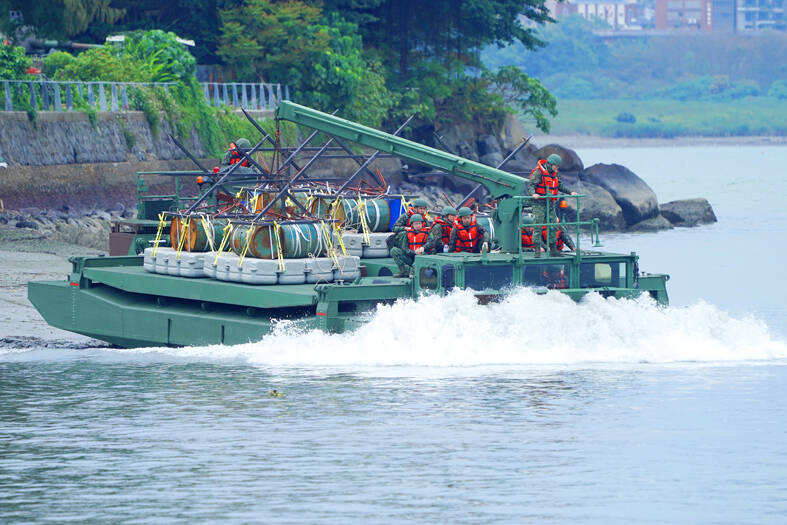
Photo: CNA
These obstacles were placed in the Tamsui River (淡水河) estuary to target enemy vessels attempting to enter the river.
The second type of obstacle, deployed further upstream, was a combination of floating platforms, mines and “Czech hedgehogs,” which are intended to incapacitate approaching enemy ships.
The army’s Guandu Area Command has stored amphibious rigs and components for creating obstacles to ensure they can be deployed rapidly when needed, a source with knowledge of the matter said.
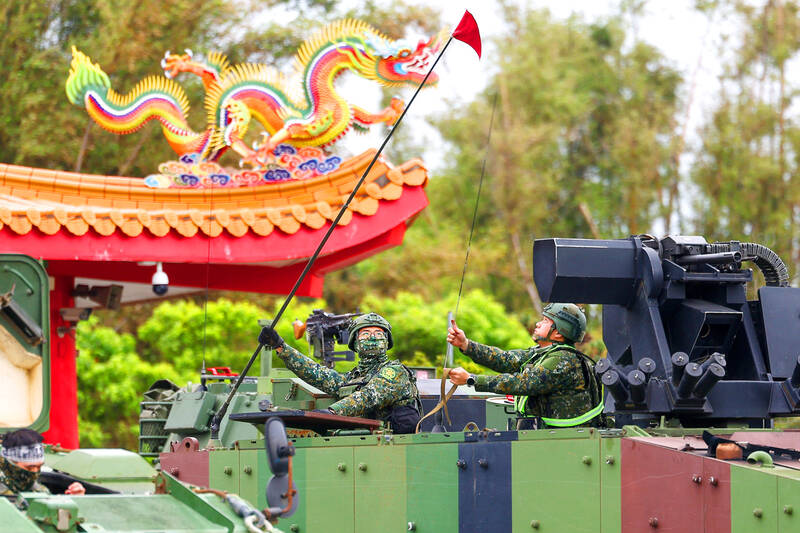
Photo: CNA
As the obstacles were being placed, an army AH-64E Apache helicopter flew over the Tamsui River.
The chopper flew back to Tamsui after completing a reconnaissance mission in the nearby Bali District (八里) and reporting to the ground command center, the source said.
Meanwhile, tanks and other armored vehicles rolled into their designated strategic positions in Bali upon receiving an order from the command center.
The vehicles mobilized for the drill included CM11 tanks, and CM33 and CM34 armored vehicles.
The five-day drills are the first of their kind and are being conducted based on the assessment that the PLA could unexpectedly pivot military exercises or “gray zone” activities — provocative or aggressive actions that fall just short of open conflict — near Taiwan into a real attack, a military source told local media on Wednesday last week.

The military has spotted two Chinese warships operating in waters near Penghu County in the Taiwan Strait and sent its own naval and air forces to monitor the vessels, the Ministry of National Defense (MND) said. Beijing sends warships and warplanes into the waters and skies around Taiwan on an almost daily basis, drawing condemnation from Taipei. While the ministry offers daily updates on the locations of Chinese military aircraft, it only rarely gives details of where Chinese warships are operating, generally only when it detects aircraft carriers, as happened last week. A Chinese destroyer and a frigate entered waters to the southwest

A magnitude 6.1 earthquake struck off the coast of Yilan County at 8:39pm tonight, the Central Weather Administration (CWA) said, with no immediate reports of damage or injuries. The epicenter was 38.7km east-northeast of Yilan County Hall at a focal depth of 98.3km, the CWA’s Seismological Center said. The quake’s maximum intensity, which gauges the actual physical effect of a seismic event, was a level 4 on Taiwan’s 7-tier intensity scale, the center said. That intensity level was recorded in Yilan County’s Nanao Township (南澳), Hsinchu County’s Guansi Township (關西), Nantou County’s Hehuanshan (合歡山) and Hualien County’s Yanliao (鹽寮). An intensity of 3 was
Japanese Prime Minister Sanae Takaichi’s comment last year on Tokyo’s potential reaction to a Taiwan-China conflict has forced Beijing to rewrite its invasion plans, a retired Japanese general said. Takaichi told the Diet on Nov. 7 last year that a Chinese naval blockade or military attack on Taiwan could constitute a “survival-threatening situation” for Japan, potentially allowing Tokyo to exercise its right to collective self-defense. Former Japan Ground Self-Defense Force general Kiyofumi Ogawa said in a recent speech that the remark has been interpreted as meaning Japan could intervene in the early stages of a Taiwan Strait conflict, undermining China’s previous assumptions
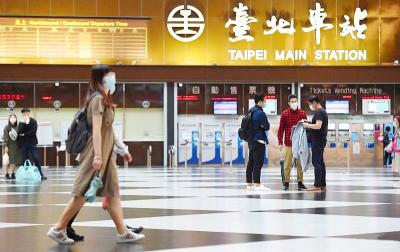
Taiwan Railways Corp (TRC) today announced that Shin Kong Mitsukoshi has been selected as the preferred bidder to operate the Taipei Railway Station shopping mall, replacing the current operator, Breeze Development Co Ltd. Among eight qualified firms that delivered presentations and were evaluated by a review committee, Shin Kong Mitsukoshi was ranked first, while Breeze was named the runner-up, the rail company said in a statement. Contract negotiations are to proceed in accordance with regulations, it said, adding that if negotiations with the top bidder fail, it could invite the second-ranked applicant to enter talks. Breeze in a statement today expressed doubts over


 RSS
RSS