


The Chinese Nationalist Party (KMT) caucus yesterday convened to discuss referendums to counter Democratic Progressive Party (DPP) proposals, KMT caucus whip Fu Kun-chi (傅?萁) said yesterday.
The DPP has proposed four referendums aimed at the opposition party, a challenge the KMT would not shy from, Fu said.
The KMT referendums would focus heavily on the welfare of Taiwanese, he said.
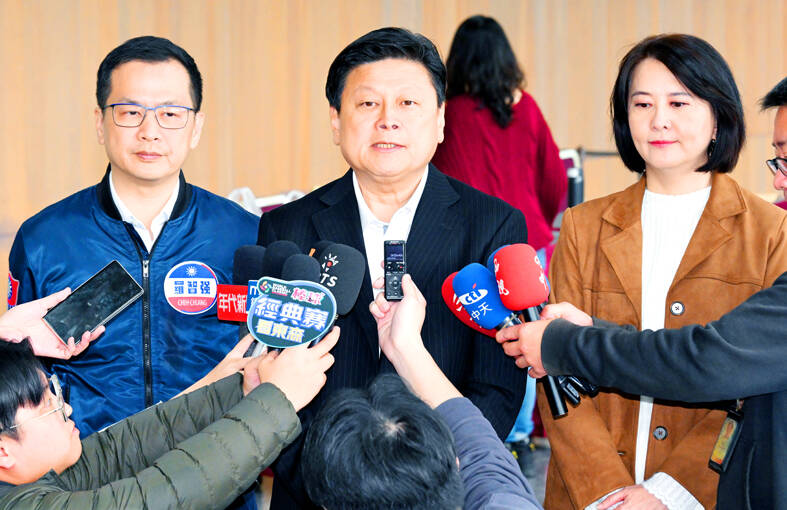
Photo: Liao Chen-huei, Taipei Times
Some local media reported that a participant at the caucus meeting said they had discussed proposing a referendum against the abolition of the death penalty to counter recall campaigns against KMT legislators.
That person also said the party hoped the recall vote could be on the same day as voting on referendums, expected to be held on Aug. 23.
Asked if the party would propose a referendum to keep the death penalty, Fu said the caucus had not yet arrived at a consensus, adding that it must complete all procedures before May 23, leaving little time to prepare additional proposals on capital punishment.
Under amendments to the Referendum Act (公民投票法), referendums are held every two years on the fourth Saturday of August.
Referendum proposals need 1,995 signatures to pass the initial threshold and 290,000 signatures to be sustained, the KMT said.
If a proposal does not meet referendum requirements, the party is considering proposing it at the Legislative Yuan, it said.
Under Article 15 of the Referendum Act, if the legislature deems it necessary to hold a referendum, it can — after the main text and the statement of reasons for the referendum are adopted in a plenary session — forward the proposal to the Central Election Commission for implementation within 10 days.
Separately, KMT Chairman Eric Chu (朱立倫) said during a meeting of the KMT’s Central Standing Committee that he would shoulder all responsibility for the controversy generated by the party’s recall proposals and asked supporters to stop blaming volunteers.
Thirty-two recall proposals against KMT members had passed signature thresholds, while all recall proposals against DPP members have failed to pass and require supplementary signatures.
The party is in close contact with legislators on the issue of recalls and understands the importance of effectively mobilizing supporters.
The KMT recognizes that some parts of its recall campaign were not perfect, Chu said, adding that he is responsible as party chairman.
Additional reporting by CNA

FUKUOKA SITUATION: Japanese media reported that the pathogen is expected to be identified by the summer, while the CDC downplayed the idea that it was hMPV A “mysterious cold-like illness” reported in Japan’s Fukuoka Prefecture does not seem to be a new disease, but Japanese authorities have been asked about the situation, the Centers for Disease Control (CDC) said yesterday. The Fukuoka Prefectural Medical Association on Wednesday told a news conference that a “mystery cold” that has become a hot topic on social media is “highly likely to be caused by some kind of viral infection,” Japan’s KBC News reported. “Many people are experiencing symptoms starting with a sore throat, followed by a runny nose, phlegm and a severe cough,” KBC News reported, citing association officials. Health authorities are

Nvidia Corp CEO Jensen Huang (黃仁勳) arrived in Taiwan yesterday ahead of upcoming AI and technology events, saying he plans to meet with clients and Taiwan Semiconductor Manufacturing Co Chairman C.C. Wei (魏哲家) during his visit. After landing at Taipei Songshan Airport, Huang posed for photos with fans and handed out Yakult drinks to reporters and supporters waiting at the scene, saying he has “a lot to do” during the trip. Asked about reports that Nvidia’s planned headquarters site in Taipei’s Beitou Shilin Technology Park could break ground on May 27, Huang said that if the company holds an event, he would

Carrefour Taiwan is to begin using a new name from the start of July, but it cannot divulge the name until then, the chairman of the supermarket chain's parent company said today. President Chain Store Co chairman Lo Chih-hsien (羅智先) was asked by reporters after a shareholders' meeting to confirm whether the company has settled on a new name for the supermarket brand. In March, the government-registered name of two Carrefour Taiwan branches was quietly changed to "Le Chia Kang" (樂家康) in Chinese, raising speculation that has been selected as the name. Lo said that because of local regulations and contractual obligations, the
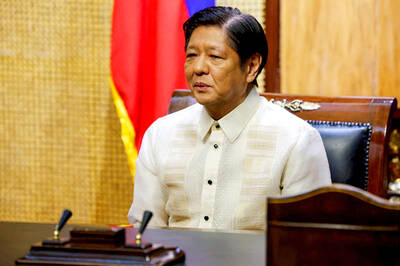
The Philippines would likely be involved in any conflict over Taiwan due to its proximity to the democracy claimed by China, President Ferdinand Marcos Jr said, reiterating a stance that risks angering Beijing. “In the Philippines, we do not have a choice because Taiwan is so close to the Philippines and we have almost 200,000 Filipino nationals living and working in Taiwan,” Marcos said in an interview with Japanese media in Manila on Monday. The Philippine leader’s comments come ahead of a state visit to Japan next week, where he is to meet with Japanese Prime Minister Sanae Takaichi to discuss security


 RSS
RSS