


Taiwan should view the foreign relations policies of US President Donald Trump’s administration as an opportunity to make Taiwan stronger, President William Lai (賴清德) said yesterday.
Lai was quoted by Democratic Progressive Party (DPP) caucus chief executive Rosalia Wu (吳思瑤) during a gathering with DPP lawmakers in his capacity as DPP chairman ahead of the new legislative session that is to begin tomorrow.
Lai spoke on three main topics, Wu said.
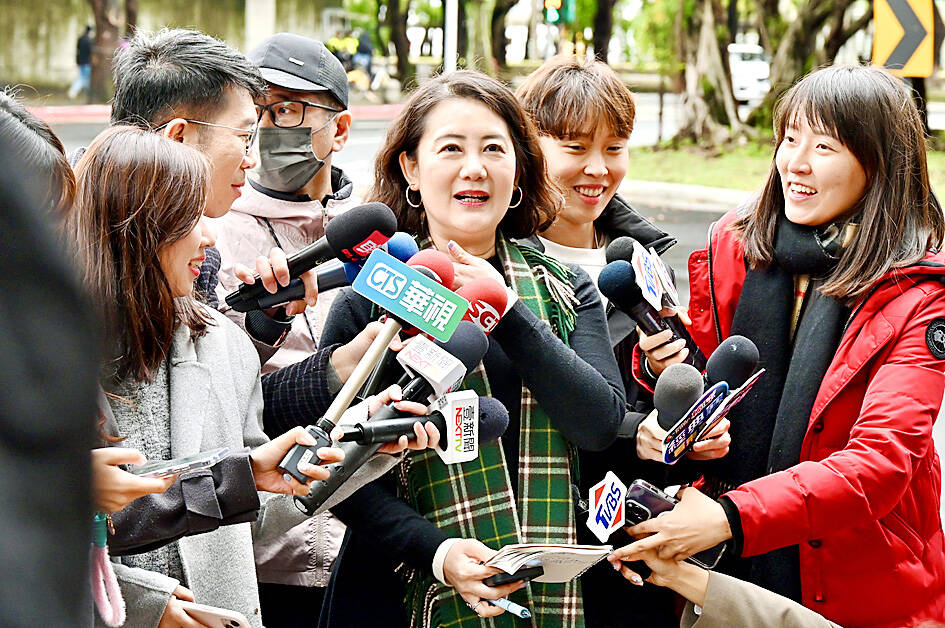
Photo: George Tsorng, Taipei Times
He spoke about Trump’s foreign relations policies, the Legislative Yuan’s upcoming session and Taiwan’s relations with China, she said.
The nation is at a critical moment, and every DPP legislator must remember their intention when joining the party, which is to serve resolutely and to safeguard Taiwan’s sovereignty and democracy, she cited Lai as saying.
“Lai also quoted former US president John F. Kennedy, telling legislators: ‘Ask not what your country can do for you, ask what you can do for your country,’” she said.
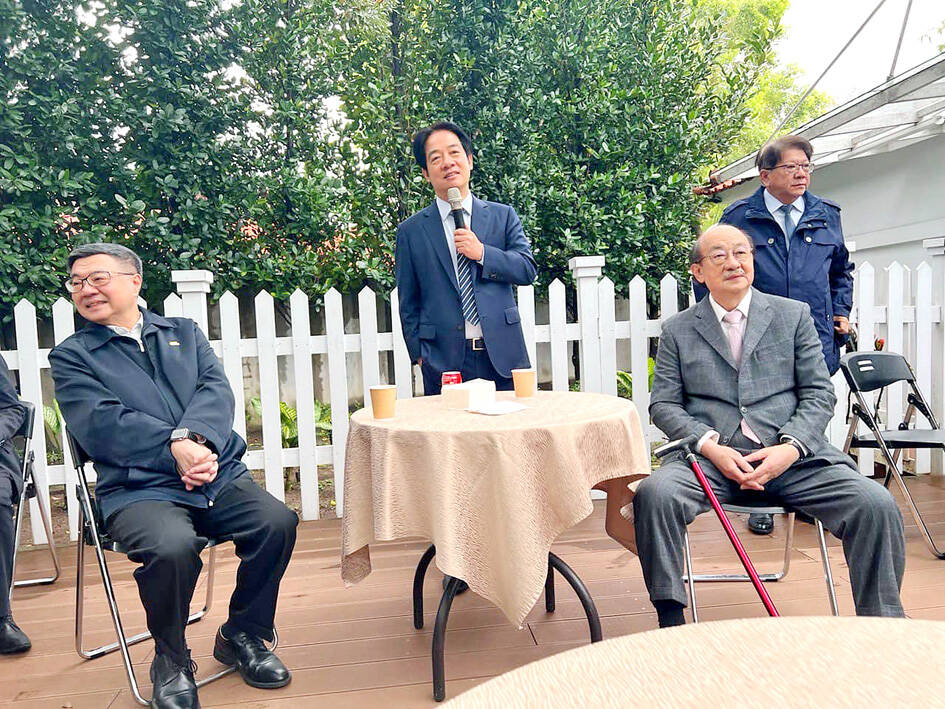
Phoro: Screen grab from Legislator Lin Tai-hua's Facebook page
On the issue of Trump’s policies, Lai said that the government was preparing to respond to anything that could affect Taiwan by reviewing national security, industrial and financial policies, she said, adding that such policies could be viewed positively as opportunities for Taiwan to grow stronger.
Taiwan enjoyed unimpeded communication with the US and a solid foundation for cooperation during the eight years of the administration of former president Tsai Ing-wen (蔡英文), she said.
“There is mutual trust and understanding there, and we have a good understanding of the policies and are ready to respond. I think people can rest assured,” she said.
On the issue of China’s threats of invasion, Lai called on legislators to have “firmer convictions to lead our country and our people,” and promised that “strengthening national defense and security is absolutely our top priority,” she said.
To be best prepared, Taiwan must bolster the resilience of the economy, she said.
“We need strong national defense and military strength, combined with resilient economic policies. We must also enhance cooperation with our democracies,” she cited Lai as saying.
Premier Cho Jung-tai (卓榮泰) and Vice Premier Cheng Li-chiun (鄭麗君) were also present at the gathering, which was held in the style of barbecue, but DPP lawmakers Liu Chien-kuo (劉建國), Chen Su-yueh (陳素月), Chen Kuan-ting (陳冠廷), Yang Yao (楊曜), Wang Ting-yu (王定宇) and Tsai Chi-chang (蔡其昌) were absent due to other obligations.
DPP Legislator Lin Tai-hua (林岱樺), who on Friday posted bail of NT$1 million (US$30,540) following her detention in an ongoing case involving fraud allegations, attended the barbecue and posted photos on Facebook, tagging Lai, Presidential Office Secretary-General Pan Men-an (潘孟安) and others.
Speaking to reporters following the event, Wu said that judicial cases involving DPP legislators were not discussed at the event.
Commenting that the DPP faced challenges from the opposition Chinese Nationalist Party (KMT) and Taiwan People’s Party — who jointly hold a legislative majority — Wu said that the DPP was “mentally prepared,” and that it would “not underestimate the enemy.”

FUKUOKA SITUATION: Japanese media reported that the pathogen is expected to be identified by the summer, while the CDC downplayed the idea that it was hMPV A “mysterious cold-like illness” reported in Japan’s Fukuoka Prefecture does not seem to be a new disease, but Japanese authorities have been asked about the situation, the Centers for Disease Control (CDC) said yesterday. The Fukuoka Prefectural Medical Association on Wednesday told a news conference that a “mystery cold” that has become a hot topic on social media is “highly likely to be caused by some kind of viral infection,” Japan’s KBC News reported. “Many people are experiencing symptoms starting with a sore throat, followed by a runny nose, phlegm and a severe cough,” KBC News reported, citing association officials. Health authorities are

Nvidia Corp CEO Jensen Huang (黃仁勳) arrived in Taiwan yesterday ahead of upcoming AI and technology events, saying he plans to meet with clients and Taiwan Semiconductor Manufacturing Co Chairman C.C. Wei (魏哲家) during his visit. After landing at Taipei Songshan Airport, Huang posed for photos with fans and handed out Yakult drinks to reporters and supporters waiting at the scene, saying he has “a lot to do” during the trip. Asked about reports that Nvidia’s planned headquarters site in Taipei’s Beitou Shilin Technology Park could break ground on May 27, Huang said that if the company holds an event, he would

The Ministry of Finance this afternoon announced the winning numbers for the March-April uniform invoice lottery. The winning number for the NT$10 million (US$318,060) special prize is 19531471, and the winning number for the NT$2 million grand prize is 85941329. Three numbers were drawn for the NT$200,000 first prize: 07225810, 20231230 and 83518781. Those with receipts matching the last seven digits of any of the first-prize numbers will win the NT$40,000 second prize, while those matching the last six digits will win the NT$10,000 third prize. Those whose receipts match the last five digits of the first-prize numbers can claim the NT$4,000 fourth prize,

SIX SUBSIDIES: The monthly allowance for older farmers is to increase to NT$10,000, and NT$5,000 is to be given to homemakers under the national pension system, Lai said The government is to implement major welfare policies for disadvantaged groups, including raising the monthly allowance for older farmers to NT$10,000 and providing homemakers with NT$5,000 per month, President William Lai (賴清德) said yesterday. Lai made the remarks during a visit to Wangling Temple in Chiayi County, saying that the planned increases were being introduced amid economic growth and an increase in tax revenue. Touting a policy, in which the government plans to provide a monthly allowance of NT$5,000 for every child under the age of 18 in a bid to address Taiwan’s low birthrate, Lai said that if received for the


 RSS
RSS