


The Democratic Progressive Party (DPP) yesterday requested an injunction and constitutional interpretation of an amendment to the Public Officials Election and Recall Act (公職人員選舉罷免法) that took effect yesterday after President William Lai’s (賴清德) promulgation on Tuesday.
It is unconstitutional to require people initiating or signing a recall petition to provide photocopies of their identification cards when submitting petition signatures, which amendments to the recall act make compulsory, DPP caucus whip Ker Chien-ming (柯建銘) said.
People risk being put in jail if they are not careful enough when exercising their basic human rights, he added.
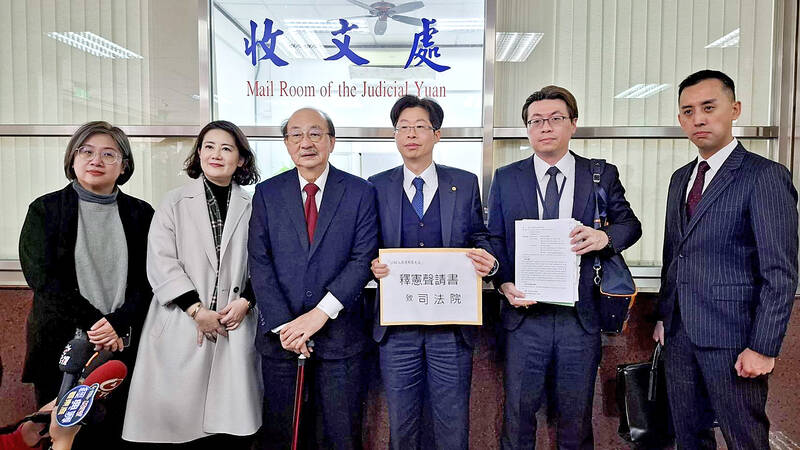
Photo: Yang Kuo-wen, Taipei Times
The new law includes punitive measures, stipulating that anyone found guilty of using someone else’s identification or forging an ID for a recall petition could face up to five years in prison or a fine of up to NT$1 million (US$30,496).
Article 17 of the Constitution gives people “the right of election, recall, initiative and referendum,” while Article 22 guarantees Taiwanese “all the freedoms and rights that are not detrimental to social order or public welfare,” Ker said.
He said the DPP’s request is to seek remedy and maintain constitutional order, as “no political parties or single person can stand on the opposite side of the Constitution.”
However, the newly amended Constitutional Court Procedure Act (憲法訴訟法) mandates that a minimum of 10 grand justices must hear and rule on a case, and that a ruling that something is unconstitutional must be supported by at least nine justices.
The court currently only has eight grand justices, as the Legislative Yuan rejected the seven nominees put forward by Lai in December last year.
Chinese Nationalist Party (KMT) caucus whip Fu Kun-chi (傅?萁) yesterday said a ruling would be illegal, as there are not enough grand justices.
The amendments, proposed by KMT legislators and backed by the Taiwan People’s Party, were passed on Dec. 20 last year.
The Cabinet on Jan. 24 requested the legislature to reconsider the amendments based on the provisions of the Constitution, saying it would be difficult to execute.
However, the Legislative Yuan on Tuesday last week voted to uphold the new legislation and sent it to the Presidential Office a day later.
The Ministry of the Interior (MOI) said it deeply regrets that it would be almost impossible to initiate a recall petition in the future, as the newly amended law would raise the threshold, and restrict the public’s right to recall elected politicians.

Actor Darren Wang (王大陸) was sentenced to six months in prison, commutable to a fine, by the New Taipei District Court today for contravening the Personal Data Protection Act (個人資料保護法) in a case linked to an alleged draft-dodging scheme. Wang allegedly paid NT$3.6 million (US$114,380) to an illegal group to help him evade mandatory military service through falsified medical documents, prosecutors said. He transferred the funds to Chen Chih-ming (陳志明), the alleged mastermind of a draft-evasion ring, although he lost contact with him as he was already in detention on fraud charges, they said. Chen is accused of helping a

SECURITY: Starlink owner Elon Musk has taken pro-Beijing positions, and allowing pro-China companies to control Taiwan’s critical infrastructure is risky, a legislator said Starlink was reluctant to offer services in Taiwan because of the nation’s extremely high penetration rates in 4G and 5G services, the Ministry of Digital Affairs said yesterday. The ministry made the comments at a meeting of the legislature’s Transportation Committee, which reviewed amendments to Article 36 of the Telecommunications Management Act (電信管理法). Article 36 bans foreigners from holding more than 49 percent of shares in public telecommunications networks, while shares foreigners directly and indirectly hold are also capped at 60 percent of the total, unless specified otherwise by law. The amendments, sponsored by Chinese Nationalist Party (KMT) Legislator Ko

The eastern extension of the Taipei MRT Red Line could begin operations as early as late June, the Taipei Department of Rapid Transit Systems said yesterday. Taipei Rapid Transit Corp said it is considering offering one month of free rides on the new section to mark its opening. Construction progress on the 1.4km extension, which is to run from the current terminal Xiangshan Station to a new eastern terminal, Guangci/Fengtian Temple Station, was 90.6 percent complete by the end of last month, the department said in a report to the Taipei City Council's Transportation Committee. While construction began in October 2016 with an
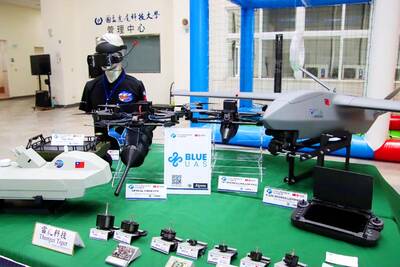
NON-RED SUPPLY: Boosting the nation’s drone industry is becoming increasingly urgent as China’s UAV dominance could become an issue in a crisis, an analyst said Taiwan’s drone exports to Europe grew 41.7-fold from 2024 to last year, with demand from Ukraine’s fight against Russian aggression the most likely driver of growth, a study showed. The Institute for Democracy, Society and Emerging Technology (DSET) in a statement on Wednesday said it found that many of Taiwan’s uncrewed aerial vehicle (UAV) sales were from Poland and the Czech Republic. These countries likely transferred the drones to Ukraine to aid it in its fight against the Russian invasion that started in 2022, it said. Despite the gains, Taiwan is not the dominant drone exporter to these markets, ranking second and fourth


 RSS
RSS