


Former Chinese Nationalist Party (KMT) legislator Sufin Siluko (廖國棟) and three others were indicted yesterday by the Taipei District Prosecutors’ Office on corruption charges linked to a failed solar energy project.
Prosecutors alleged that Sufin accepted NT$5 million (US$152,681) in bribes from business developers to pressure government agencies to restart a green energy project in Pingtung County’s Mudan Township (牡丹).
Sufin accepted the bribes in exchange for applying pressure on the Southern Region Water Resources Branch of the Water Resources Agency (WRA) to continue plans to build a floating solar power station on the Mudan Reservoir (牡丹水庫), prosecutors said.
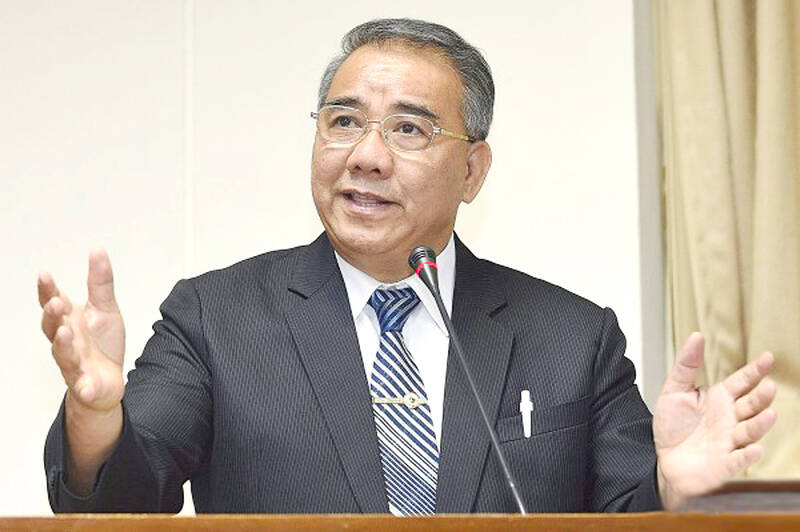
Photo: Wang Chien-hao, Taipei Times
The Ministry of Economic Affairs requested funding for the project in 2017, but due to high investment costs and protests from local indigenous communities, no bidders showed interest and the project was officially halted with approval from the Pingtung County Government in 2018, the prosecutors’ office said.
However, two developers surnamed Tsai (蔡) and Chih (池) in 2019 intended to restart the project, with Chih cooperating with the then-development manager of Maiora Renewable Energy Co, surnamed Hsieh (謝), the office said.
Tsai approached Sufin’s office director, surnamed Hung (洪), to ask the legislator to help apply pressure on the WRA, promising a substantial reward in return, it said.
Sufin in November 2019 told the developers via Hung that the WRA was to restart the project, and solicited a bribe of NT$5 million from Tsai under the guise of a political campaign donation, it added.
Tsai, Chih and Hsieh traveled to Hualien County to pay a cash bribe to Hung as an advance payment for Sufin’s involvement, the office said.
Sufin in January 2020 was re-elected as a KMT legislator and became convener of the legislature’s Economics Committee, prosecutors said.
He convened a meeting the following month with the WRA and the Southern Region Water Resources Branch to lower the threshold for investment tenders, which the two rejected, they said.
The same month, Sufin convened another meeting, requesting that the project’s reinstatement be evaluated and instructing Hung to solicit more bribes from Tsai, after which the developers handed over a further NT$2 million, prosecutors said.
Sufin in March 2020 invited Chung Chao-kung (鍾朝恭), then-vice director of the WRA, to a meeting to pressure him to restart the project, for which Hung solicited Tsai for a further NT$2.5 million bribe, they said.
Under pressure from Sufin, the Southern Region Water Resources Branch wrote to the Mudan Township Office and the Mudan Township Council to ask them to reconsider the project, which the township office rejected, with the representative council asking Sufin to stop applying pressure to restart the project, they added.
Sufin in September 2020 was indicted and later detained without visitation rights in a separate corruption scandal in which he accepted bribes in a case linked to an ownership dispute over the Pacific Sogo Department Store chain.
As the Mudan Township project would no longer go ahead, Tsai requested that Sufin return the total sum of NT$5 million, prosecutors said.
As Sufin could not return the money, the two had a disagreement and Tsai reported him to the Investigation Bureau of the Ministry of Justice, they said.
An investigation found evidence that Sufin and Hung had contravened the Anti-Corruption Act (貪污治罪條例) by receiving bribes in exchange for performing official duties.
Tsai, Chih and Hsieh were also charged under the act for offering bribes to public officials, but prosecutors have recommended a reduced or waived sentence for Tsai due to his cooperation and early confession.
Sufin was previously sentenced to eight years, six months in prison for his involvement in the Pacific Sogo corruption case.


Kenting National Park service technician Yang Jien-fon (楊政峰) won a silver award in World Grand Prix Photography Awards Spring Season for his photograph of two male rat snakes intertwined in combat. Yang’s colleagues at Kenting National Park said he is a master of nature photography who has been held back by his job in civil service. The awards accept entries in all four seasons across six categories: architectural and urban photography, black-and-white and fine art photography, commercial and fashion photography, documentary and people photography, nature and experimental photography, and mobile photography. Awards are ranked according to scores and divided into platinum, gold and

More than half of the bamboo vipers captured in Tainan in the past few years were found in the city’s Sinhua District (新化), while other districts had smaller catches or none at all. Every year, Tainan captures about 6,000 snakes which have made their way into people’s homes. Of the six major venomous snakes in Taiwan, the cobra, the many-banded krait, the brown-spotted pit viper and the bamboo viper are the most frequently captured. The high concentration of bamboo vipers captured in Sinhua District is puzzling. Tainan Agriculture Bureau Forestry and Nature Conservation Division head Chu Chien-ming (朱健明) earlier this week said that the
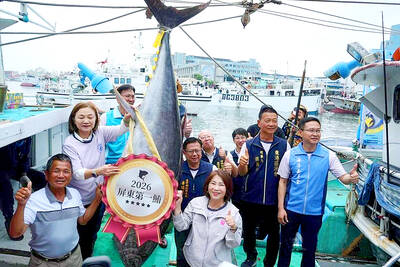
The first bluefin tuna of the season, brought to shore in Pingtung County and weighing 190kg, was yesterday auctioned for NT$10,600 (US$333.5) per kilogram, setting a record high for the local market. The auction was held at the fish market in Donggang Fishing Harbor, where the Siaoliouciou Island-registered fishing vessel Fu Yu Ching No. 2 delivered the “Pingtung First Tuna” it had caught for bidding. Bidding was intense, and the tuna was ultimately jointly purchased by a local restaurant and a local company for NT$10,600 per kilogram — NT$300 ,more than last year — for a total of NT$2.014 million. The 67-year-old skipper
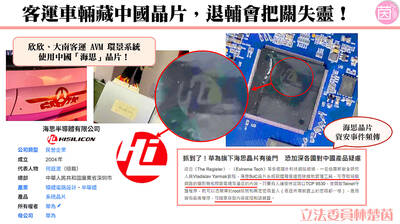
BREACH OF CONTRACT: The bus operators would seek compensation and have demanded that the manufacturer replace the chips with ones that meet regulations Two bus operators found to be using buses with China-made chips are to demand that the original manufacturers replace the systems and provide compensation for breach of contract, the Veterans Affairs Council said yesterday. Democratic Progressive Party Legislator Michelle Lin (林楚茵) yesterday said that Da Nan Bus Co and Shin-Shin Bus Co Ltd have fielded a total of 82 buses that are using Chinese chips. The bus models were made by Tron-E, while the systems provider was CYE Electronics, Lin said. Lin alleged that the buses were using chips manufactured by Huawei subsidiary HiSilicon Co, which presents a national security risk if the


 RSS
RSS