


As part of its continued focus on “national security” concerns in Hong Kong, the Chinese Communist Party (CCP) has begun classes on “Xi Jinping thought” as part of the territory’s curriculum, the Mainland Affairs Council (MAC) said.
Since the passage of the National Security Law in Hong Kong, the council has given a quarterly report to the Legislative Yuan on Hong Kong’s status.
All aspects of Hong Kong’s development are dominated and constrained by the CCP’s focus on national security, the report said.
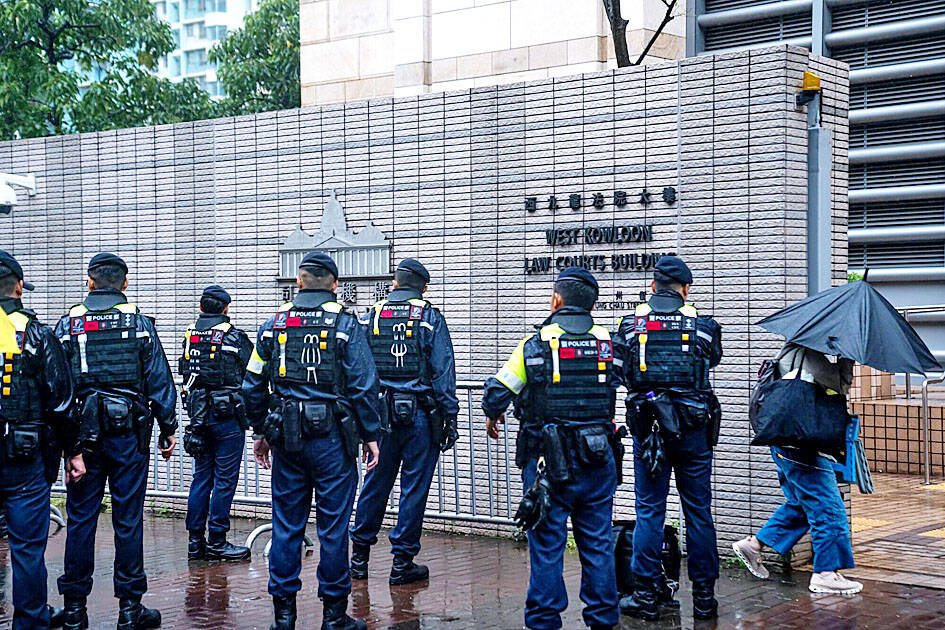
Photo: Bloomberg
Last year marked the fifth year in a row that Hong Kong’s civil society groups failed to hold marches or demonstrations on July 1, it said.
Instead of peaceful demonstrations, police officers were on high alert and armored vehicles patrolled the streets, the report said.
Other indicators of the intimidation Hong Kongers face include the harassment of student unions and punishments even for those who organize peaceful rallies, it said.
The report cited comments on Nov. 24 last year by Zhang Yong (張勇), deputy chairman of the Hong Kong Basic Law Committee and deputy chairman of the Legislative Affairs Commission of the Standing Committee of the Chinese National People’s Congress, who said that “Hong Kong governed by Hong Kongers” does not mean it is exclusively governed by Hong Kongers.
The central government and patriots must also be included, it cited Zhang as saying, adding that public opinion supported that definition.
High-school social studies courses now include readings on “Xi Jinping thought” — referring to China’s president (習近平) — and “socialism with Chinese characteristics,” it said.
Classes on religion focus on how students can contribute to the country, and refer to the National Security Law and other legal provisions, it added.
The Hong Kong Education Bureau updated its School Administration Guide to require that schools monitor their libraries to immediately remove materials deemed detrimental to national security, the report said.
Principals at primary and secondary schools would also receive excerpts of Xi’s book to boost their ideological education, it said.
In July last year, the Hong Kong Legislative Council established a new Social Workers Registration Board that requires all members to take an oath of allegiance to the Basic Law, and the governments of Hong Kong and China, it said.
Meanwhile, Nicholas Philips, a foreign judge, left Hong Kong’s Court of Final Appeal, leaving only six justices, down 60 percent from 2020, the report said.
A proposal by the Legislative Council to expand protection at “critical infrastructure” has raised foreign investors’ concerns about expanded regulatory targets, lowering confidence in Hong Kong’s ability to attract international investments, the report said.
The MAC would continue to monitor Hong Kong’s integration with China and warn people of the potential dangers of traveling to Hong Kong, the report said.
On Dec. 24 last year, the Hong Kong government published its third bounty list, promising HK$1 million (US$128,407) for information leading to the capture of one of six democracy advocates, and a list of prohibited activities under the Safeguarding National Security Ordinance, it said.
The US Congressional-Executive Commission on China said in its annual report in December last year that “Hong Kong officials may now be more zealous than their mainland counterparts in enforcing national security laws.”

Taiwan's Vice President Hsiao Bi-khim (蕭美琴) said Saturday that she would not be intimidated by the Chinese Communist Party (CCP), following reports that Chinese agents planned to ram her car during a visit to the Czech Republic last year. "I had a great visit to Prague & thank the Czech authorities for their hospitality & ensuring my safety," Hsiao said on social media platform X. "The CCP's unlawful activities will NOT intimidate me from voicing Taiwan's interests in the international community," she wrote. Hsiao visited the Czech Republic on March 18 last year as vice president-elect and met with Czech Senate leadership, including

There have been clear signs of Chinese Communist Party (CCP) attempts to interfere in the nationwide recall vote on July 26 in support of Chinese Nationalist Party (KMT) legislators facing recall, an unnamed government official said, warning about possible further actions. The CCP is actively involved in Taiwanese politics, and interference in the recall vote is to be expected, with multiple Chinese state media and TAO attempts to discredit the Democratic Progressive Party (DPP) and undermine public support of their recall movement, the official said. This interference includes a smear campaign initiated this month by a pro-Beijing Hong Kong news outlet against

A week-long exhibition on modern Tibetan history and the Dalai Lama’s global advocacy opened yesterday in Taipei, featuring quotes and artworks highlighting human rights and China’s ongoing repression of Tibetans, Hong Kongers and Uighurs. The exhibition, the first organized by the Human Rights Network for Tibet and Taiwan (HRNTT), is titled “From the Snowy Ridges to the Ocean of Wisdom.” “It would be impossible for Tibetans inside Tibet to hold an exhibition like this — we can do it. because we live in a free and democratic country,” HRNTT secretary-general Tashi Tsering said. Tashi Tsering, a Taiwan-based Tibetan who has never
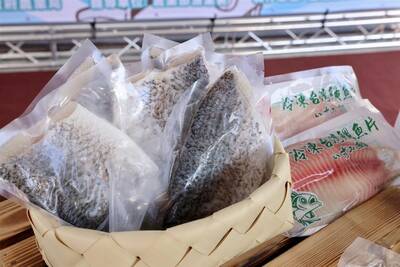
A first shipment of five tons of Taiwan tilapia was sent from Tainan to Singapore on Wednesday, following an order valued at NT$600,000 (US$20,500) placed with a company in the city. The products, including frozen whole fish and pre- cooked fish belly, were dispatched from Jiangjun Fishing Harbor, where a new aquatic processing and logistics center is under construction. At the launch, Tainan Mayor Huang Wei-che (黃偉哲) called the move a “breakthrough,” marking Taiwan’s expansion into the Singaporean tilapia market. Taiwan’s tilapia exports have traditionally focused on the United States, Canada, and the Middle East, Huang said, adding that the new foothold in


 RSS
RSS