


Pig farming at scale continues to be the trend with most pig farms averaging about 900 pigs, while farms with fewer than 200 pigs continue to decrease, according to the Ministry of Agriculture’s most recent swine census.
Multiple factors influence the exit of smaller pig farms, including rising overhead costs as a result of regulations on wastewater emissions and waste treatment, Department of Animal Industry Director-General Lee Yi-chien (李宜謙) said.
The disinclination of younger generations to pick up the family business among small-scale farms is another reason, Lee said.
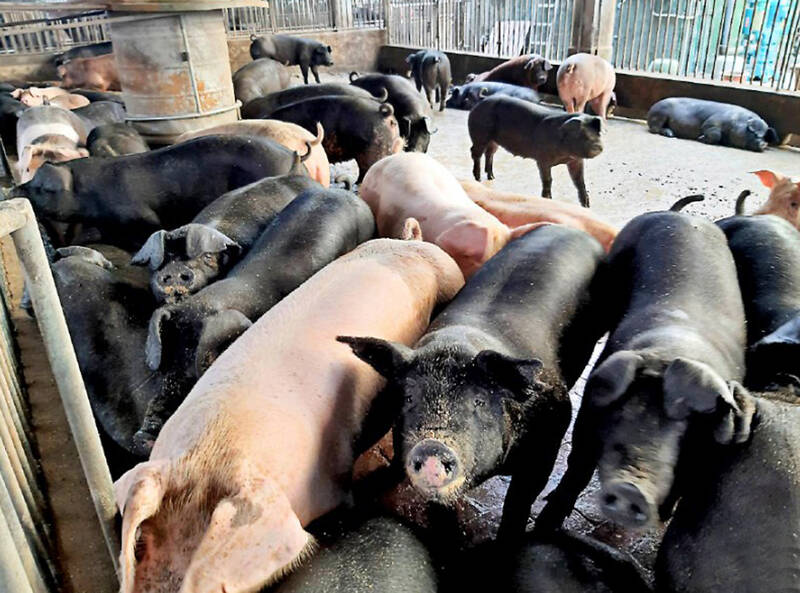
Photo: Yang Yuan-ting, Taipei Times
As a result, domestic pig farming is trending toward large-scale farming with a focus on high efficiency and high returns, Lee said.
The ministry’s biannual pig farm census showed that Taiwan had a total of 5,564 pig farms as of November last year, 40 less than in May.
There were a total of 5,206,927 pigs across all farms, the ministry said.
The previous average number of pigs at husbandry farms stood at about 800, but now it is 900, Lee said.
Peripheral industries, such as butchering, processing, transportation, feed manufacturing and retail, have a combined value of NT$200 billion (US$6.1 billion), Lee said, adding that recent policies aimed at growing the industry through investments exceeding NT$10 billion have seen an increased average of piglets being born.
Previously, a sow would give birth to 11 piglets on average, but newer methodologies and technology have increased it to 13, Lee added.
Should Taiwan’s application to the World Organization for Animal Health to be recognized as a swine fever-free country be approved this year, international pork exports would become possible, Lee said.
However, budget cuts would harm the ministry’s efforts to promote disease prevention awareness and overseas sales, Lee added.
Chinese Nationalist Party (KMT) and Taiwan People’s Party lawmakers have cut the ministry’s public relations and media funding by 60 percent, reduced administrative funding by 30 percent, and slashed budgets for overseas and domestic travel, Lee said.
Lee said the reduced budget would prevent the ministry from dispatching agents to pig farms for consultation, inspection and disease prevention.
The reduction in media promotion fees could also hamper Taiwan’s foothold in the Singaporean and Philippine markets, he said, adding that the ministry would be hard-pressed to expand into new markets with limited funding.

NATIONAL SECURITY: Authorities are working to confirm the identities of the military personnel involved and investigating possible illegal conduct and regulatory violations Authorities are probing possible national security implications after Kinmen police and immigration officers on Sunday found a Chinese woman allegedly posing as a tourist while engaging in prostitution involving more than 10 military personnel. The woman, surnamed Chen (陳), has since been deported, authorities said, adding that investigators are still working to confirm the identities of those implicated, as the records only listed code names and aliases. The case stemmed from a report received by the Kinmen District Prosecutors’ Office on Friday last week from the Jinhu Precinct of the Kinmen County Police Bureau. On Sunday, police, along with the National Immigration

GLOBALGIVING: ‘ Caving to external pressure is not acceptable for an organization that has cultivated justice reform and human rights for 30 years,’ one NGO said A slew of non-government organizations (NGOs) have withdrawn from the GlobalGiving fundraising platform after it announced it would use “Chinese Taipei” instead of “Taiwan” from next month. The Taiwan Good Rice Association wrote on Facebook on Friday that it was informed on April 28 via a teleconference call of the change, which was made because the platform wanted to operate in China. Taiwan Good Rice is to terminate all cooperative relationships with GlobalGiving in response to the platform’s “unilateral and non-negotiable” decision to remove references to Taiwan, the NGO said. “Taiwan is in the official name of Taiwan Good Rice Association and the

HEAVY WEATHER: Typhoon Jangmi is due to crash straight into the Ryukyus as airlines look to shift flights to larger aircraft or cancel flights to Okinawa entirely Taiwan’s international air carriers announced flight adjustments over the weekend as Typhoon Jangmi is forecast to hit the Ryukyu Islands today and tomorrow. The Central Weather Administration (CWA) upgraded Jangmi from a tropical storm to a typhoon at 8am yesterday, with the eye located 580km south of Naha city. It was moving north at 19kph. Today, China Airlines’ CI-120, CI-121, CI-122 and CI-123 flights between Taoyuan and Naha, Okinawa, have been canceled as well as CI-132 and CI-133 between Kaohsiung and Naha. EVA Air’s BR-112, BR-113, BR-186 and BR-185 flights between Taoyuan and Naha are also canceled. Low-cost carrier Tigerair Taiwan canceled IT-230,

REASONS FOR TRAVEL: An assistant professor said that proposed amendments to penalize drivers if they used drugs overseas would not deter people from traveling People who operate a motor vehicle under the influence of marijuana would have their driver’s license revoked, even if they used the substance while overseas, the Ministry of Transportation and Communications said yesterday, citing proposed amendments to the Road Traffic Management and Penalty Act (道路交通管理處罰條例). The amendments would also authorize the government to revoke the licenses of people determined to have used Category 1 or Category 2 narcotics, even if they were not operating a vehicle while under the influence of drugs, as well as ban them from taking the license test for three years, the ministry said. People aged 18 or


 RSS
RSS