


People should judge whether their clothing adds value to their lives as the standard when tidying their closets ahead of the Lunar New Year, home space management adviser Sung Yung-hsin (宋永馨) said.
The Year of the Snake in the Chinese zodiac begins on Wednesday.
“Clothes that do not bring value to the people or space around you, are no longer comfortable or take too much time to arrange should probably be thrown out,” she said.
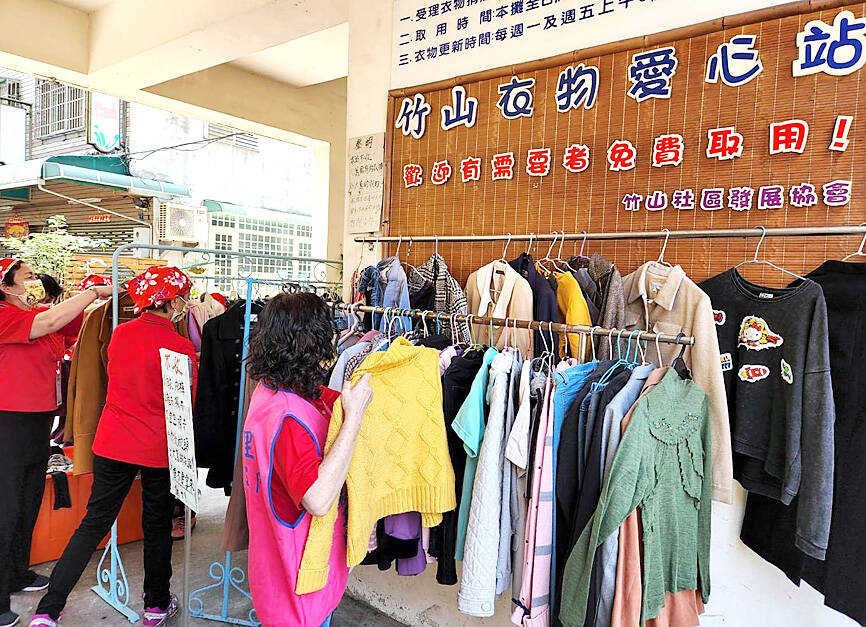
Photo: Hsieh Chieh-yu, Taipei Times
Garments that are uncomfortable, ill-fitting, lack usefulness or evoke bad memories should be discarded even if they are in good condition, she said.
The sentimental value, price at the time of purchase or guilt connected to clothes are the most common reasons people feel conflicted about parting with them, Sung said.
Clothes with sentimental value can be stored in a box or container separate from other clothing to reduce clutter and prevent people from being stuck with something they feel indecisive about in the middle of cleaning, she said.
Keeping clothes that invoke nostalgia or are mementos of important events in life in one place would also help people decide which of these items are truly valuable and worth keeping, she added.
Expensive clothes can be sold online or at auction, donated to a second-hand store, or given to friends or family, she said.
Donating to charity is good for assuaging a lingering sense of guilt, she said.
Selling to a second-hand store saves time and putting them up on an online auction site gives the best chance of recouping monetary value, she said.
Clothes that have become threadbare or stained should not be donated, as such items are worthless to charities, Sung said.
“Everything has an expiry date and we should be thankful for clothes that have been our faithful companions to the end, while knowing when to let go,” she said.
People who are too conflicted about getting rid of household items can consult with a professional home space manager for help, she added.
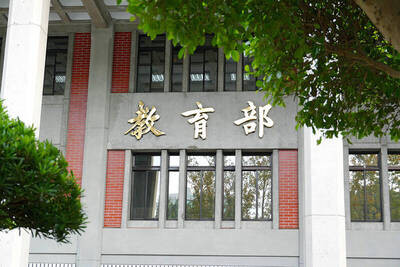
The Ministry of Education (MOE) is to launch a new program to encourage international students to stay in Taiwan and explore job opportunities here after graduation, Deputy Minister of Education Yeh Ping-cheng (葉丙成) said on Friday. The government would provide full scholarships for international students to further their studies for two years in Taiwan, so those who want to pursue a master’s degree can consider applying for the program, he said. The fields included are science, technology, engineering, mathematics, semiconductors and finance, Yeh added. The program, called “Intense 2+2,” would also assist international students who completed the two years of further studies in

Former president Tsai Ing-wen (蔡英文) departed for Europe on Friday night, with planned stops in Lithuania and Denmark. Tsai arrived at Taiwan Taoyuan International Airport on Friday night, but did not speak to reporters before departing. Tsai wrote on social media later that the purpose of the trip was to reaffirm the commitment of Taiwanese to working with democratic allies to promote regional security and stability, upholding freedom and democracy, and defending their homeland. She also expressed hope that through joint efforts, Taiwan and Europe would continue to be partners building up economic resilience on the global stage. The former president was to first
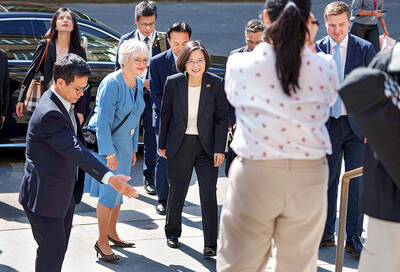
Former president Tsai Ing-wen (蔡英文) on Monday called for greater cooperation between Taiwan, Lithuania and the EU to counter threats to information security, including attacks on undersea cables and other critical infrastructure. In a speech at Vilnius University in the Lithuanian capital, Tsai highlighted recent incidents in which vital undersea cables — essential for cross-border data transmission — were severed in the Taiwan Strait and the Baltic Sea over the past year. Taiwanese authorities suspect Chinese sabotage in the incidents near Taiwan’s waters, while EU leaders have said Russia is the likely culprit behind similar breaches in the Baltic. “Taiwan and our European

The Taipei District Court sentenced babysitters Liu Tsai-hsuan (劉彩萱) and Liu Jou-lin (劉若琳) to life and 18 years in prison respectively today for causing the death of a one-year-old boy in December 2023. The Taipei District Prosecutors’ Office said that Liu Tsai-hsuan was entrusted with the care of a one-year-old boy, nicknamed Kai Kai (剴剴), in August 2023 by the Child Welfare League Foundation. From Sept. 1 to Dec. 23 that year, she and her sister Liu Jou-lin allegedly committed acts of abuse against the boy, who was rushed to the hospital with severe injuries on Dec. 24, 2023, but did not


 RSS
RSS