


China’s Taiwan Affairs Office (TAO) Director Song Tao (宋濤) was joined by Chinese Nationalist Party (KMT) Legislator Chen Yu-jen (陳玉珍) at a cross-strait Lunar New Year (LNY) event in Xiamen, China, on Thursday.
The office posted photographs of Chen and Song together at a holiday cross-strait cultural event in the city in China’s Fujian Province, wearing red scarves along with other attendees.
“I was very touched. Chinese culture is so great,” Chen said in an interview with Chinese media about a performance by young Chinese and Taiwanese students who played guitar and performed martial arts.
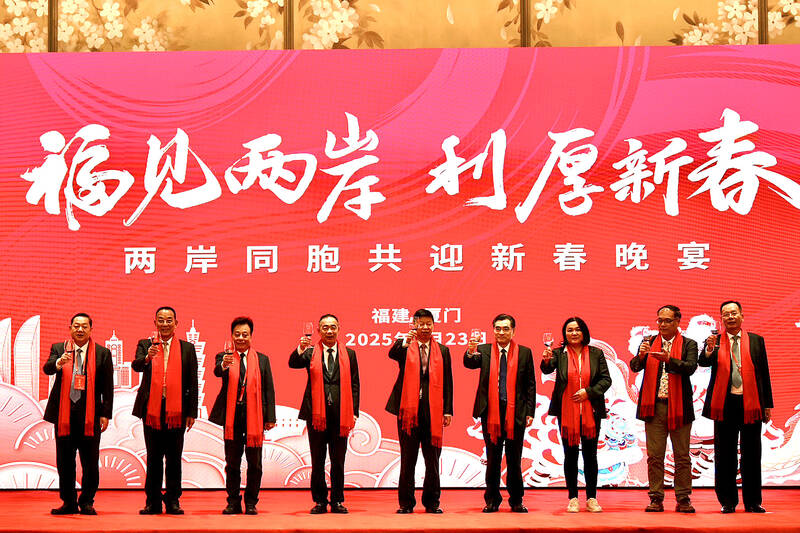
Photo courtesy of Chen Yu-jen Warning: Excessive consumption of alcohol can damage your health.
The event was held by Chinese authorities, with Taiwanese businesspeople and residents in Fujian, as well as Kinmen County locals, invited to participate.
It featured Southern Min folk traditions, traditional cuisine and cultural heritage performances.
China’s Ministry of Culture and Tourism recently announced that Fujian and Shanghai residents could visit Taipei as part of tour groups, Chen told the Strait Herald.
China allows Fujian residents to visit Kinmen, which has significantly helped the development of the county’s industries, she said.
The Mainland Affairs Council should “catch this ball” by continuing to welcome Chinese tourists, she added.
Chen traveled to China after the central government budget was passed, joining Song in Xiamen to celebrate the Lunar New Year.
Chen, who told Taiwan’s cultural industry to “throw away the bowl they use to beg for food” when she proposed cutting the Ministry of Culture’s entire NT$2.309 billion (US$70.7 million) budget for the Public Television Service (PTS), was accused by Democratic Progressive Party Legislator Wang Mei-hui (王美惠) of going to China to “beg.”
“Doesn’t she feel sorry about Taiwan? What is she celebrating?” Wang said, adding that the KMT was praised by the TAO for its budget cuts.
Chen is a legislator whose salary is paid by Taiwanese taxpayers, Wang said, adding: “Did she speak up for Taiwan? Or does she recognize China as her motherland?”
Chen was joined by Kinmen County Deputy Commissioner Li Wen-liang (李文良), Kinmen County Council Speaker Hung Yun-tien (洪允典) and representatives of associations and community groups of Kinmen as they attended a dinner party with Chinese officials.
Song was visiting Taiwanese companies in Shenzhen and Xiamen from Tuesday to Thursday.
At the cultural event, Song said he hopes that Taiwanese “compatriots” would adhere to the “one China” principle and the “1992 consensus,” and firmly oppose Taiwanese independence.
The so-called “1992 consensus” refers to a tacit understanding between the KMT and the Chinese Communist Party that both sides of the Taiwan Strait acknowledge that there is “one China,” with each side having its own interpretation of what “China” means.
Both sides of the Taiwan Strait should work together to expand cross-strait cooperation, promote the peaceful development of cross-strait relations and expand integration, Song said.
Nearly 400 Taiwanese businesspeople and residents in China participated in Lunar New Year activities in Shenzhen and Xiamen, according to a report from China’s state-run Xinhua news agency.
Officials from China’s Guangdong Province and Xiamen also participated, the report said.
Taiwanese participants offered advice on helping Taiwanese businesses accelerate improvements, sharing opportunities from China’s Belt and Road Initiative, and strengthening cross-strait industrial cooperation, the report said.
They expressed their commitment to firmly developing themselves in China, engaging in cross-strait economic cooperation and integrated development, it said.
They would adhere to the “1992 consensus,” oppose “Taiwan independence” and promote cross-strait exchanges to maintain peace and stability across the Taiwan Strait, the report said.
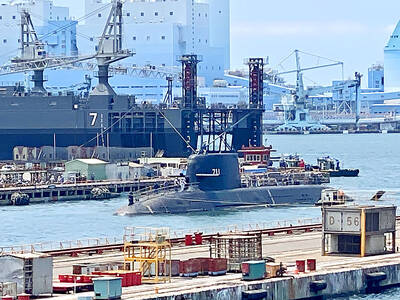
AGING: While Japan has 22 submarines, Taiwan only operates four, two of which were commissioned by the US in 1945 and 1946, and transferred to Taiwan in 1973 Taiwan would need at least 12 submarines to reach modern fleet capabilities, CSBC Corp, Taiwan chairman Chen Cheng-hung (陳政宏) said in an interview broadcast on Friday, citing a US assessment. CSBC is testing the nation’s first indigenous defense submarine, the Hai Kun (海鯤, Narwhal), which is scheduled to be delivered to the navy next month or in July. The Hai Kun has completed torpedo-firing tests and is scheduled to undergo overnight sea trials, Chen said on an SET TV military affairs program. Taiwan would require at least 12 submarines to establish a modern submarine force after assessing the nation’s operational environment and defense

A white king snake that frightened passengers and caused a stir on a Taipei MRT train on Friday evening has been claimed by its owner, who would be fined, Taipei Rapid Transit Corp (TRTC) said yesterday. A person on Threads posted that he thought he was lucky to find an empty row of seats on Friday after boarding a train on the Bannan (Blue) Line, only to spot a white snake with black stripes after sitting down. Startled, he jumped up, he wrote, describing the encounter as “terrifying.” “Taipei’s rat control plan: Release snakes on the metro,” one person wrote in reply, referring
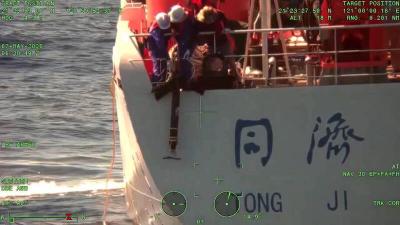
The coast guard today said that it had disrupted "illegal" operations by a Chinese research ship in waters close to the nation and driven it away, part of what Taipei sees a provocative pattern of China's stepped up maritime activities. The coast guard said that it on Thursday last week detected the Chinese ship Tongji (同濟號), which was commissioned only last year, 29 nautical miles (54km) southeast of the southern tip of Taiwan, although just outside restricted waters. The ship was observed lowering ropes into the water, suspected to be the deployment of scientific instruments for "illegal" survey operations, and the coast
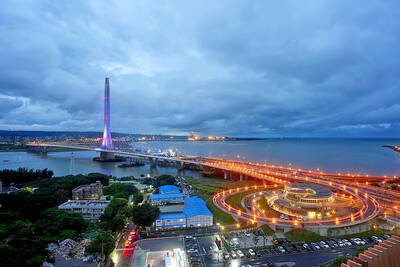
An inauguration ceremony was held yesterday for the Danjiang Bridge, the world’s longest single-mast asymmetric cable-stayed bridge, ahead of its official opening to traffic on Tuesday, marking a major milestone after nearly three decades of planning and construction. At the ceremony in New Taipei City attended by President William Lai (賴清德), Premier Cho Jung-tai (卓榮泰), Minister of Transportation and Communications Chen Shih-kai (陳世凱) and New Taipei City Mayor Hou Yu-ih (侯友宜), the bridge was hailed as both an engineering landmark and a long-awaited regional transport link connecting Tamsui (淡水) and Bali (八里)


 RSS
RSS