


Taiwan should request arms purchases worth billions of US dollars from the US and create more jobs in the nation through semiconductor-related investments, which would placate US president-elect Donald Trump, an academic said.
“Those two things seem to be the most likely ways for Taiwan to diminish Trump’s complaints, and also reduce the fear that he will use Taiwan as a bargaining chip,” said Thomas Shattuck last month, a senior program manager at University of Pennsylvania’s Perry World House policy research center.
“Putting together a multibillion dollar package [of US arms purchases] within the first six months” would be a “great way” for Taiwan to signal to Trump that his concerns have been heard, Shattuck said.
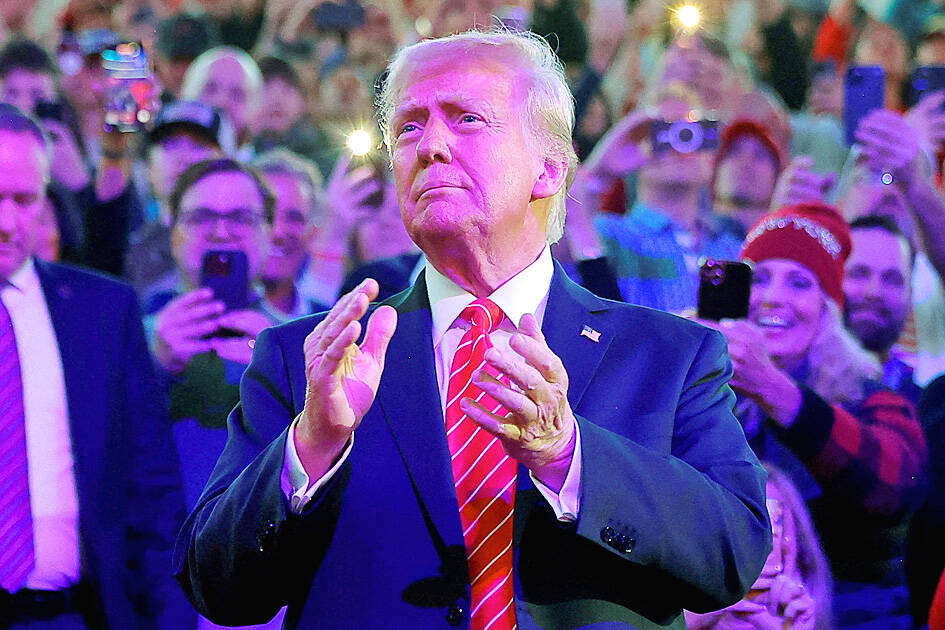
Photo: Reuters
Taiwan also needs to remind Trump that Taipei “pays more” than the US’ NATO allies for its own defense, Shattuck said.
The nation’s defense budget exceeds NATO’s target of 2 percent of GDP, which Trump had previously talked about, he said.
Trump on his campaign trail said that Taiwan “stole” the US’ chip business and needed to “pay us for defense.”
During his first term from 2017 to 2021, Trump did not make those “accusations,” Shattuck said, adding that it had made lawmakers and others in Taiwan a “little afraid” about a second Trump term.
However, “Trump and his team understand the strategic nature of keeping Taiwan as Taiwan, keeping the alliances strong,” he said.
Trump’s “very pro-Taiwan” picks for top roles in his administration, such as US Senator Marco Rubio as US secretary of state, further suggest that Taiwan would not “get sold out for a big trade deal with China” during the next four years, Shattuck said.
“If the big great power competition between the US and China continues, you don’t sell Taiwan out on day one or the last day in the office,” the expert added.
Shattuck, who is also a non-resident research fellow at both the Global Taiwan Institute and the Foreign Policy Research Institute, said that “Taiwan keeps China boxed in,” due to its geographical location.
The US’ strategic interests in the region should dissuade Washington from putting “any deals on the table with any country to give up a country or give up a piece of land or do any sort of thing,” he said.
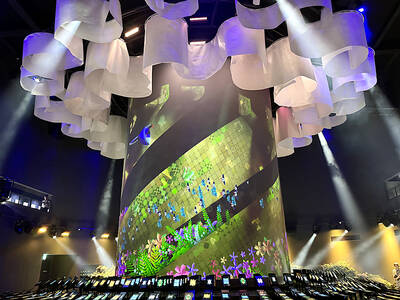
PRAISE: Japanese visitor Takashi Kubota said the Taiwanese temple architecture images showcased in the AI Art Gallery were the most impressive displays he saw Taiwan does not have an official pavilion at the World Expo in Osaka, Japan, because of its diplomatic predicament, but the government-backed Tech World pavilion is drawing interest with its unique recreations of works by Taiwanese artists. The pavilion features an artificial intelligence (AI)-based art gallery showcasing works of famous Taiwanese artists from the Japanese colonial period using innovative technologies. Among its main simulated displays are Eastern gouache paintings by Chen Chin (陳進), Lin Yu-shan (林玉山) and Kuo Hsueh-hu (郭雪湖), who were the three young Taiwanese painters selected for the East Asian Painting exhibition in 1927. Gouache is a water-based
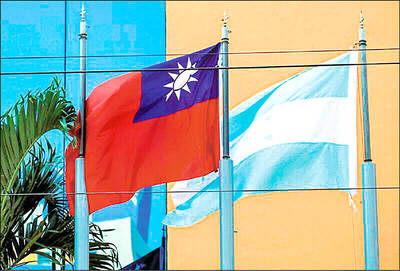
Taiwan would welcome the return of Honduras as a diplomatic ally if its next president decides to make such a move, Minister of Foreign Affairs Lin Chia-lung (林佳龍) said yesterday. “Of course, we would welcome Honduras if they want to restore diplomatic ties with Taiwan after their elections,” Lin said at a meeting of the legislature’s Foreign Affairs and National Defense Committee, when asked to comment on statements made by two of the three Honduran presidential candidates during the presidential campaign in the Central American country. Taiwan is paying close attention to the region as a whole in the wake of a
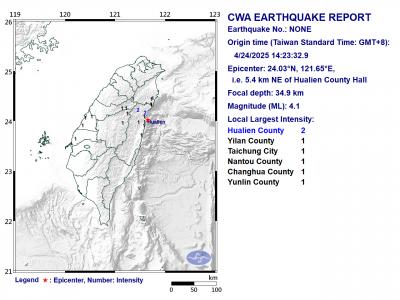
A magnitude 4.1 earthquake struck eastern Taiwan's Hualien County at 2:23pm today, according to the Central Weather Administration (CWA). The epicenter of the temblor was 5.4 kilometers northeast of Hualien County Hall, at a depth of 34.9 km, according to the CWA. The earthquake's intensity, which gauges the actual effect of a temblor, was the highest in Hualien County, where it measured 2 on Taiwan's 7-tier intensity scale. The quake also measured an intensity of 1 in Yilan county, Taichung, Nantou County, Changhua County and Yunlin County, the CWA said. There were no immediate reports of damage or injuries.

OFF-TARGET: More than 30,000 participants were expected to take part in the Games next month, but only 6,550 foreign and 19,400 Taiwanese athletes have registered Taipei city councilors yesterday blasted the organizers of next month’s World Masters Games over sudden timetable and venue changes, which they said have caused thousands of participants to back out of the international sporting event, among other organizational issues. They also cited visa delays and political interference by China as reasons many foreign athletes are requesting refunds for the event, to be held from May 17 to 30. Jointly organized by the Taipei and New Taipei City governments, the games have been rocked by numerous controversies since preparations began in 2020. Taipei City Councilor Lin Yen-feng (林延鳳) said yesterday that new measures by


 RSS
RSS