


The High Court late on Saturday night rejected appeals against the detention of former Taiwan People’s Party (TPP) chairman Ko Wen-je (柯文哲) and three other suspects, who are being held as part of an investigation into alleged corruption in connection with the Core Pacific City redevelopment project.
The High Court ruled that Ko, mayor of Taipei from 2014 to 2022, real estate tycoon Sheen Ching-jing (沈慶京), Taipei City Councilor Ying Hsiao-wei (應曉薇) of the Chinese Nationalist Party (KMT) and Ko’s former mayoral office head Lee Wen-tsung (李文宗) should be held in incommunicado detention, it said in a statement issued yesterday.
The Taipei District Court granted the prosecutors’ motion to detain Ying on Aug. 29 last year and Sheen and Wu the following day. It ordered that they be held incommunicado for bribes Sheen allegedly paid to Ying in relation to the redevelopment project on the site of the now-demolished Core Pacific City shopping center.
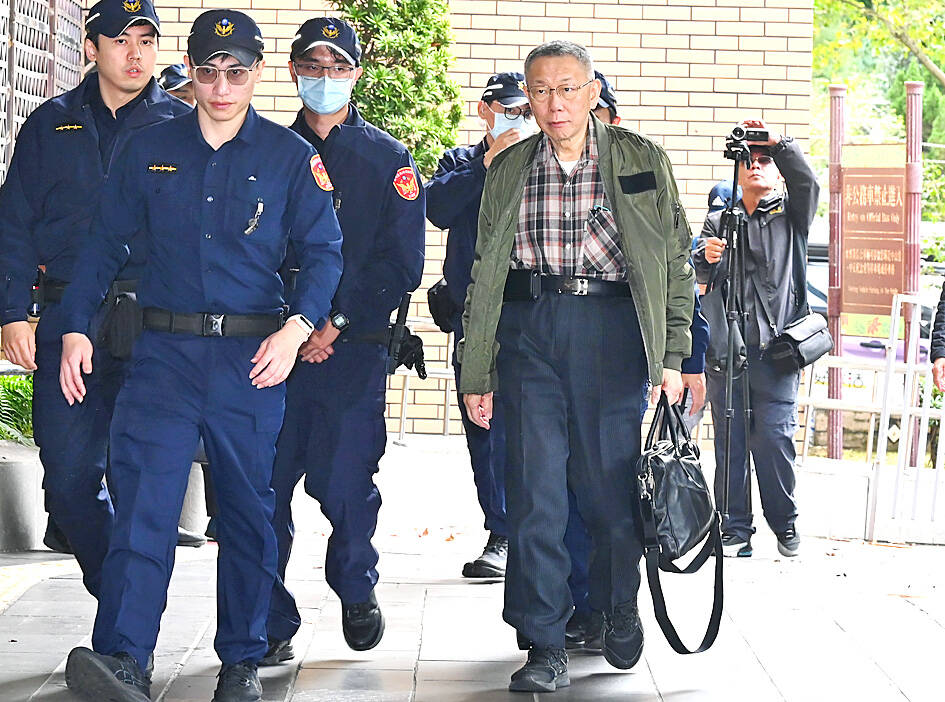
Photo: Wang Yi-sung, Taipei Times
The suspected bribery involves more than NT$47.4 million (US$1.44 million) transferred from the bank account of the Core Pacific Group to the city councilor.
Sheen said the money was for charity causes Ying was involved in, but the prosecutors believe that the timing of the payments correlated with the redevelopment project’s increase in floor area ratio from 560 percent to 840 percent, which was approved by the city government in 2021.
In its latest ruling, the High Court cited sufficient evidence to determine that the corruption charges, among others, were felonies that carry a prison term of five years or more under the Anti-Corruption Act (貪污治罪條例), a condition for detention.
There is also the possibility of them fleeing or colluding with each other to tamper with evidence if they are released on bail or under other restrictions, the court said.
Ko and the three other suspects filed appeals against their detention earlier this month, saying there was no credible reason to suggest they were likely to flee, destroy evidence or collude with accomplices and witnesses, and there was no need or reason to detain them, the court statement said.
However, after reviewing the files and evidence of this case, the High Court determined the claims of Ko and others were not credible and therefore rejected their appeals on Saturday night. The High Court ruling is final.
The High Court also approved a Taipei District Prosecutors’ Office request to impound Ying’s property in Taipei, valued at NT$57.27 million.
Ko, 65, was the TPP’s presidential candidate in last year’s election. He appealed to the court after a third bail hearing earlier this month and requested that he be granted bail.
He was indicted on Dec. 26 last year on bribery and other corruption charges in connection with real-estate dealings during his second term as Taipei mayor, which began in 2018. He was also charged with embezzling political donations given to the TPP during last year’s presidential election.
After being held incommunicado for nearly four months during the investigation into the allegations, Ko was released on bail of NT$30 million on Dec. 27 last year, as ordered by the Taipei District Court, and again on bail of NT$70 million on Dec. 30 after the Taipei District Prosecutors’ Office appealed the decision.
After prosecutors appealed a second time, the court reversed its earlier decision and ordered him detained on Jan. 2.
The TPP yesterday criticized the latest ruling, saying that the High Court knew the evidence presented by prosecutors was weak and that it was helping the prosecution.
Additional reporting by Chang Wen-chuan

The military has spotted two Chinese warships operating in waters near Penghu County in the Taiwan Strait and sent its own naval and air forces to monitor the vessels, the Ministry of National Defense (MND) said. Beijing sends warships and warplanes into the waters and skies around Taiwan on an almost daily basis, drawing condemnation from Taipei. While the ministry offers daily updates on the locations of Chinese military aircraft, it only rarely gives details of where Chinese warships are operating, generally only when it detects aircraft carriers, as happened last week. A Chinese destroyer and a frigate entered waters to the southwest
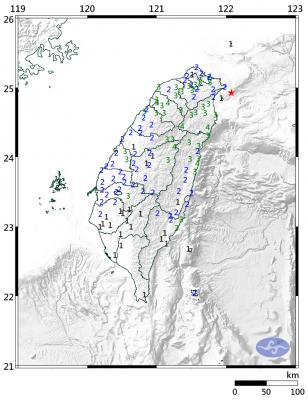
A magnitude 6.1 earthquake struck off the coast of Yilan County at 8:39pm tonight, the Central Weather Administration (CWA) said, with no immediate reports of damage or injuries. The epicenter was 38.7km east-northeast of Yilan County Hall at a focal depth of 98.3km, the CWA’s Seismological Center said. The quake’s maximum intensity, which gauges the actual physical effect of a seismic event, was a level 4 on Taiwan’s 7-tier intensity scale, the center said. That intensity level was recorded in Yilan County’s Nanao Township (南澳), Hsinchu County’s Guansi Township (關西), Nantou County’s Hehuanshan (合歡山) and Hualien County’s Yanliao (鹽寮). An intensity of 3 was

Japanese Prime Minister Sanae Takaichi’s comment last year on Tokyo’s potential reaction to a Taiwan-China conflict has forced Beijing to rewrite its invasion plans, a retired Japanese general said. Takaichi told the Diet on Nov. 7 last year that a Chinese naval blockade or military attack on Taiwan could constitute a “survival-threatening situation” for Japan, potentially allowing Tokyo to exercise its right to collective self-defense. Former Japan Ground Self-Defense Force general Kiyofumi Ogawa said in a recent speech that the remark has been interpreted as meaning Japan could intervene in the early stages of a Taiwan Strait conflict, undermining China’s previous assumptions
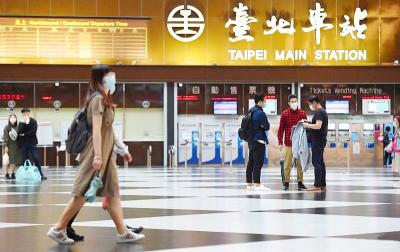
Taiwan Railways Corp (TRC) today announced that Shin Kong Mitsukoshi has been selected as the preferred bidder to operate the Taipei Railway Station shopping mall, replacing the current operator, Breeze Development Co Ltd. Among eight qualified firms that delivered presentations and were evaluated by a review committee, Shin Kong Mitsukoshi was ranked first, while Breeze was named the runner-up, the rail company said in a statement. Contract negotiations are to proceed in accordance with regulations, it said, adding that if negotiations with the top bidder fail, it could invite the second-ranked applicant to enter talks. Breeze in a statement today expressed doubts over


 RSS
RSS