


CRIME
Kaohsiung indicts 18
Eighteen people were indicted by Kaohsiung prosecutors on Wednesday on suspicion of engaging in money laundering in online gambling platforms that allegedly earned them illicit profits estimated at NT$80.6 million (US$2.46 million). The prime suspect, a 41-year-old man surnamed, Lee (李), and 17 others were charged with contraventions of the Criminal Code, the Money Laundering Control Act (洗錢防制法) and the Organized Crime Prevention Act (組織犯罪條例), the Kaohsiung District Prosecutors’ Office said. Lee allegedly set up several dummy accounts for deposits in Vietnamese dong and recruited people to launder money from online gambling platforms, the office said. The operation was undertaken remotely, with Lee renting two residential apartments in Kaohsiung’s Sanmin District (三民), at which the computer equipment providing the service was installed, the office said. The ring was found to have laundered 10.99 trillion Vietnamese dong (US$432.38 million) in two years, it said.
CRIME
Passport suspect indicted
The head of a Taipei immigration services company has been indicted for allegedly selling forged Burkina Faso passports, Taipei District Prosecutors’ Office said. The suspect, a woman surnamed Lai (賴), targeted parents looking to get their children into international schools in Taiwan that restrict admission to foreign passport holders, the office said. Lai obtained the fake passports from a man named Daniel Wang and sold seven of the forgeries for roughly US$16,000 each between 2018 and last year, it said. Despite Lai’s claims that she thought the passports were genuine, text messages indicated that she was aware of the fraud and colluded with Wang, it said. A separate investigation into Wang has been launched.
CRIME
Theft of coins probed
An investigation was launched this week over the theft of coins and other items from a warehouse, Tainan police said, adding that a Vietnamese woman has been questioned regarding the matter. The 44-year-old woman is suspected to have stolen goods and money worth a total of NT$460,000, the Tainan City Police Department said. Among the items that were taken were approximately 2,200 NT$50 coins, 400 NT$5 coins, 1,600 NT$10 coins, 100 NT$1,000 bills and a gold necklace, the department said. The victim, who had saved money by collecting coins, reported the burglary about a week ago, it said. The items were recovered from the woman’s residence and returned to the victim.
DIPLOMACY
Turkey to get sewing gear
Taiwan has signed an agreement to donate sewing machines and other equipment to support the livelihoods of women in a municipality of Istanbul Province, Turkey, the Taipei Economic and Cultural Mission in Ankara said. The agreement was inked at a ceremony on Monday by Representative to Turkey Huang Chih-yang (黃志揚) and Ismet Yildirim, the mayor of Umraniye, which is to receive the aid. Taiwan has worked with the Turkish government and non-governmental organizations on humanitarian aid and programs for the empowerment of women for many years, Huang said. Last year, Taiwan’s donations to Turkey for post-earthquake reconstruction efforts prompted Turkish parliamentarian Tugba Isik Ercan to reach out to the mission for help to enhance employment opportunities for disadvantaged women in Turkey, Huang said. The municipality offers courses on sewing, which are especially popular among women, Yildirim said.
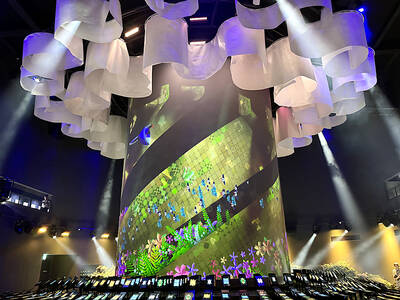
PRAISE: Japanese visitor Takashi Kubota said the Taiwanese temple architecture images showcased in the AI Art Gallery were the most impressive displays he saw Taiwan does not have an official pavilion at the World Expo in Osaka, Japan, because of its diplomatic predicament, but the government-backed Tech World pavilion is drawing interest with its unique recreations of works by Taiwanese artists. The pavilion features an artificial intelligence (AI)-based art gallery showcasing works of famous Taiwanese artists from the Japanese colonial period using innovative technologies. Among its main simulated displays are Eastern gouache paintings by Chen Chin (陳進), Lin Yu-shan (林玉山) and Kuo Hsueh-hu (郭雪湖), who were the three young Taiwanese painters selected for the East Asian Painting exhibition in 1927. Gouache is a water-based
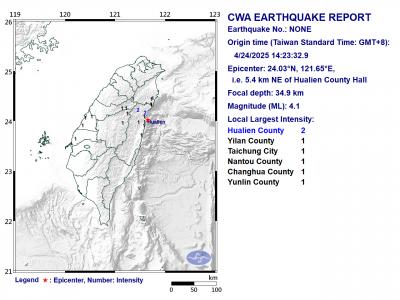
A magnitude 4.1 earthquake struck eastern Taiwan's Hualien County at 2:23pm today, according to the Central Weather Administration (CWA). The epicenter of the temblor was 5.4 kilometers northeast of Hualien County Hall, at a depth of 34.9 km, according to the CWA. The earthquake's intensity, which gauges the actual effect of a temblor, was the highest in Hualien County, where it measured 2 on Taiwan's 7-tier intensity scale. The quake also measured an intensity of 1 in Yilan county, Taichung, Nantou County, Changhua County and Yunlin County, the CWA said. There were no immediate reports of damage or injuries.

OFF-TARGET: More than 30,000 participants were expected to take part in the Games next month, but only 6,550 foreign and 19,400 Taiwanese athletes have registered Taipei city councilors yesterday blasted the organizers of next month’s World Masters Games over sudden timetable and venue changes, which they said have caused thousands of participants to back out of the international sporting event, among other organizational issues. They also cited visa delays and political interference by China as reasons many foreign athletes are requesting refunds for the event, to be held from May 17 to 30. Jointly organized by the Taipei and New Taipei City governments, the games have been rocked by numerous controversies since preparations began in 2020. Taipei City Councilor Lin Yen-feng (林延鳳) said yesterday that new measures by
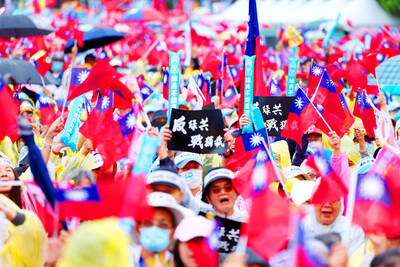
‘WORSE THAN COMMUNISTS’: President William Lai has cracked down on his political enemies and has attempted to exterminate all opposition forces, the chairman said The legislature would motion for a presidential recall after May 20, Chinese Nationalist Party (KMT) Chairman Eric Chu (朱立倫) said yesterday at a protest themed “against green communists and dictatorship” in Taipei. Taiwan is supposed to be a peaceful homeland where people are united, but President William Lai (賴清德) has been polarizing and tearing apart society since his inauguration, Chu said. Lai must show his commitment to his job, otherwise a referendum could be initiated to recall him, he said. Democracy means the rule of the people, not the rule of the Democratic Progressive Party (DPP), but Lai has failed to fulfill his


 RSS
RSS