


The Ministry of National Defense yesterday reported a spike in Chinese military activity around Taiwan.
It reported that 53 Chinese People’s Liberation Army (PLA) aircraft were detected operating around Taiwan, including 23 that crossed the median line of the Taiwan Strait, in the 24 hours beginning at 6am on Tuesday.
The warplanes flew into Taiwan’s northern, southwestern and eastern air defense identification zone, a flight map showed.
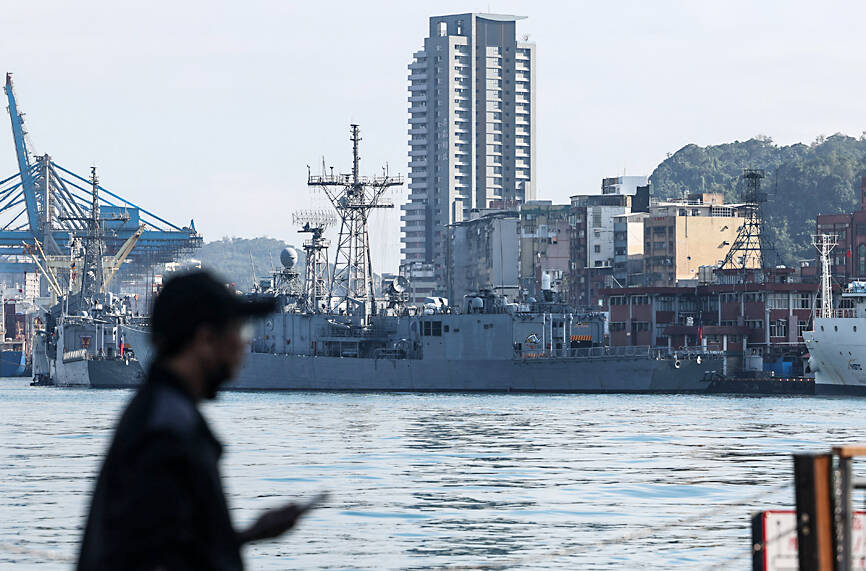
Photo: Cheng I-hwa, AFP
The zone is a self-declared area where the country claims the right to identify, locate and control approaching foreign aircraft, but is not part of its territorial airspace as defined by international law.
In addition, 11 PLA Navy vessels and eight government ships were observed, the ministry said.
Taiwan’s armed forces used aircraft, naval vessels and land-based missile systems to monitor the situation, it said.
The military activity follows the identification of 47 PLA aircraft in Taiwan’s zone in the 24 hours starting at 6am on Monday, when China designated seven areas east of Zhejiang Province and its Fujian Province as “temporary reserved areas” of airspace until yesterday, typically indicating airspace reserved for specific military activities.
China’s military has yet to comment and has not confirmed it is carrying out any military exercises.
China had been expected to launch drills to express its anger at President William Lai’s (賴清德) tour of the Pacific that ended on Friday last week, which included stopovers in Hawaii and the US territory of Guam.
However, in a break from usual practice, the Chinese government has not officially announced a large-scale deployment of naval troops in the vicinity of Taiwan, nor officially labeled the activity “military exercises.”
On Tuesday, the ministry that said China was deploying its largest naval fleet in regional waters in nearly three decades, posing a threat to Taiwan that is more pronounced than previous Chinese war games.
A US military official said that China’s naval deployments in the East and South China seas are elevated, but consistent with other large exercises in has conducted.
Taiwan’s military was on alert on Monday after saying that China had reserved airspace, and deployed naval and coast guard vessels.
Su Tzu-yun (蘇紫雲), a research fellow at the Institute for National Defense and Security Research, on Tuesday said that the PLA was attempting to play “mind games” and pressure Taiwan.
Given the reported deployment of 90 warships near Taiwan and in the East and South China seas, the PLA could still announce a round of military exercises before the end of yesterday or launch a round of tabletop wargames instead of live-round exercises, which would likely send a strong message to Taiwan without drawing the ire of other countries in the region, Su said.
Regardless of whether a drill is announced, China is trying to keep Taiwan guessing and put pressure on it, Su said.
Meanwhile, Lin Ying-yu (林穎佑), an assistant professor at Tamkang University’s Graduate Institute of International Affairs and Strategic Studies, said that Beijing’s decision not to officially announce military drills or label the activity could be attributed to the relatively low-profile nature of Lai’s visit to Pacific diplomatic allies, as he did not make any “provocative” remarks during his trip.
The uptick in military activity this week could be a PLA internal deployment drill and not targeting Taiwan, Lin said, but added that the country still must watch every PLA move closely.
An unnamed national security official on Tuesday said that Taiwan believes the latest PLA naval deployment took 70 days to prepare, meaning it was unlikely to be specifically targeting Taiwan.
China might use Lai’s overseas trip as an excuse, but it is really flexing its muscles in front of the US and other countries in the Indo-Pacific region ahead of US president-elect Donald Trump taking office on Jan. 20, the source said.

NATIONAL SECURITY: Authorities are working to confirm the identities of the military personnel involved and investigating possible illegal conduct and regulatory violations Authorities are probing possible national security implications after Kinmen police and immigration officers on Sunday found a Chinese woman allegedly posing as a tourist while engaging in prostitution involving more than 10 military personnel. The woman, surnamed Chen (陳), has since been deported, authorities said, adding that investigators are still working to confirm the identities of those implicated, as the records only listed code names and aliases. The case stemmed from a report received by the Kinmen District Prosecutors’ Office on Friday last week from the Jinhu Precinct of the Kinmen County Police Bureau. On Sunday, police, along with the National Immigration

GLOBALGIVING: ‘ Caving to external pressure is not acceptable for an organization that has cultivated justice reform and human rights for 30 years,’ one NGO said A slew of non-government organizations (NGOs) have withdrawn from the GlobalGiving fundraising platform after it announced it would use “Chinese Taipei” instead of “Taiwan” from next month. The Taiwan Good Rice Association wrote on Facebook on Friday that it was informed on April 28 via a teleconference call of the change, which was made because the platform wanted to operate in China. Taiwan Good Rice is to terminate all cooperative relationships with GlobalGiving in response to the platform’s “unilateral and non-negotiable” decision to remove references to Taiwan, the NGO said. “Taiwan is in the official name of Taiwan Good Rice Association and the

HEAVY WEATHER: Typhoon Jangmi is due to crash straight into the Ryukyus as airlines look to shift flights to larger aircraft or cancel flights to Okinawa entirely Taiwan’s international air carriers announced flight adjustments over the weekend as Typhoon Jangmi is forecast to hit the Ryukyu Islands today and tomorrow. The Central Weather Administration (CWA) upgraded Jangmi from a tropical storm to a typhoon at 8am yesterday, with the eye located 580km south of Naha city. It was moving north at 19kph. Today, China Airlines’ CI-120, CI-121, CI-122 and CI-123 flights between Taoyuan and Naha, Okinawa, have been canceled as well as CI-132 and CI-133 between Kaohsiung and Naha. EVA Air’s BR-112, BR-113, BR-186 and BR-185 flights between Taoyuan and Naha are also canceled. Low-cost carrier Tigerair Taiwan canceled IT-230,
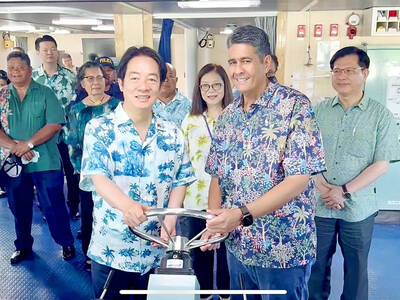
MULTIPRONGED APPROACH: China has sought to pressure Palau across a number of fronts, but the island nation has staunchly resisted overtures to ditch Taiwan Palau has been firm in backing Taiwan despite Chinese pressure that uses tourism economics, cyberattacks and criminal infiltration as tools to threaten the Pacific ally into renouncing its recognition of Taiwan as a sovereign state. The Presidential Office yesterday announced that Vice President Hsiao Bi-khim (蕭美琴) would visit Palau from Saturday to Wednesday next week at the invitation of Palauan President Surangel Whipps Jr. Whipps in April said in an interview that China had outspokenly asked Palau to “denounce Taiwan.” “And we have said: ‘We have no enemies, but nobody tells us who our friends are,’” he said. Whipps has told reporters multiple times


 RSS
RSS