


The Executive Yuan today approved an incentive subsidy program for private buildings to install rooftop solar panels to help achieve Taiwan’s zero-emission target by 2050, the Ministry of Economic Affairs said.
Starting from next year, owners of buildings with roofs smaller than 1,000 square meters can apply for a subsidy of up to NT$3,000 per kilowatt (kW) and NT$300,000 (US$9,251) per project.
The actual subsidy amount is to be determined on a case-by-case basis, Energy Administration Director-General Yu Cheng-wei (游振偉) said.
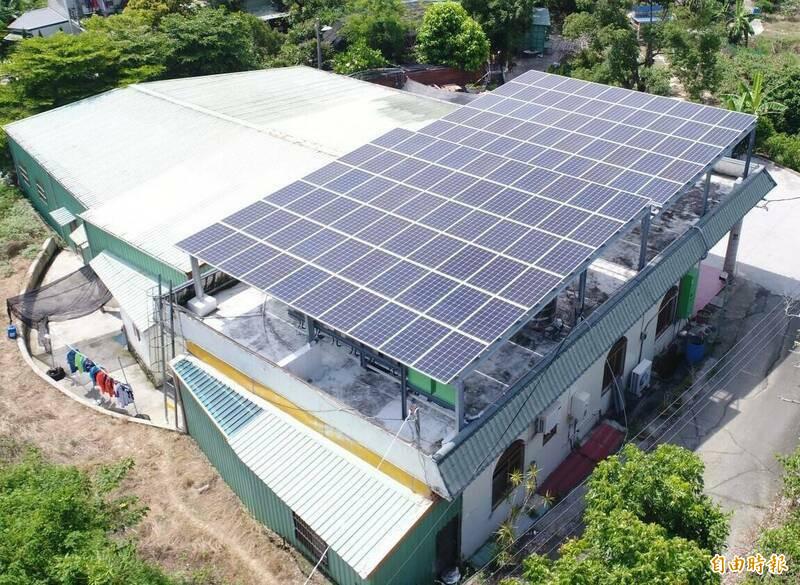
Photo: Taipei Times
The program, planned to run for four years, is projected to cost NT$4.08 billion and increase rooftop power generation by 1.2 gigawatts (GW).
It is estimated that 120,000 households could benefit from the program.
Taiwan only currently has 13.82GW of solar photovoltaic (PV) installations, according to the ministry.
When compared to ground-mounted systems, rooftop solar is a more mature technology and less controversial.
Previously, the Ministry of Economic Affairs and the Ministry of the Interior discussed expanding PV installations to all new or renovated buildings with roofs larger than 1,000 square meters.
For smaller rooftops, the Ministry of Economic Affairs has offered subsidies through feed-in-tariff (FIT) rates, which currently stand at NT$5.7 per kilowatt-hour (kWh), higher than the rate for ground-based systems at NT$3.7 per kwH.
The ministry also said it simplified the application process for households, so that when individuals register their equipment they can simultaneously apply for the subsidy.
The ministry estimates that if program participants apply for about 10kW each, it will increase total rooftop capacity by 1.2GW, which would be 1.5 billion kwH per year.

Taiwanese paleontologists have discovered fossil evidence that pythons up to 4m long inhabited Taiwan during the Pleistocene epoch, reporting their findings in the international scientific journal Historical Biology. National Taiwan University (NTU) Institute of Ecology and Evolutionary Biology associate professor Tsai Cheng-hsiu (蔡政修) led the team that discovered the largest snake fossil ever found in Taiwan. The single trunk vertebra was discovered in Tainan at the Chiting Formation, dated to between 400,000 and 800,000 years ago in the Middle Pleistocene, the paper said. The area also produced Taiwan’s first avian fossil, as well as crocodile, mammoth, saber-toothed cat and rhinoceros fossils, it said. Discoveries

WATCH FOR HITCHHIKERS: The CDC warned those returning home from Japan to be alert for any contagious diseases that might have come back with them People who have returned from Japan following the World Baseball Classic (WBC) games during the weekend are recommended to watch for symptoms of infectious gastroenteritis, flu and measles for two weeks, the Centers for Disease Control (CDC) said. Flu viruses remain the most common respiratory pathogen in Taiwan in the past four weeks and the influenza B virus accounted for 55.7 percent of the tested cases, exceeding the percentage of influenza A (H3N2) infections and becoming the local dominant strain, CDC Epidemic Intelligence Center Deputy Director Lee Chia-lin (李佳琳) said at a news conference on Tuesday. There were 82,187 hospital visits for

Alumni from Japan’s Kyoto Tachibana Senior High School marching band, widely known as the “Orange Devils,” staged a flash mob performance at the Grand Hotel in Taipei yesterday to thank Taiwan for its support after the Great East Japan Earthquake. The show, performed on the earthquake’s 15th anniversary, drew more than 100 spectators, some of whom arrived two hours before the show to secure a good viewing spot. The 26-member group played selections from “High School Musical,” “Beauty and the Beast,” and their signature piece “Sing Sing Sing” and shouted “I love

Taiwan’s three major international carriers are increasing booking fees, with EVA Airways having already increased the charge to US$28 per flight segment from US$25, while China Airlines (CAL) and Starlux Airlines are set to follow suit. Booking fees are charged by airlines through a global distribution system (GDS) and passed on to passengers. Carriers that apply the fees include CAL, EVA, Starlux and Tigerair Taiwan. A GDS is a computerized network operated by a company that connects airlines with travel agents and ticketing platforms, allowing reservations to be made and processed in real time. Major players include Amadeus, Sabre and Travelport. EVA Air began


 RSS
RSS