


Domestic airfares are to drop by an average of 4.3 percent from Dec. 31, following a cut in fuel prices by state-owned CPC Corp, Taiwan, the Civil Aviation Administration (CAA) said yesterday.
Under the local air ticket pricing mechanism, domestic flight operators must cut fares if fuel prices set by CPC fall below a certain threshold, which is NT$21.74 per liter for the October-to-December period.
Mandarin Airlines, a wholly owned subsidiary of state-run flag carrier, China Airlines, would see the biggest fare cut, with one-way tickets on its Taipei-Kinmen route dropping from NT$2,641 to NT$2,459, down NT$182 or 6.1 percent.
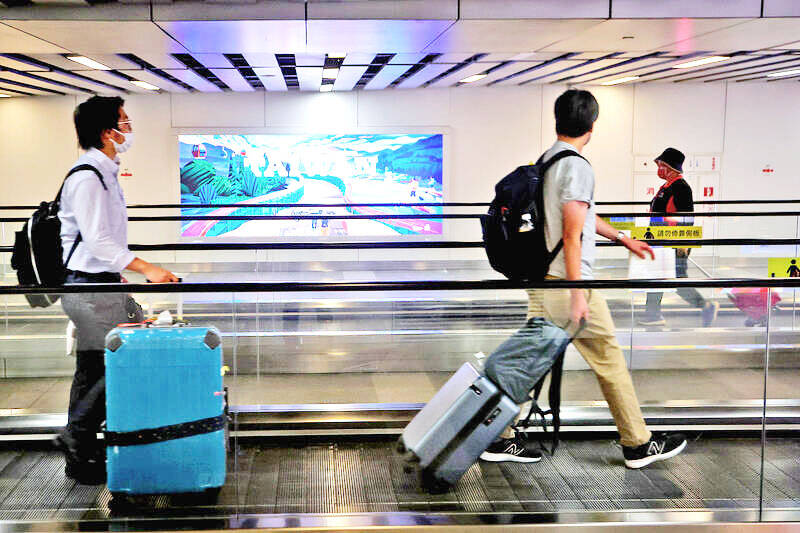
Photo: CNA
One-way tickets between Taipei and Kinmen on flights run by EVA Airway’s subsidiary UNI Airways would see the second-largest drop, falling from NT$2,618 to NT$2,458, down NT$160 or 6.1 percent.
Daily Air passengers flying from Taitung to Green Island would see the smallest reduction, with one-way fares dropping only NT$30, or NT$2.7, percent from NT$1,130 to NT$1,100.
Carriers would refund the price difference to passengers who have already bought tickets for flights departing from Dec. 31, the CAA said.
According to market analysts, fuel accounts for about 40 percent of a carrier’s operating costs.
In other news, the Tourism Administration yesterday said that for the first three quarters of this year, the average hotel room price decreased by NT$30, or 1.01 percent.
In Hualien and Taitung counties, the occupancy rate recovered slightly to 30 percent, following the April 3 earthquake.
The average room rate decreased from NT$2,973 to NT$2,943, slowing the trend of price increase, the agency said.
The room occupancy rate for the first three quarters was 48.33 percent, a 3.03 percent decrease from 49.84 percent for the same period last year, it said.
The reasons behind the lower occupancy rates include the reopening of borders, which has led to more people traveling abroad, and exchange rate fluctuations, the agency said, adding that the earthquake in April, typhoons and lack of traveler confidence negatively affected tourism to Hualien and Taitung.
The occupancy rate in Hualien County in the second quarter was about 10 percent, and rose slightly to between 20 percent and 30 percent in the third quarter, it said.
Meanwhile, Taitung County’s room occupancy rate was between 20 percent and 30 percent in the second quarter, and rose to 32 percent to 36 percent in the third quarter, it added.
Local activities can entice travelers to stay the night, as the room occupancy rates in Hsinchu, Tainan, New Taipei City, Kaohsiung, Penghu and Yunlin improved in the third quarter compared with the same period last year, the agency said.
That shows local cultural attractions, such as food, musical events, art shows, athletic competitions and the like, can increase travelers’ desire to visit Hualien, it said.
The Hualien travel subsidies provide monthly accommodation funds of NT$1,000 for the first night and NT$1,500 for the second night until Dec. 20, or until the funds run out, it added.

Considering that most countries issue more than five denominations of banknotes, the central bank has decided to redesign all five denominations, the bank said as it prepares for the first major overhaul of the banknotes in more than 24 years. Central bank Governor Yang Chin-lung (楊金龍) is expected to report to the Legislative Yuan today on the bank’s operations and the redesign’s progress. The bank in a report sent to the legislature ahead of today’s meeting said it had commissioned a survey on the public’s preferences. Survey results showed that NT$100 and NT$1,000 banknotes are the most commonly used, while NT$200 and NT$2,000

The Centers for Disease Control (CDC) yesterday reported the first case of a new COVID-19 subvariant — BA.3.2 — in a 10-year-old Singaporean girl who had a fever upon arrival in Taiwan and tested positive for the disease. The girl left Taiwan on March 20 and the case did not have a direct impact on the local community, it said. The WHO added the BA.3.2 strain to its list of Variants Under Monitoring in December last year, but this was the first imported case of the COVID-19 variant in Taiwan, CDC Deputy Director-General Lin Ming-cheng (林明誠) said. The girl arrived in Taiwan on

South Korea is planning to revise its controversial electronic arrival card, a step Taiwanese officials said prompted them to hold off on planned retaliatory measures, a South Korean media report said yesterday. A Yonhap News Agency report said that the South Korean Ministry of Foreign Affairs is planning to remove the “previous departure place” and “next destination” fields from its e-arrival card system. The plan, reached after interagency consultations, is under review and aims to simplify entry procedures and align the electronic form with the paper version, a South Korean ministry official said. The fields — which appeared only on the electronic form

The Ministry of Foreign Affairs (MOFA) is suspending retaliation measures against South Korea that were set to take effect tomorrow, after Seoul said it is updating its e-arrival system, MOFA said today. The measures were to be a new round of retaliation after Taiwan on March 1 changed South Korea's designation on government-issued alien resident certificates held by South Korean nationals to "South Korea” from the "Republic of Korea," the country’s official name. The move came after months of protests to Seoul over its listing of Taiwan as "China (Taiwan)" in dropdown menus on its new online immigration entry system. MOFA last week


 RSS
RSS