


Beijing’s apparent crackdown on Taiwanese textbooks aims to sever ties between the children of Taiwanese businesspeople in China and their native Taiwan, academics said yesterday.
Chinese customs on Sunday released a video of officers seizing a shipment of Taiwanese textbooks sent from Taiwan, claiming they contained “problematic maps” that incorrectly label “the Chinese province of Taiwan” as an independent country and do not include territories such as the Diaoyu Islands (釣魚台) and South Tibet (the Indian state of Arunachal Pradesh) within China’s borders, violating the “one China” principle.
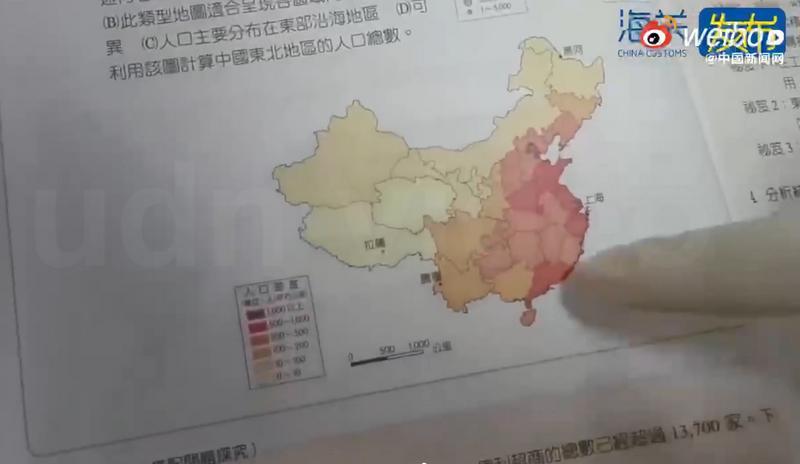
Screenshot from a video released by China Customs
Academics yesterday said that China had previously “turned a blind eye” to the content of Taiwanese textbooks.
However, Beijing now aims to sever ties between the children of Taiwanese businesspeople in China and Taiwan, Taiwan Thinktank researcher Wu Se-chih (吳瑟致) said, adding that he fears only patriotic educational materials would be available in the future.
China has never previously adopted strict surveillance of educational books or printed materials, and has allowed the use of Taiwanese textbooks in Taiwanese schools in China, Wu said.
These exceptions were not unusual, as the Chinese Communist Party (CCP) wanted to appease Taiwanese businesspeople to ensure their continued local investment, he said.
However, this latest seizure of textbooks shows that the CCP no longer wants to maintain this “gray area,” Wu added.
Wu said he believes that had recent Taiwanese investment in China been more substantial, the CCP would not have taken these measures.
However, as more Taiwanese are leaving China and Taiwanese investment is rapidly declining, it is possible that the CCP no longer recognizes the importance of Taiwanese schools in China, and so has begun gradually adding pressure, Wu said.
This latest development reflects the predicament faced by China in losing Taiwanese businesspeople, he added.
Hung Chin-fu (洪敬富), a professor of political science at National Cheng Kung University, said CCP officials had previously maintained a level of tolerance and allowed the use of Taiwanese textbooks in China’s three Taiwanese schools in Shanghai, Dongguan and Huadong.
Now the need to respect the “one China” principle shows that, in a time of fervent Chinese nationalism, Taiwanese educational materials are beyond what the CCP is willing to tolerate, he added.
The Taiwanese textbooks’ descriptions of national sovereignty and a democratic, constitutional political system make the CCP uneasy, Hung said.
Chinese President Xi Jinping (習近平) wants to draw a clear party line and there would no longer be room for any “gray area,” he said.
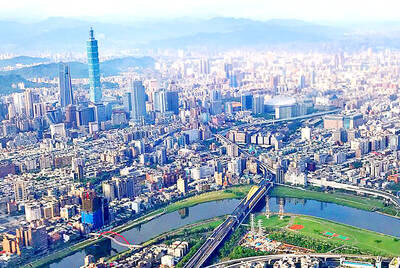
Taipei has once again made it to the top 100 in Oxford Economics’ Global Cities Index 2025 report, moving up five places from last year to 60. The annual index, which was published last month, evaluated 1,000 of the most populated metropolises based on five indices — economics, human capital, quality of life, environment and governance. New York maintained its top spot this year, placing first in the economics index thanks to the strength of its vibrant financial industry and economic stability. Taipei ranked 263rd in economics, 44th in human capital, 15th in quality of life, 284th for environment and 75th in governance,

The Sports Administration yesterday demanded an apology from the national table tennis association for barring 17-year-old Yeh Yi-tian (葉伊恬) from competing in the upcoming World Table Tennis (WTT) United States Smash tournament in Las Vegas this July. The sports agency said in a statement that the Chinese Taipei Table Tennis Association (CTTTA) must explain to the public why it withdrew Yeh from the WTT tournament in Las Vegas. The sports agency said it contacted the association to express its disapproval of the decision-making process after receiving a complaint from Yeh’s coach, Chuang
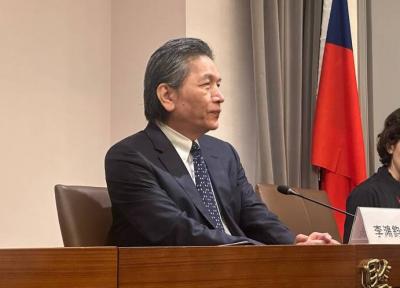
Control Yuan Secretary-General Lee Chun-yi (李俊俋) tendered his resignation last night, admitting that he had misused a government vehicle, as reported by media. His resignation was immediately accepted by the Control Yuan. In a statement explaining why he had resigned, Lee apologized for using a Control Yuan vehicle to transport his dog to a pet grooming salon on May 20. The issue first came to light late last month, when TVBS News reported that Lee had instructed his driver to take the dog to the salon. The news channel broadcast photos that it said were taken by an unnamed whistle-blower, which purportedly showed the
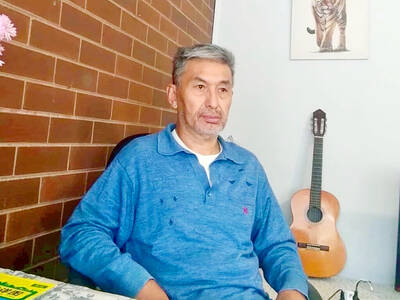
A former officer in China’s People’s Liberation Army (PLA) who witnessed the aftermath of the 1989 Tiananmen Square massacre has warned that Taiwan could face a similar fate if China attempts to unify the country by force. Li Xiaoming (李曉明), who was deployed to Beijing as a junior officer during the crackdown, said Taiwanese people should study the massacre carefully, because it offers a glimpse of what Beijing is willing to do to suppress dissent. “What happened in Tiananmen Square could happen in Taiwan too,” Li told CNA in a May 22 interview, ahead of the massacre’s 36th anniversary. “If Taiwanese students or


 RSS
RSS