


President William Lai (賴清德) praised the progress made in Taiwan's ongoing domestic shipbuilding project today while presiding over a keel-laying ceremony for an indigenous-built light frigate prototype in Kaohsiung.
Speaking at Jong Shyn Shipbuilding Co's shipyard, Lai said it took the company about a year to reach the second phase of constructing the 2,500-tonne light frigate prototype.
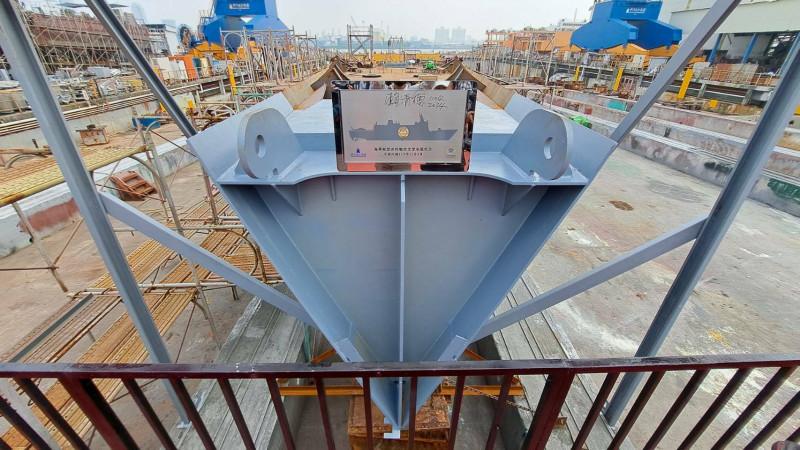
Photo: Lee Hui-chou, Taipei Times
In November last year, then-president Tsai Ing-wen (蔡英文) presided over a commencement ceremony for the anti-air light frigate prototype, Lai said.
Today marks a major milestone in the nation's indigenous ship and aircraft construction project, Lai said.
He added that the project, initiated during Tsai's administration, has exemplified Taiwan's determination to defend itself while boosting the local defense industry's development.
The prototype is the first Republic of China Navy vessel classified as a "Tier 2," or second class, combat ship, Lai said.
Once it enters service, the vessel would be equipped with domestically built anti-ship and anti-air missiles developed by the military's top research unit, the National Chung-Shan Institute of Science and Technology, and would be responsible for patrolling seas around the country, he said.
Laying the keel or laying down is one of several celebrated events in the life of a ship, signifying major progress in the vessel's construction.
The other ceremonies normally include launching, commissioning and decommissioning.
The anti-air light frigate prototype is one of two being built by the Kaohsiung-based Jong Shyn Shipbuilding Co.
The other is an anti-submarine prototype, both of which are scheduled to be delivered to the navy by October 2026.
According to the navy, the vessels are to respond to situations in the "gray zone," patrol the Taiwan Strait, conduct reconnaissance and surveillance missions, escort transport ships and supplies to remote islands, secure sea lines of communication, and support military exercises and training.
Gray-zone tactics are generally defined as coercive actions that do not meet the threshold of conventional warfare. They can refer to Chinese aircraft flying maneuvers not far from Taiwan or China's use of fishing fleets to stake out waters at sea.

Taipei has once again made it to the top 100 in Oxford Economics’ Global Cities Index 2025 report, moving up five places from last year to 60. The annual index, which was published last month, evaluated 1,000 of the most populated metropolises based on five indices — economics, human capital, quality of life, environment and governance. New York maintained its top spot this year, placing first in the economics index thanks to the strength of its vibrant financial industry and economic stability. Taipei ranked 263rd in economics, 44th in human capital, 15th in quality of life, 284th for environment and 75th in governance,

The Sports Administration yesterday demanded an apology from the national table tennis association for barring 17-year-old Yeh Yi-tian (葉伊恬) from competing in the upcoming World Table Tennis (WTT) United States Smash tournament in Las Vegas this July. The sports agency said in a statement that the Chinese Taipei Table Tennis Association (CTTTA) must explain to the public why it withdrew Yeh from the WTT tournament in Las Vegas. The sports agency said it contacted the association to express its disapproval of the decision-making process after receiving a complaint from Yeh’s coach, Chuang
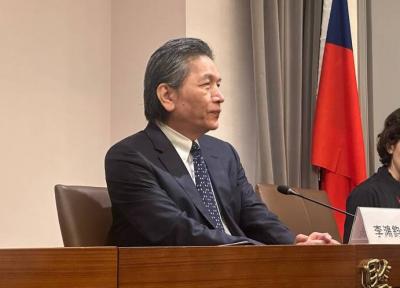
Control Yuan Secretary-General Lee Chun-yi (李俊俋) tendered his resignation last night, admitting that he had misused a government vehicle, as reported by media. His resignation was immediately accepted by the Control Yuan. In a statement explaining why he had resigned, Lee apologized for using a Control Yuan vehicle to transport his dog to a pet grooming salon on May 20. The issue first came to light late last month, when TVBS News reported that Lee had instructed his driver to take the dog to the salon. The news channel broadcast photos that it said were taken by an unnamed whistle-blower, which purportedly showed the
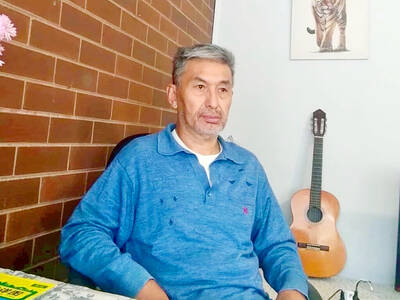
A former officer in China’s People’s Liberation Army (PLA) who witnessed the aftermath of the 1989 Tiananmen Square massacre has warned that Taiwan could face a similar fate if China attempts to unify the country by force. Li Xiaoming (李曉明), who was deployed to Beijing as a junior officer during the crackdown, said Taiwanese people should study the massacre carefully, because it offers a glimpse of what Beijing is willing to do to suppress dissent. “What happened in Tiananmen Square could happen in Taiwan too,” Li told CNA in a May 22 interview, ahead of the massacre’s 36th anniversary. “If Taiwanese students or


 RSS
RSS