


An amendment to the Legislators’ Conduct Act (立法委員行為法) to impose more severe punishment on legislators who commit serious crimes was initiated by Democratic Progressive Party (DPP) lawmakers.
The current Legislators’ Conduct Act requires final verdict and could be appealed through the three court circuits, DPP Legislator Lee Kuen-cheng (李坤城) said, adding that if convicted, lawmakers could be given prison sentences and deprived of their rights and duties.
It is very different from the Local Government Act (地方制度法), which states that a mayor or county commissioner would be suspended from office upon conviction in the first ruling by a district court, Lee said.
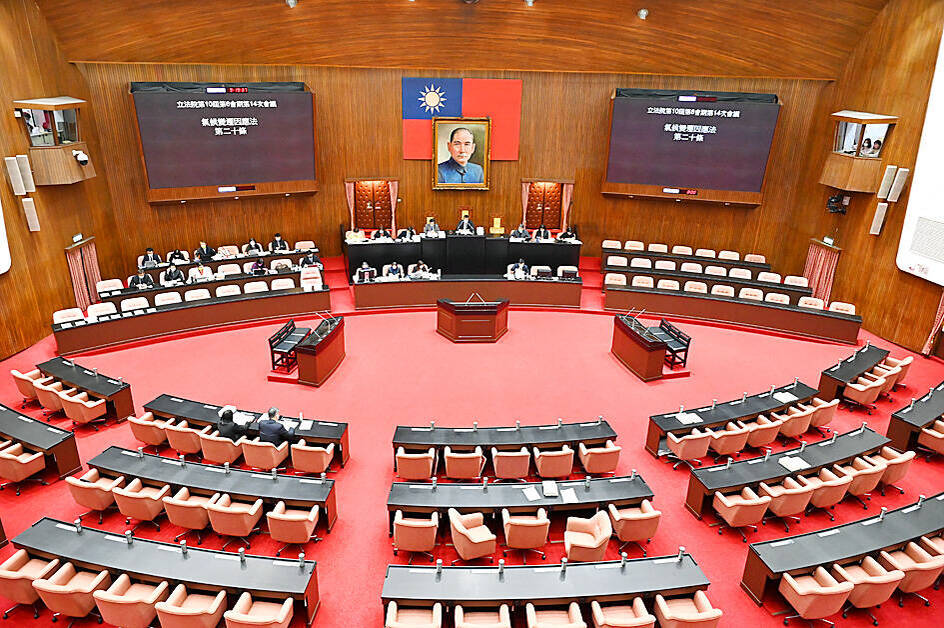
Photo: Taipei Times
“By contrast, legislators found guilty of corruption or other serious crimes can still file for an appeal and would not be suspended from office even if they are convicted in the first and second rulings,” he said.
“We see legislators who have been found guilty of serious crimes stay on the job; in the legislature, they could challenge or castigate officials of Judicial Yuan and Ministry of Justice... Most of the public find it very hard to accept such a situation,” Lee said.
Lee said he proposed to amend Article 7, Item 1 of the Legislators’ Conduct Act to stipulate suspending a legislator from office when they are convicted of corruption, engaging in organized crime, colluding with a foreign state or sedition.
When convicted in the first ruling, they would be given prison sentences, Lee said, adding that “misuse of public power for private profit” would require a conviction in a second ruling.
Those would also apply to convictions of serious crimes that impose the death penalty, life in prison, or those with at least a five-year sentence, he said.
If a legislator is found guilty in the first ruling, they would be suspended from office and would be placed in judicial detention or on the wanted bulletin depending on the proceedings of the criminal prosecution, he said.
A Chinese Nationalist Party (KMT) legislator who declined to be named opposed the proposed amendment, saying that the DPP has ignored the principle of “presumption of innocence.”
The reason that Taiwan would still need to have the three-circuit court system is to prevent wrongful convictions, the KMT lawmaker said.
“The proposed amendment aimed to focus on rooting out the evils of corruption by officials, but actually it showed the ambition of the DPP to undermine the justice system,” the KMT lawmaker said, adding that the judiciary was working to prosecute opposition parties, but gave lenient treatment when prosecuting members of the ruling DPP.
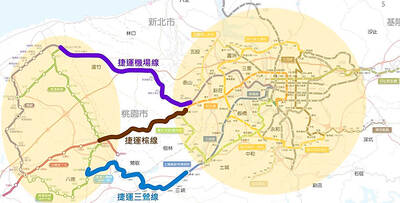
The Executive Yuan yesterday approved a southwestern extension of the Sanying MRT Line from New Taipei to Bade District (八德) in Taoyuan, with a goal of starting construction by late 2026. The 4.03-kilometer extension, featuring three new stations, will run from the current terminus at Yingtao Fude Station (LB12) in New Taipei City to Dannan Station (LB14), where it will connect with Taoyuan’s Green Line, New Taipei City Metro Corp said in a statement. This extension will follow the completion of core Sanying Line, a 14.29-kilometer medium-capacity system linking Tucheng (土城), Sansia (三峽)

CARGO LOSS: About 50 containers at the stern of the ‘Ever Lunar’ cargo ship went overboard, prompting the temporary closure of the port and disrupting operations Evergreen Marine Corp, Taiwan’s largest container shipper, yesterday said that all crew members aboard the Ever Lunar (長月) were safe after dozens of containers fell overboard off the coast of Peru the previous day. The incident occurred at 9:40am on Friday as the Ever Lunar was anchored and waiting to enter the Port of Callao when it suddenly experienced severe rolling, Evergreen said in a statement. The rolling, which caused the containers to fall, might have been caused by factors including a tsunami triggered by an earthquake in Russia, poor winter sea conditions in South America or a sudden influx of waves,

The Ministry of Culture yesterday officially launched the “We TAIWAN” cultural program on Osaka’s Nakanoshima sandbank, with the program’s mascot receiving overwhelming popularity. The cultural program, which runs from Aug. 2 to 20, was designed to partner with and capitalize on the 2025 World Expo that is being held in Osaka, Japan, from April 13 to Oct. 13, the ministry said. On the first day of the cultural program, its mascot, a green creature named “a-We,” proved to be extremely popular, as its merch was immediately in high demand. Long lines formed yesterday for the opening

BE CAREFUL: The virus rarely causes severe illness or death, but newborns, older people and those with medical conditions are at risk of more severe illness As more than 7,000 cases of chikungunya fever have been reported in China’s Guangdong Province this year, including 2,892 new cases last week, the Centers for Disease Control (CDC) yesterday said it is monitoring the situation and considering raising the travel notice level, which might be announced today. The CDC issued a level 1 travel notice, or “watch,” for Guangdong Province on July 22, citing an outbreak in Foshan, a manufacturing hub in the south of the province, that was reported early last month. Between July 27 and Saturday, the province reported 2,892 new cases of chikungunya, reaching a total of 7,716


 RSS
RSS