


The Taiwan-produced original musical Don’t Cry, Dancing Girls (勸世三姊妹) is set to make its overseas debut in New York next year, as the local creative industry navigates the road to commercial success, its director said.
VMTheatre Co cofounder and director Tseng Hui-cheng (曾慧誠) said that despite two sold-out tours in Taiwan since last year, bringing the musical to off-Broadway in New York is not just about sharing Taiwan’s culture, but also about learning how to achieve commercial success on the global stage.
New York is the global capital of musical theater and Broadway represents the highest level a commercial theater production can reach, Tseng, 49, said in an interview.
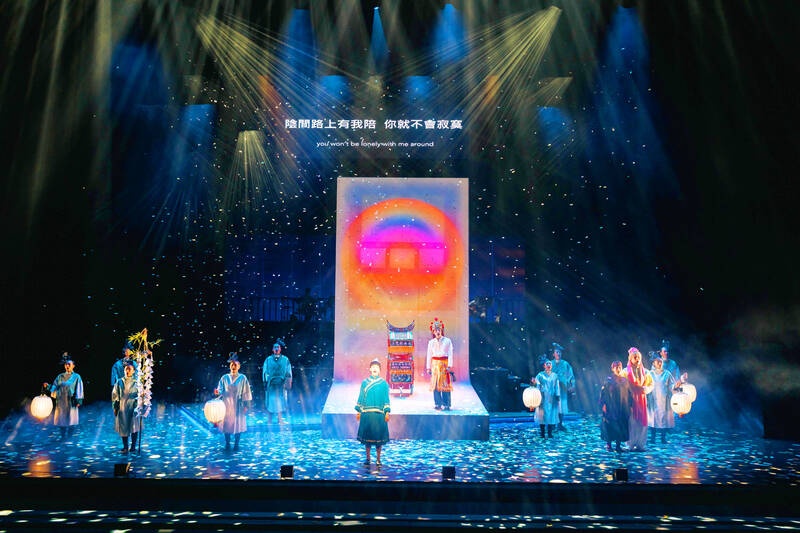
Photo courtesy of KOKO Entertainment
In mid-September, Tseng announced that Don’t Cry, Dancing Girls is to be staged in the format of a reading concert at the Theater Row complex in New York from Jan. 23 to 25.
“We will bring the musical in a reading concert format, performing in Hoklo [commonly known as Taiwanese] and Mandarin. A narrator speaking in English has been added, and the pace of the show has been adjusted in the hope of attracting people working in the commercial theater industry in the West to see our shows,” Tseng said.
Don’t Cry, Dancing Girls tells the story of three siblings’ rediscovery of a soul-guiding song ritual their parents performed at funerals to make a living during a trip back to their hometown in Yunlin County’s Huwei Township (虎尾).
Through the traditional funeral ritual of singing, dancing and storytelling, the siblings’ reconciliation with the past, including being abandoned by their heavily indebted father, the musical seeks to tackle issues such as life and death and complex family relations, VMTheatre said.
The next step is to bring in these people in the industry to create a new production based on the original story for an English-speaking audience, Tseng said.
Although the musical enjoyed commercial success in Taiwan, including selling out 12,000 tickets for 10 shows in Taipei in this year’s tour in eight minutes, VMTheatre said it does not plan to bring the same show abroad.
The theater group hopes to find investors or production teams interested in developing new works based on its original story and Taiwan’s unique funeral culture for their own local audience, it said.
South Korea, Japan and the Philippines all have original stories and productions aiming at Broadway, because the ability to export culture is part of a country’s competitiveness, Tseng said.
After wrapping up its 2024 tour in Taipei, Taichung and Kaohsiung between June and August, VMTheatre took part in the Ministry of Culture’s free tour throughout Taiwan, with a revised version of Don’t Cry, Dancing Girls for outdoor performances.
VMTheatre said its performance of the musical as part of the line-up of the ministry’s tour at Jhunan Sports Park in Miaoli County on Nov. 16 would be the last show in Taiwan before 2026.

Considering that most countries issue more than five denominations of banknotes, the central bank has decided to redesign all five denominations, the bank said as it prepares for the first major overhaul of the banknotes in more than 24 years. Central bank Governor Yang Chin-lung (楊金龍) is expected to report to the Legislative Yuan today on the bank’s operations and the redesign’s progress. The bank in a report sent to the legislature ahead of today’s meeting said it had commissioned a survey on the public’s preferences. Survey results showed that NT$100 and NT$1,000 banknotes are the most commonly used, while NT$200 and NT$2,000

The Centers for Disease Control (CDC) yesterday reported the first case of a new COVID-19 subvariant — BA.3.2 — in a 10-year-old Singaporean girl who had a fever upon arrival in Taiwan and tested positive for the disease. The girl left Taiwan on March 20 and the case did not have a direct impact on the local community, it said. The WHO added the BA.3.2 strain to its list of Variants Under Monitoring in December last year, but this was the first imported case of the COVID-19 variant in Taiwan, CDC Deputy Director-General Lin Ming-cheng (林明誠) said. The girl arrived in Taiwan on

South Korea is planning to revise its controversial electronic arrival card, a step Taiwanese officials said prompted them to hold off on planned retaliatory measures, a South Korean media report said yesterday. A Yonhap News Agency report said that the South Korean Ministry of Foreign Affairs is planning to remove the “previous departure place” and “next destination” fields from its e-arrival card system. The plan, reached after interagency consultations, is under review and aims to simplify entry procedures and align the electronic form with the paper version, a South Korean ministry official said. The fields — which appeared only on the electronic form

The Ministry of Foreign Affairs (MOFA) is suspending retaliation measures against South Korea that were set to take effect tomorrow, after Seoul said it is updating its e-arrival system, MOFA said today. The measures were to be a new round of retaliation after Taiwan on March 1 changed South Korea's designation on government-issued alien resident certificates held by South Korean nationals to "South Korea” from the "Republic of Korea," the country’s official name. The move came after months of protests to Seoul over its listing of Taiwan as "China (Taiwan)" in dropdown menus on its new online immigration entry system. MOFA last week


 RSS
RSS