


The Legislative Yuan’s Budget Center has called for a review of rules on political donations and how to regulate new modes of donating after it found that less than half of related audits in the past decade resulted in penalties.
Penalties were only imposed in less than half of the cases, especially in cases in which candidates running in elections were involved, the center said in a report released this week.
The Control Yuan is responsible for scrutinizing asset declarations of elected officials and civil servants, as well as auditing political donations for individual candidates and political parties.
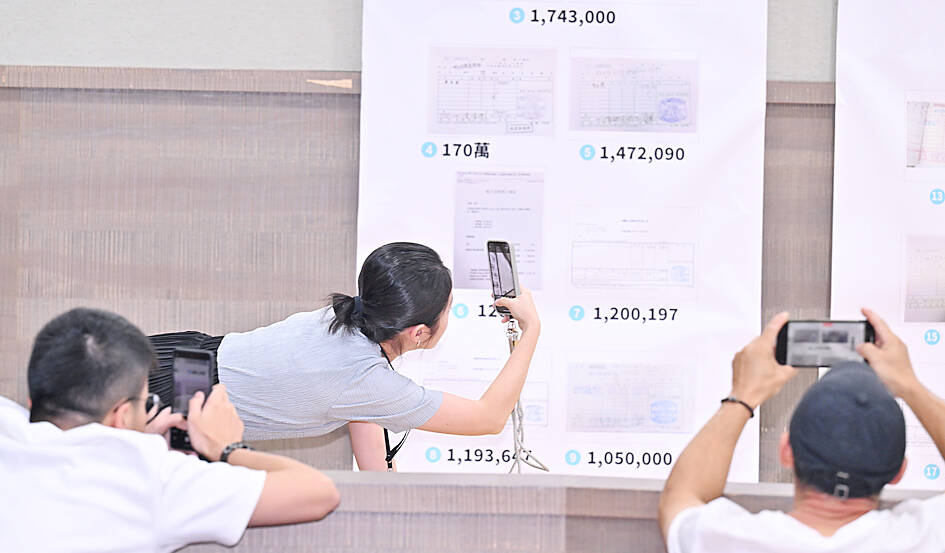
Photo: Liu Hsin-de, Taipei Times
For next year’s budget, the Control Yuan has set aside NT$610,000 (US$19,044) to check bank accounts of candidates and parties accepting political donations, review accounting reports and conduct audits of selected cases, the report said.
The Control Yuan has audited about 25 percent of political parties’ declarations, 44 percent of those by presidential and vice presidential candidates, 66 percent of those contesting a legislative seat and 15 percent of local elections, it said.
Its review covered 2014 to last year, totaling 1,548 cases, 718 of which resulted in penalties, or 46.4 percent, while those without penalties were 811, or 52.4 percent.
The highest proportion for those who were not penalized were candidates in elections at 72.4 percent, while the most imposed penalties involved contraventions and illegal conduct relating to donations from foreign sources, donations exceeding the upper limit, submitting accounting reports past the due date, failure to submit an accounting report, accepting unlawful donations and depositing money into a bank account dedicated to political donations past the 15-day deadline.
When it comes to candidates who were not penalized, it is likely due to the Control Yuan not finding fraudulent reporting or accounting discrepancies, center officials said.
However, the lack of personnel for investigations and limited authority to carry out audits, were also another factor, they said, adding that they had to close some cases due to lack of evidence.
Those who contravene the Political Donations Act (政治獻金法) could be fined up to double the amount of the donation accepted and imprisoned.
Under the Act on Property-Declaration by Public Servants (公職人員財產申報法), making false declarations with the intention of concealing assets could be fined up to NT$4 million.
Center officials recommended that the Control Yuan carry out a thorough review on measures and regulations to scrutinize political donations.
They also suggested changes to include new modes of money transfer, to regulate donations during live-streams and the use of cryptocurrency.
The Control Yuan should consider making campaign expenditures reports, enhancing regulations on and scrutiny of political donations and campaign finances, and revise and strengthen related law statutes, the center said.

Taiwan's Vice President Hsiao Bi-khim (蕭美琴) said Saturday that she would not be intimidated by the Chinese Communist Party (CCP), following reports that Chinese agents planned to ram her car during a visit to the Czech Republic last year. "I had a great visit to Prague & thank the Czech authorities for their hospitality & ensuring my safety," Hsiao said on social media platform X. "The CCP's unlawful activities will NOT intimidate me from voicing Taiwan's interests in the international community," she wrote. Hsiao visited the Czech Republic on March 18 last year as vice president-elect and met with Czech Senate leadership, including

There have been clear signs of Chinese Communist Party (CCP) attempts to interfere in the nationwide recall vote on July 26 in support of Chinese Nationalist Party (KMT) legislators facing recall, an unnamed government official said, warning about possible further actions. The CCP is actively involved in Taiwanese politics, and interference in the recall vote is to be expected, with multiple Chinese state media and TAO attempts to discredit the Democratic Progressive Party (DPP) and undermine public support of their recall movement, the official said. This interference includes a smear campaign initiated this month by a pro-Beijing Hong Kong news outlet against

A week-long exhibition on modern Tibetan history and the Dalai Lama’s global advocacy opened yesterday in Taipei, featuring quotes and artworks highlighting human rights and China’s ongoing repression of Tibetans, Hong Kongers and Uighurs. The exhibition, the first organized by the Human Rights Network for Tibet and Taiwan (HRNTT), is titled “From the Snowy Ridges to the Ocean of Wisdom.” “It would be impossible for Tibetans inside Tibet to hold an exhibition like this — we can do it. because we live in a free and democratic country,” HRNTT secretary-general Tashi Tsering said. Tashi Tsering, a Taiwan-based Tibetan who has never
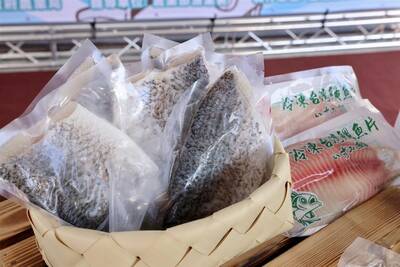
A first shipment of five tons of Taiwan tilapia was sent from Tainan to Singapore on Wednesday, following an order valued at NT$600,000 (US$20,500) placed with a company in the city. The products, including frozen whole fish and pre- cooked fish belly, were dispatched from Jiangjun Fishing Harbor, where a new aquatic processing and logistics center is under construction. At the launch, Tainan Mayor Huang Wei-che (黃偉哲) called the move a “breakthrough,” marking Taiwan’s expansion into the Singaporean tilapia market. Taiwan’s tilapia exports have traditionally focused on the United States, Canada, and the Middle East, Huang said, adding that the new foothold in


 RSS
RSS