


A Chinese aircraft carrier group yesterday sailed through the Taiwan Strait, Minister of National Defense Wellington Koo (顧立雄) said, a day after China held a live-fire exercise near Taiwan.
“The Liaoning is passing through the Taiwan Strait now, sailing north along the west of the median line and we are closely monitoring it,” Koo told reporters at the Legislative Yuan in Taipei.
The Liaoning also took part in China’s large-scale military drills around Taiwan on Monday last week.
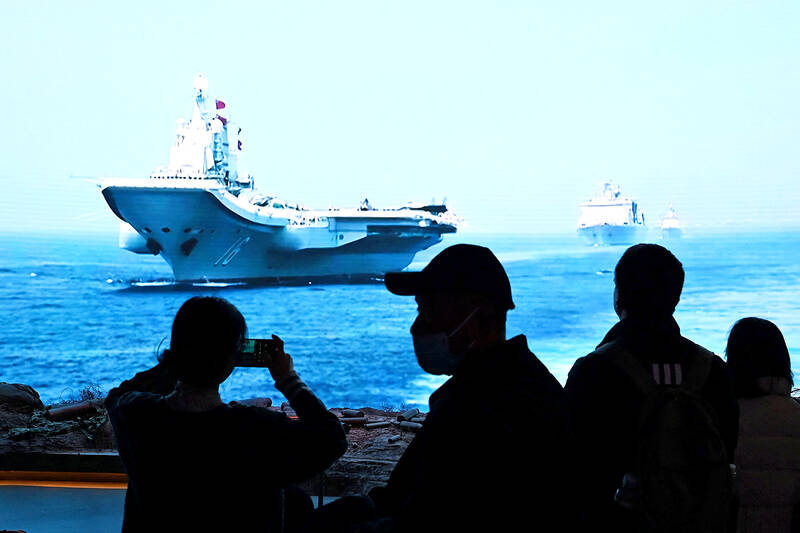
Photo: AFP
Taiwan said at the time that the Liaoning operated off the nation’s southeast coast during those drills, launching aircraft off its deck.
It appeared to be returning to Qingdao port in eastern China via the Pratas Islands (Dongsha Island, 東沙島), in the northern part of the South China Sea, for “replenishing and necessary maintenance,” said Jiang Hsin-biao (江炘杓), a retired navy captain at the Taipei-based Institute for National Defense and Security Research think tank.
Its involvement in the recent military drills was for “the purpose of practising against foreign forces and intimidating Taiwan,” Jiang said.
In Beijing, China said that it was “perfectly normal” for its aircraft carriers to sail near Taiwan.
“Taiwan is Chinese territory. It is perfectly normal for Chinese aircraft carriers to sail in its own territory and territorial waters,” Chinese Ministry of Foreign Affairs spokesman Lin Jian (林劍) told a regular briefing.
China has two aircraft carriers in service, and a third undergoing sea trials. The Liaoning has previously passed through the Strait.
Japan last month said the same carrier had entered Japan’s contiguous waters for the first time.
China has sailed its carriers through the strategic strait before, including in December shortly before Taiwan held elections.
China says it alone has jurisdiction over the nearly 180km-wide waterway that is a major passageway for international trade. Taiwan and the US dispute that, saying the Taiwan Strait is an international waterway.
The US Navy regularly sails through the Strait to assert freedom of navigation rights. Other allied states, such as Canada, Germany and Britain, have also carried out similar missions, to the anger of Beijing.
In related news, Japan and the US yesterday commenced 10 days of joint military drills involving tens of thousands of personnel.
The joint military drills “Keen Sword” would involve 45,000 Japanese and US troops, 40 vessels and 370 aircraft, as well as some forces from Australia and Canada, the Japanese Joint Staff said.
The exercises, which take place every two years, are being held across Japan, including at Japanese and US military bases, through Friday next week.
“We have a strong sense of urgency that we can’t rule out the possibility of a serious situation resembling Ukraine happening in regions near our country,” General Yoshihide Yoshida, the top uniformed officer in Japan’s Self-Defense Forces, said on Tuesday.
“We are determined to prevent and deter such a situation,” he told a news conference, adding that the US-Japan alliance was integral to regional stability.
“Keen Sword will ensure we maintain our advantage over those who seek to undermine the rule-based international order,” Admiral Steve Koehler, commander of the US Pacific Fleet, told reporters on Tuesday.

Considering that most countries issue more than five denominations of banknotes, the central bank has decided to redesign all five denominations, the bank said as it prepares for the first major overhaul of the banknotes in more than 24 years. Central bank Governor Yang Chin-lung (楊金龍) is expected to report to the Legislative Yuan today on the bank’s operations and the redesign’s progress. The bank in a report sent to the legislature ahead of today’s meeting said it had commissioned a survey on the public’s preferences. Survey results showed that NT$100 and NT$1,000 banknotes are the most commonly used, while NT$200 and NT$2,000

The Centers for Disease Control (CDC) yesterday reported the first case of a new COVID-19 subvariant — BA.3.2 — in a 10-year-old Singaporean girl who had a fever upon arrival in Taiwan and tested positive for the disease. The girl left Taiwan on March 20 and the case did not have a direct impact on the local community, it said. The WHO added the BA.3.2 strain to its list of Variants Under Monitoring in December last year, but this was the first imported case of the COVID-19 variant in Taiwan, CDC Deputy Director-General Lin Ming-cheng (林明誠) said. The girl arrived in Taiwan on

South Korea is planning to revise its controversial electronic arrival card, a step Taiwanese officials said prompted them to hold off on planned retaliatory measures, a South Korean media report said yesterday. A Yonhap News Agency report said that the South Korean Ministry of Foreign Affairs is planning to remove the “previous departure place” and “next destination” fields from its e-arrival card system. The plan, reached after interagency consultations, is under review and aims to simplify entry procedures and align the electronic form with the paper version, a South Korean ministry official said. The fields — which appeared only on the electronic form

The Ministry of Foreign Affairs (MOFA) is suspending retaliation measures against South Korea that were set to take effect tomorrow, after Seoul said it is updating its e-arrival system, MOFA said today. The measures were to be a new round of retaliation after Taiwan on March 1 changed South Korea's designation on government-issued alien resident certificates held by South Korean nationals to "South Korea” from the "Republic of Korea," the country’s official name. The move came after months of protests to Seoul over its listing of Taiwan as "China (Taiwan)" in dropdown menus on its new online immigration entry system. MOFA last week


 RSS
RSS