


The Chinese Nationalist Party (KMT) yesterday said it is mulling street protests and plebiscites to remove limits on capital punishment imposed last week by the Constitutional Court.
The Democratic Progressive Party (DPP) said that the KMT was inciting populism and vowed to draft legislation to bolster life imprisonment sentencing without parole and help prevent wrongful convictions.
The death penalty is allowed, but applies only to exceptionally heinous cases that have been tried according to the strictest possible due process standards, the Constitutional Court said in a constitutional interpretation on Friday last week.
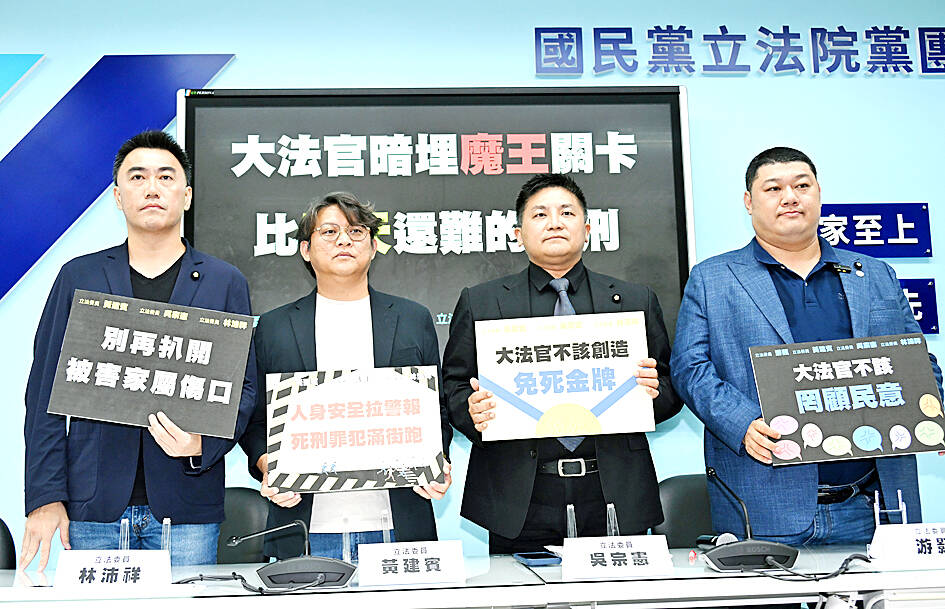
Photo: Fang Pin-chao, Taipei Times
The court placed restrictions that made exercising capital punishment “virtually impossible” while ostensibly upholding the penalty, KMT Legislator Wu Tsung-hsien (吳宗憲), a former prosecutor, told a news conference at the Legislative Yuan in Taipei yesterday.
KMT lawmakers in the legislature and on the streets would fight to restore the “status quo” of the death penalty, Wu said, adding that they “do not rule out” proposing referendums to challenge the judgement.
People who are third parties to the tragedy of crime should not demand that the family members of people who have been murdered respect the rights of the perpetrator, he said.
The court’s restrictions on the death penalty shield perpetrators from justice and would contribute to social unrest, KMT Legislator Huang Chien-pin (黃建賓) said.
KMT Legislator Lin Pei-hsiang (林沛祥) said the Constitutional Court “showed hypocrisy” by neglecting the rights of people targeted by crime.
DPP Legislator Rosalia Wu (吳思瑤) later told a news conference that the KMT is “sowing populism and division for political gain.”
An average person would have understood the law enough to comply with a decision rendered by the nation’s highest court instead of making slanderous comments about its judges, she said.
The DDP caucus would amend laws to ensure constitutional standards are met in the justice system’s handling of cases and bring life imprisonment without parole out of near-dead status, she said.
Taiwan in 2009 ratified the International Covenant on Civil and Political Rights at the prompting of then-president Ma Ying-jeou (馬英九), DPP Legislator Tsai Yi-yu (蔡易餘) said.
The KMT had praised the court for upholding the punishment before slamming the judges for its de facto abolition in a circle of self-contradiction, Tsai said.
The opposition should play a constructive role in the legislative work of maintaining the justice system in light of the ruling and not use scare tactics on voters, he said.
“What is a referendum going to be about after the court ruled in favor of the death penalty?” he asked.
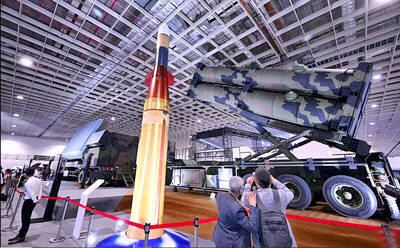
Taiwan is to commence mass production of the Tien Kung (天弓, “Sky Bow”) III, IV and V missiles by the second quarter of this year if the legislature approves the government’s NT$1.25 trillion (US$39.78 billion) special defense budget, an official said yesterday. Commenting on condition of anonymity, a defense official with knowledge of the matter said that the advanced systems are expected to provide crucial capabilities against ballistic and cruise missiles for the proposed “T-Dome,” an advanced, multi-layered air defense network. The Tien Kung III is an air defense missile with a maximum interception altitude of 35km. The Tien Kung IV and V
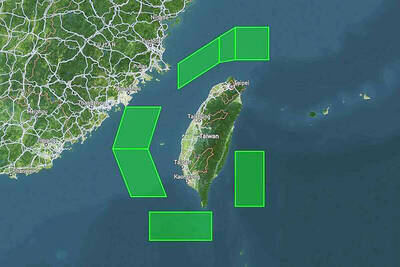
The disruption of 941 flights in and out of Taiwan due to China’s large-scale military exercises was no accident, but rather the result of a “quasi-blockade” used to simulate creating the air and sea routes needed for an amphibious landing, a military expert said. The disruptions occurred on Tuesday and lasted about 10 hours as China conducted live-fire drills in the Taiwan Strait. The Civil Aviation Administration (CAA) said the exercises affected 857 international flights and 84 domestic flights, affecting more than 100,000 travelers. Su Tzu-yun (蘇紫雲), a research fellow at the government-sponsored Institute for National Defense and Security Research, said the air
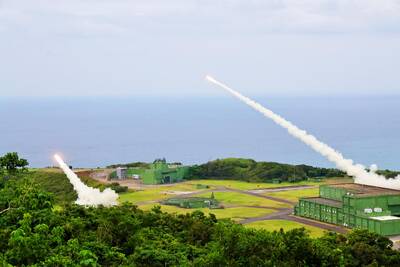
Taiwan lacks effective and cost-efficient armaments to intercept rockets, making the planned “T-Dome” interception system necessary, two experts said on Tuesday. The concerns were raised after China’s military fired two waves of rockets during live-fire drills around Taiwan on Tuesday, part of two-day exercises code-named “Justice Mission 2025.” The first wave involved 17 rockets launched at 9am from Pingtan in China’s Fujian Province, according to Lieutenant General Hsieh Jih-sheng (謝日升) of the Office of the Deputy Chief of the General Staff for Intelligence at the Ministry of National Defense. Those rockets landed 70 nautical miles (129.6km) northeast of Keelung without flying over Taiwan,
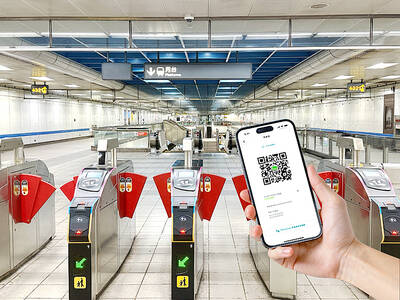
City buses in Taipei and New Taipei City, as well as the Taipei MRT, would on Saturday begin accepting QR code payments from five electronic payment providers, the Taipei Department of Transportation said yesterday. The new option would allow passengers to use the “transportation QR code” feature from EasyWallet, iPass Money, iCash Pay, Jkopay or PXPay Plus. Passengers should open their preferred electronic payment app, select the “transportation code” — not the regular payment code — unlock it, and scan the code at ticket readers or gates, General Planning Division Director-General Liu Kuo-chu (劉國著) said. People should move through the


 RSS
RSS