


The solidifying military alliance between China and Russia constitutes a grave challenge to regional security, the Mainland Affairs Council (MAC) said in a report released yesterday.
The increase in Sino-Russian strategic cooperation has triggered a regional arms race, making the region less secure and stable, said the MAC-commissioned report, which was edited by Tung Hui-ming (董慧明), an associate professor of China military studies at National Defense University.
Naval drills jointly conducted by China and Russia in July were a sign that the two nations intended to further their military cooperation, which could lead to a surge in low-intensity “gray zone” conflict, the report said.
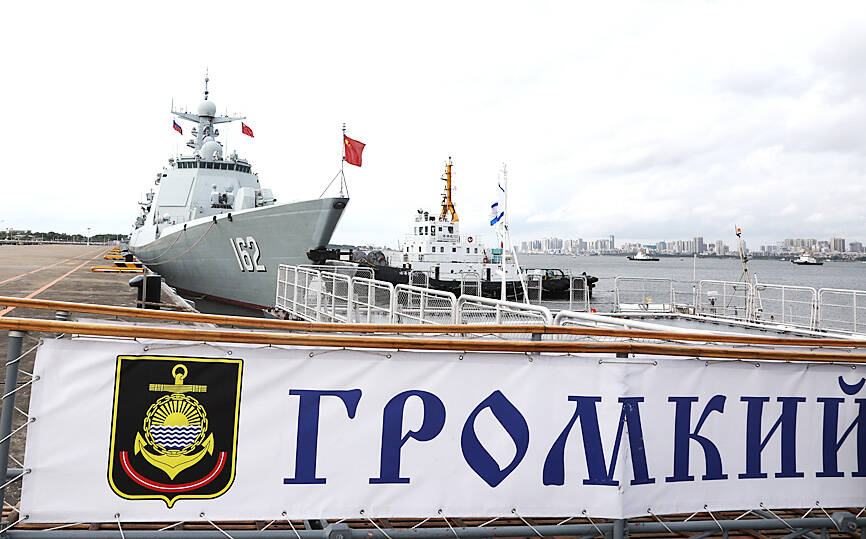
Photo: EPA-EFE / Xinhua / Liu Fang
In May, Russian President Vladimir Putin met with Chinese President Xi Jinping (習近平) in Beijing, saying in a joint statement that the two nations would deepen their comprehensive strategic partnership, it said.
The statement declared an intention to upgrade collaboration between Beijing and Moscow in political, economic and military domains while putting their discontent with the Western-led international order on display, the report said.
The Chinese and Russian combined naval drills from July 15 to 17 were a demonstration of their joint military capabilities and show of force directed at nations in the region, it said.
The exercises were conducted in waters off Zhanjiang in China’s Guangdong Province, the base of operations for the Southern Theater Command of the Chinese People’s Liberation Army Navy (PLAN), the report said.
The selection of the naval base in Zhanjiang to assemble the fleets that took part in the drills signaled the intent and apparent capability of Beijing and Moscow to project power jointly in the region, it said.
The PLAN deployed the Nanning Type 052D guided missile destroyer, two Type 054A guided missile destroyers and a Type 903 replenishment oiler, as well as navy helicopters and marines, while Russia deployed two Gnevny-class destroyers and a Dubna-class oiler, the report said.
The combined force possessed potent anti-ship, anti-submarine and logistics capabilities, and implied that the two navies have achieved interoperability, it said.
Their bolstered military cooperation is likely to facilitate the expansion of China’s sphere of influence, increase Chinese military activities in the Pacific — including in the Taiwan Strait — and lead to a hardening of the US-led security alliance in the region, it said.
As East Asian nations perceive military displays by China and Russia as a direct challenge to their sovereignty and territorial integrity, and not merely for show, their responses would likely be forceful, the report said.
That means regional conflicts might escape the “gray zone” to become low-intensity, but high-frequency clashes, it said, adding that more effective deconfliction mechanisms are needed to maintain peace and security in the region.

UNREASONABLE SURVEILLANCE: A camera targeted on an road by a neighbor captured a man’s habitual unsignaled turn into home, netting him dozens of tickets The Taichung High Administrative Court has canceled all 45 tickets given to a man for failing to use a turn signal while driving, as it considered long-term surveillance of his privacy more problematic than the traffic violations. The man, surnamed Tseng (曾), lives in Changhua County and was reported 45 times within a month for failing to signal while driving when he turned into the alley where his residence is. The reports were filed by his neighbor, who set up security cameras that constantly monitored not only the alley but also the door and yard of Tseng’s house. The surveillance occurred from July
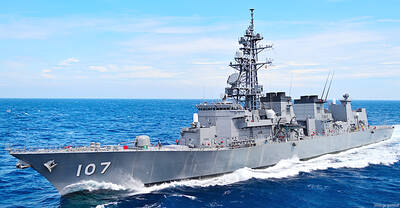
A Japan Self-Defense Forces vessel entered the Taiwan Strait yesterday, Japanese media reported. After passing through the Taiwan Strait, the Ikazuchi was to proceed to the South China Sea to take part in a joint military exercise with the US and the Philippines, the reports said. Japan Self-Defense Force vessels were first reported to have passed through the strait in September, 2024, with two further transits taking place in February and June last year, the Asahi Shimbun reported. Yesterday’s transit also marked the first time since Japanese Prime Minister Sanae Takaichi took office that a Japanese warship has been sent through the Taiwan

SECURITY: Starlink owner Elon Musk has taken pro-Beijing positions, and allowing pro-China companies to control Taiwan’s critical infrastructure is risky, a legislator said Starlink was reluctant to offer services in Taiwan because of the nation’s extremely high penetration rates in 4G and 5G services, the Ministry of Digital Affairs said yesterday. The ministry made the comments at a meeting of the legislature’s Transportation Committee, which reviewed amendments to Article 36 of the Telecommunications Management Act (電信管理法). Article 36 bans foreigners from holding more than 49 percent of shares in public telecommunications networks, while shares foreigners directly and indirectly hold are also capped at 60 percent of the total, unless specified otherwise by law. The amendments, sponsored by Chinese Nationalist Party (KMT) Legislator Ko
‘SAME OLD TRICK’: Even if Beijing resumes individual travel to Taiwan, it would only benefit Chinese tourism companies, the Economic Democracy Union convener said China’s 10 new “incentives” are “sugar-coated poison,” an official said yesterday, adding that Taiwanese businesses see them clearly for what they are, but that Beijing would inevitably find some local collaborators to try to drums up support. The official, speaking on condition of anonymity, made the remark ahead of a news conference the General Chamber of Commerce is to hold today. The event, titled “Industry Perspectives on China’s Recent Pro-Taiwan Policies,” is expected to include representatives from industry associations — such as those in travel, hotels, food and agriculture — to request the government cooperate with China’s new measures, people familiar with


 RSS
RSS