


A motorcycle rider who was strangled by a power line during a typhoon last year has become the world’s first person to have a traumatic tracheal rupture repaired using an aortic graft, the National Taiwan University Hospital (NTUH) said on Wednesday.
During Typhoon Koinu in October last year, a 24-year-old man surnamed Tseng (曾) was riding his motorcycle home from work in Yunlin County when the accident happened, NTUH Department of Surgery chairman Chen Jin-shing (陳晉興) said at a news conference.
After initial treatment at a local hospital, Tseng was transferred to NTUH’s Yunlin Branch, where further complications arose, including serious tracheal stenosis, forcing him to rely on a tracheostomy tube to breathe and a nasogastric tube to eat due to airway blockage, Chen said.
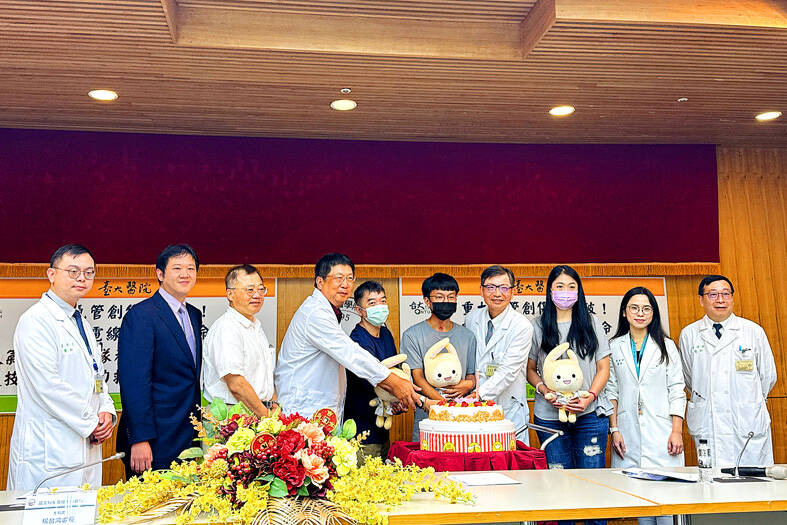
Photo: Chiu Chih-jou, Taipei Times
“Everyone can imagine how difficult it would be for a 24-year-old man to rely on tracheostomy and nasogastric tubes for the rest of his life,” Chen said.
Tseng was then referred to NTUH in Taipei, where Chen’s team in October last year performed a tracheal reconstruction using an aortic graft from an organ donor.
The patient recovered well after the surgery, and was off the ventilator the day after the operation and discharged in December, Chen said.
Tseng had his tracheostomy tube removed in April and has since returned to a normal life, regaining his ability to eat and speak, an NTUH news release said.
Such kinds of cases are rarely successful, as many patients either pass away at the scene or end up relying on a tracheostomy tube for the rest of their lives, Chen said.
That surgery was the world’s first instance of repairing a traumatic tracheal rupture using an aortic graft, and the case was accepted for publication last month by JTCVS Techniques, a peer-reviewed journal, he added.
Regarding the difficulty of performing the reconstruction, Chen said that while short tracheal lesions can be easily managed by resection and reconnection, lesions that are more than 5cm present significant challenges.
“When the trachea cannot be reconnected due to tumors, stenosis or severe trauma, reconstruction or even transplantation becomes necessary,” he said.
Tracheal reconstruction or transplantation that involved donated or artificial tracheas has long been a challenging task in pulmonology due to serious transplant rejection, he added.
Chen and his team, building on the work of French researcher Emmanuel Martinod in 2018, have successfully treated three patients with severe tracheal conditions since 2021 under a human clinical trial program approved by the Ministry of Health and Welfare, the news release said.
The team used a tissue-engineering technique involving aortic grafts stored at negative 80°C, which were thawed before implantation, and supported by tracheal stents to maintain their shape, eliminating the need for blood type matching and immunosuppressive drugs, it said.
Asked about the principle of the technique, Chen said that after an aorta is thawed, all the cells die, leaving only a structure similar to that of a trachea, which therefore does not trigger transplant rejection.
“It [the implanted aortic graft] acts like a bridge or an empty house... As the recipient’s [trachea] cells grow inside of it, they develop into mucosa and cartilage cells, gradually transforming the aorta into a trachea,” he said.
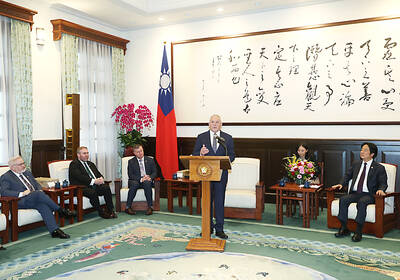
‘NON-RED’: Taiwan and Ireland should work together to foster a values-driven, democratic economic system, leveraging their complementary industries, Lai said President William Lai (賴清德) yesterday expressed hopes for closer ties between Taiwan and Ireland, and that both countries could collaborate to create a values-driven, democracy-centered economic system. He made the remarks while meeting with an Irish cross-party parliamentary delegation visiting Taiwan. The delegation, led by John McGuinness, deputy speaker of the Irish house of representatives, known as the Dail, includes Irish lawmakers Malcolm Byrne, Barry Ward, Ken O’Flynn and Teresa Costello. McGuinness, who chairs the Ireland-Taiwan Parliamentary Friendship Association, is a friend of Taiwan, and under his leadership, the association’s influence has grown over the past few years, Lai said. Ireland is

A saleswoman, surnamed Chen (陳), earlier this month was handed an 18-month prison term for embezzling more than 2,000 pairs of shoes while working at a department store in Tainan. The Tainan District Court convicted Chen of embezzlement in a ruling on July 7, sentencing her to prison for illegally profiting NT$7.32 million (US$248,929) at the expense of her employer. Chen was also given the opportunity to reach a financial settlement, but she declined. Chen was responsible for the sales counter of Nike shoes at Tainan’s Shinkong Mitsukoshi Zhongshan branch, where she had been employed since October 2019. She had previously worked
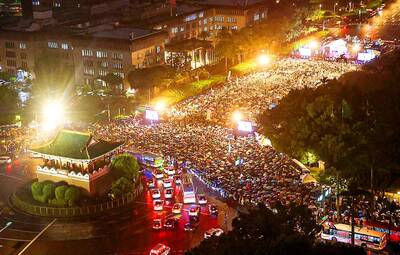
FINAL COUNTDOWN: About 50,000 attended a pro-recall rally yesterday, while the KMT and the TPP plan to rally against the recall votes today Democracy activists, together with arts and education representatives, yesterday organized a motorcade, while thousands gathered on Ketagalan Boulevard in Taipei in the evening in support of tomorrow’s recall votes. Recall votes for 24 Chinese Nationalist Party (KMT) lawmakers and suspended Hsinchu City mayor Ann Kao (高虹安) are to be held tomorrow, while recall votes for seven other KMT lawmakers are scheduled for Aug. 23. The afternoon motorcade was led by the Spring Breeze Culture and Arts Foundation, the Tyzen Hsiao Foundation and the Friends of Lee Teng-hui Association, and was joined by delegates from the Taiwan Statebuilding Party and the Taiwan Solidarity
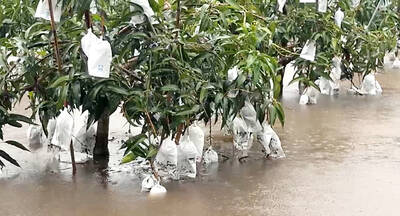
TRANSPORT DISRUPTION: More than 100 ferry services were suspended due to rough seas and strong winds, and eight domestic flights were canceled, the ministry said Tropical Storm Wipha intensified slightly yesterday as it passed closest to Taiwan, dumping more than 200mm of rain in Hualien and Taitung counties, the Central Weather Administration (CWA) said. As of 11am, Wipha was about 210km southwest of Cape Oluanpi (鵝鑾鼻) and was moving west-northwest at 27km per hour (kph). The storm carried maximum sustained winds of 101kph and gusts reaching 126kph, with a 150km radius of strong winds, CWA data showed. Wipha’s outer rainbands began sweeping across Taiwan early yesterday, delivering steady rainfall in the east and scattered showers in other regions, forecasters said. More heavy rain was expected, especially in the eastern


 RSS
RSS