


Taiwan yesterday carried out anti-landing drills on a strategic river on the first day of the annual Han Kuang exercises, which this year aim to be as close as possible to actual combat, with no script, while simulating how to repel a Chinese attack.
China has been staging regular exercises around Taiwan to pressure Taipei and has never renounced the use of force to bring Taiwan under its control.
Taiwan’s drills this year do not include elements that are mostly for show, such as scripted displays of firepower, while there would be intensified nighttime exercises and personnel would practice how to operate with severed command lines.
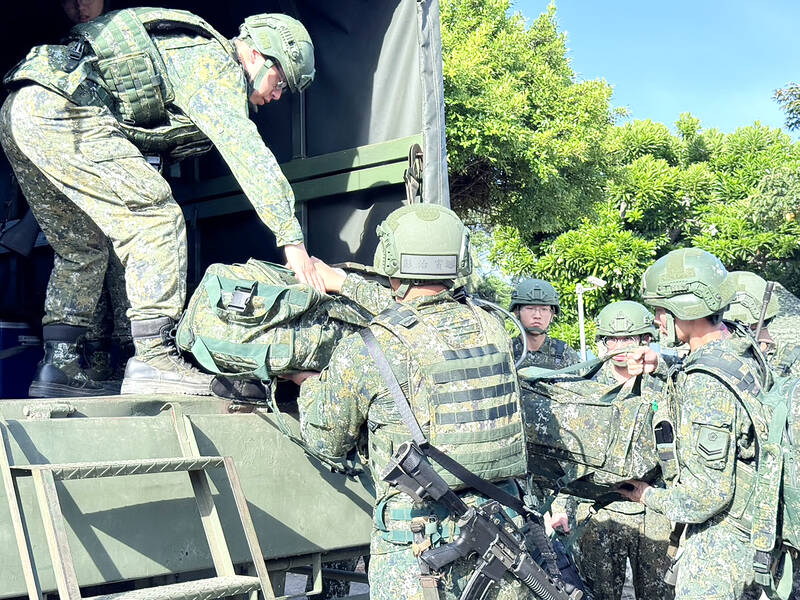
Photo: Lo Kou-chia, Taipei Times
At the mouth of a major river leading to Taipei in Tamsui District (淡水), soldiers practiced laying mines and nets to stymie landing enemy forces, part of a series of drills designed to prevent the capital from being seized.
“We are trying our best to slow them down as much as possible,” a military officer told reporters, referring to a scenario in which the enemy was trying to make landfall by sending rubber boats up Tamsui River.
“The slower they move, the better for us,” he added.
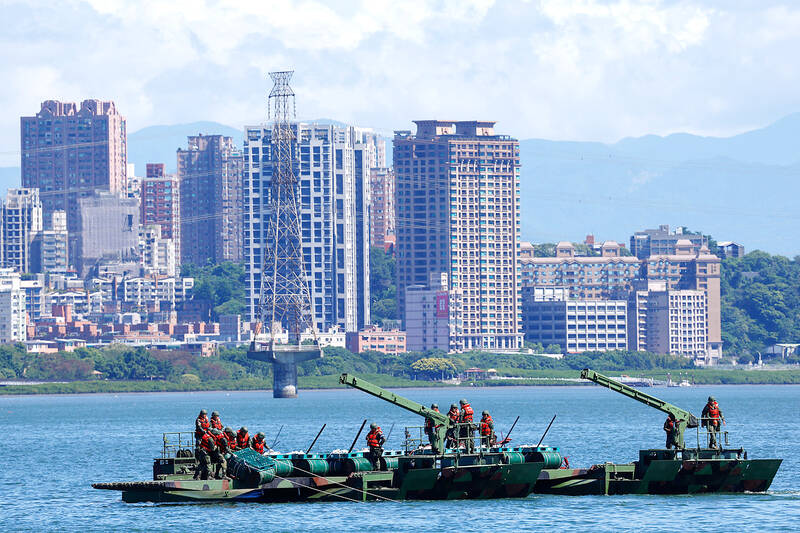
Photo: Ann Wang, Reuters
Earlier yesterday in nearby Taoyuan, outside of Taipei and home to the Taiwan Taoyuan International Airport, reservists gathered to receive their orders as they would during a war, and civilian vans were pressed into service to carry supplies.
On Thursday, Taoyuan airport is to close for an hour in the morning for the drills, although a typhoon is expected to affect Taiwan that day, meaning the exercise could be delayed.
Live-fire drills are only taking place on Taiwan’s outlying islands, including Kinmen and Lienchiang counties, which are near China’s coast.
The five-day war games are happening in conjunction with the Wanan air defense exercise, where the streets of major cities are evacuated for half an hour during a simulated Chinese missile attack, and test warning alarms would sound on mobile phones.
The Han Kuang drill scenarios this week include setting up contingency command lines after existing hubs are destroyed and dispersing Chinese forces trying to land on Taiwan’s west coast, a defense official involved in the planning said.

SECURITY: Starlink owner Elon Musk has taken pro-Beijing positions, and allowing pro-China companies to control Taiwan’s critical infrastructure is risky, a legislator said Starlink was reluctant to offer services in Taiwan because of the nation’s extremely high penetration rates in 4G and 5G services, the Ministry of Digital Affairs said yesterday. The ministry made the comments at a meeting of the legislature’s Transportation Committee, which reviewed amendments to Article 36 of the Telecommunications Management Act (電信管理法). Article 36 bans foreigners from holding more than 49 percent of shares in public telecommunications networks, while shares foreigners directly and indirectly hold are also capped at 60 percent of the total, unless specified otherwise by law. The amendments, sponsored by Chinese Nationalist Party (KMT) Legislator Ko

The eastern extension of the Taipei MRT Red Line could begin operations as early as late June, the Taipei Department of Rapid Transit Systems said yesterday. Taipei Rapid Transit Corp said it is considering offering one month of free rides on the new section to mark its opening. Construction progress on the 1.4km extension, which is to run from the current terminal Xiangshan Station to a new eastern terminal, Guangci/Fengtian Temple Station, was 90.6 percent complete by the end of last month, the department said in a report to the Taipei City Council's Transportation Committee. While construction began in October 2016 with an

NON-RED SUPPLY: Boosting the nation’s drone industry is becoming increasingly urgent as China’s UAV dominance could become an issue in a crisis, an analyst said Taiwan’s drone exports to Europe grew 41.7-fold from 2024 to last year, with demand from Ukraine’s fight against Russian aggression the most likely driver of growth, a study showed. The Institute for Democracy, Society and Emerging Technology (DSET) in a statement on Wednesday said it found that many of Taiwan’s uncrewed aerial vehicle (UAV) sales were from Poland and the Czech Republic. These countries likely transferred the drones to Ukraine to aid it in its fight against the Russian invasion that started in 2022, it said. Despite the gains, Taiwan is not the dominant drone exporter to these markets, ranking second and fourth
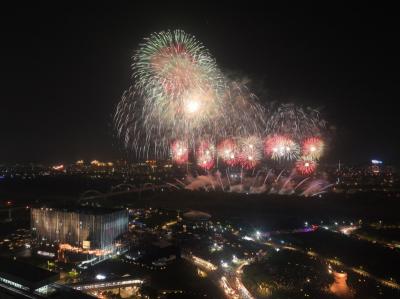
The New Taipei City Art Museum this weekend plans to celebrate its first anniversary with a two-day extravaganza featuring live concerts and a large-scale synchronized fireworks and drone display, the New Taipei City Cultural Affairs Department said. The two-day celebrations are to take place in the museum’s outdoor park, with markets and live performances by singers including Ann Bai (白安), Bii (畢書盡) and the Cosmos People (宇宙人), the department said. The highlight on both evenings would be the "Echoes of Light" show, an aerial spectacle combining fireworks and drone performances designed around the concept of "dual stages in the sky," it


 RSS
RSS