


The first reactor at Ma-anshan Nuclear Power Plant in Pingtung County is to retire on July 27 as planned, the Executive Yuan said yesterday, adding that the reactor would not be reactivated immediately even if the legislature passes bills to extend its operation.
The Executive Yuan reiterated its position in a news conference after the legislature’s Education and Culture Committee failed to pass a preliminary review of an amendment to Article 6 of the Nuclear Reactor Facilities Regulation Act (核子反應器設施管制法), which would relax the regulations governing the license renewal of nuclear power plants.
“Although the Jinshan Nuclear Power Plant and the Guosheng Nuclear Power Plant in New Taipei City have been decommissioned, the fuel rods are still in the nuclear reactor cores. Dry storage sites need to be set up first before the rods can be removed from the cores and properly stored,” Cabinet spokesman Chen Shi-kai (陳世凱) said.
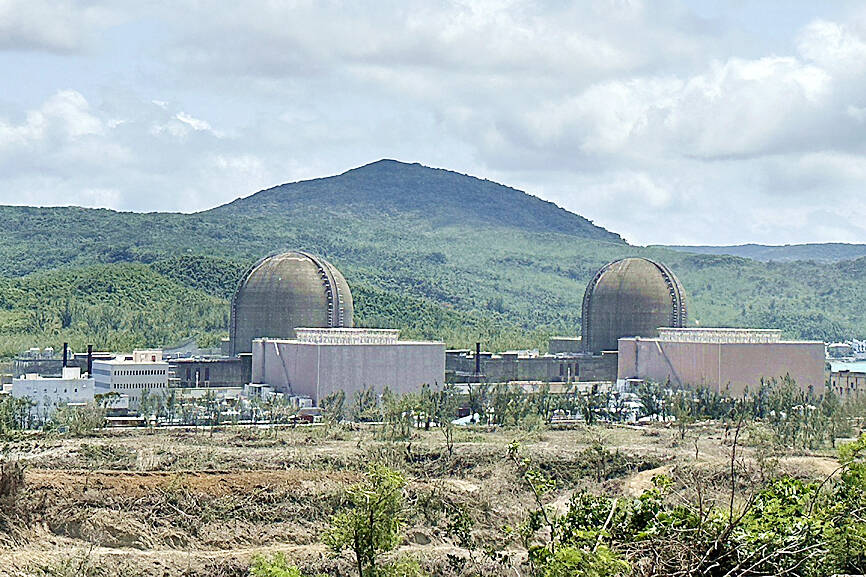
Photo: Tsai Tsung-hsien, Taipei Times
“Given the high density population in Taiwan, it is difficult to find interim and final nuclear waste storage sites. We will continue to work on communicating with the public on this matter, but we have encountered difficulties doing so,” he said.
The existing regulations require that reactor No. 1 stop operating when its license expires on July 27, Chen said, adding that it would not be immediately reactivated even if the legislature passes the amendments.
“The government’s position remains that the reactivation of nuclear power plants can only proceed if storage sites for nuclear waste can be located, the safety of the nuclear power plants can be secured and the public reaches a consensus on the issues,” Chen said. “The government will also continue the energy transition through developing green energy and efforts to reduce carbon emissions.”
Taiwan Power Co in May said that electricity would come from renewable energy as well as natural gas and coal-powered plants after the Ma-anshan plant is decommissioned.
Aside from photovoltaics and offshore wind power, generators in gas-fired Fong Der Power Plant in Tainan, natural gas-powered Tatan Power Plant and coal-powered Hsinta Power Plant can collectively add 4.43 gigawatts to the power system.
In a field trip to the Ma-anshan plant on Wednesday, lawmakers shared different views on whether the operation of the power plant should be extended.
“It is not a simple ‘yes’ or ‘no’ question,” Democratic Progressive Party Legislator Hsu Fu-kuei (徐富癸) said. “It involves a change to the national energy policy, and input from residents of the Hengchun Peninsula must be taken into consideration.”
Given the long half-period of radioactive waste generated by the nuclear power plant, the government should compensate residents for the sacrifices they would make due to the national energy policy, he said.
How to use site of the plant to develop renewable energy should be planned ahead of time, Chiu said.
Chinese Nationalist Party (KMT) Legislator Su Ching-chuan (蘇清泉) said that he supported extending its operation, as it does not conflict with the development of green energy.
The development of artificial intelligence and other high-technology industries need a lot of power, which cannot be supplied through green energy alone, he said.

Considering that most countries issue more than five denominations of banknotes, the central bank has decided to redesign all five denominations, the bank said as it prepares for the first major overhaul of the banknotes in more than 24 years. Central bank Governor Yang Chin-lung (楊金龍) is expected to report to the Legislative Yuan today on the bank’s operations and the redesign’s progress. The bank in a report sent to the legislature ahead of today’s meeting said it had commissioned a survey on the public’s preferences. Survey results showed that NT$100 and NT$1,000 banknotes are the most commonly used, while NT$200 and NT$2,000

The Centers for Disease Control (CDC) yesterday reported the first case of a new COVID-19 subvariant — BA.3.2 — in a 10-year-old Singaporean girl who had a fever upon arrival in Taiwan and tested positive for the disease. The girl left Taiwan on March 20 and the case did not have a direct impact on the local community, it said. The WHO added the BA.3.2 strain to its list of Variants Under Monitoring in December last year, but this was the first imported case of the COVID-19 variant in Taiwan, CDC Deputy Director-General Lin Ming-cheng (林明誠) said. The girl arrived in Taiwan on

South Korea is planning to revise its controversial electronic arrival card, a step Taiwanese officials said prompted them to hold off on planned retaliatory measures, a South Korean media report said yesterday. A Yonhap News Agency report said that the South Korean Ministry of Foreign Affairs is planning to remove the “previous departure place” and “next destination” fields from its e-arrival card system. The plan, reached after interagency consultations, is under review and aims to simplify entry procedures and align the electronic form with the paper version, a South Korean ministry official said. The fields — which appeared only on the electronic form

The Ministry of Foreign Affairs (MOFA) is suspending retaliation measures against South Korea that were set to take effect tomorrow, after Seoul said it is updating its e-arrival system, MOFA said today. The measures were to be a new round of retaliation after Taiwan on March 1 changed South Korea's designation on government-issued alien resident certificates held by South Korean nationals to "South Korea” from the "Republic of Korea," the country’s official name. The move came after months of protests to Seoul over its listing of Taiwan as "China (Taiwan)" in dropdown menus on its new online immigration entry system. MOFA last week


 RSS
RSS