


Chinese Nationalist Party (KMT) legislators yesterday voted through the first reading of a bill to exempt party-affiliated organizations from being implicated for holding ill-gotten assets, while Democratic Progressive Party (DPP) lawmakers criticized Taiwan People’s Party (TPP) legislators for not voting.
The KMT proposed amending articles 4 and 34 of the Act Governing the Handling of Ill-gotten Properties by Political Parties and Their Affiliate Organizations (政黨及其附隨組織不當取得財產處理條例).
The former article defines an “affiliated organization” as a group “once substantially controlled by the political parties in terms of personnel, finance or operation and has acquired its separated status and assets from the political parties without paying fair price.”
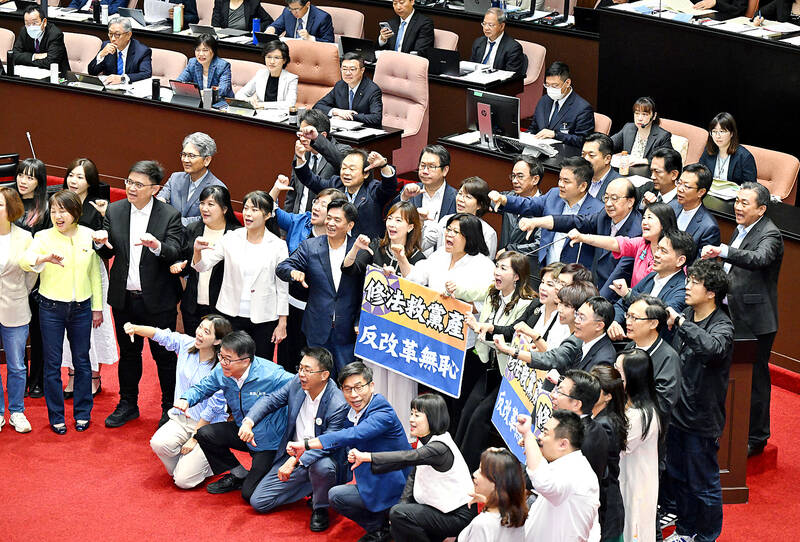
Photo: Liao Chen-huei, Taipei Times
KMT Legislator Yu Hao’s (游顥) proposal would add: “but those once belonging to the country shall not be included.”
A DPP proposal to return the motion to the Procedure Committee failed in a 52-49 vote, with a recount yielding the same result.
There were 101 of the 113 lawmakers at the vote.
The DPP said that the TPP was a lackey of the KMT after its lawmakers abstained from voting during the bid to return the amendment to the Procedure Committee.
DPP caucus deputy chief executive Michelle Lin (林楚茵) wrote on Facebook that the KMT’s first move after expanding the powers of the Legislative Yuan was to attempt to reclaim party assets.
The TPP, by its inaction, was supporting the KMT’s act and willingly becoming its lackey, Lin wrote.
DPP Legislator Huang Jie (黃捷) wrote on Threads that the KMT was the “greatest robber baron in the nation.”
The KMT attempted to reclaim about 20,000 hectares of land and NT$1.63 billion (US$50.39 million) that the Ill-gotten Party Assets Settlement Committee in 2016 ruled was illegally obtained.
DPP Legislator Wang Ting-yu (王定宇) posted photographs on Facebook showing TPP Legislator Wu Chun-cheng (吳春城) smoking during the vote, alleging that Wu had skipped it.
Wu said it spoke volumes that the DPP was silent on DPP caucus whip Ker Chien-ming (柯建銘) smoking in areas where it is forbidden while “making a fuss” over his smoking in permitted areas.
The TPP is an autonomous party and is not affiliated with anyone, he said.
The TPP caucus did not attend to express the party’s neutrality in the matter, he added.
Additional reporting by CNA

FUKUOKA SITUATION: Japanese media reported that the pathogen is expected to be identified by the summer, while the CDC downplayed the idea that it was hMPV A “mysterious cold-like illness” reported in Japan’s Fukuoka Prefecture does not seem to be a new disease, but Japanese authorities have been asked about the situation, the Centers for Disease Control (CDC) said yesterday. The Fukuoka Prefectural Medical Association on Wednesday told a news conference that a “mystery cold” that has become a hot topic on social media is “highly likely to be caused by some kind of viral infection,” Japan’s KBC News reported. “Many people are experiencing symptoms starting with a sore throat, followed by a runny nose, phlegm and a severe cough,” KBC News reported, citing association officials. Health authorities are

Nvidia Corp CEO Jensen Huang (黃仁勳) arrived in Taiwan yesterday ahead of upcoming AI and technology events, saying he plans to meet with clients and Taiwan Semiconductor Manufacturing Co Chairman C.C. Wei (魏哲家) during his visit. After landing at Taipei Songshan Airport, Huang posed for photos with fans and handed out Yakult drinks to reporters and supporters waiting at the scene, saying he has “a lot to do” during the trip. Asked about reports that Nvidia’s planned headquarters site in Taipei’s Beitou Shilin Technology Park could break ground on May 27, Huang said that if the company holds an event, he would

The Ministry of Finance this afternoon announced the winning numbers for the March-April uniform invoice lottery. The winning number for the NT$10 million (US$318,060) special prize is 19531471, and the winning number for the NT$2 million grand prize is 85941329. Three numbers were drawn for the NT$200,000 first prize: 07225810, 20231230 and 83518781. Those with receipts matching the last seven digits of any of the first-prize numbers will win the NT$40,000 second prize, while those matching the last six digits will win the NT$10,000 third prize. Those whose receipts match the last five digits of the first-prize numbers can claim the NT$4,000 fourth prize,
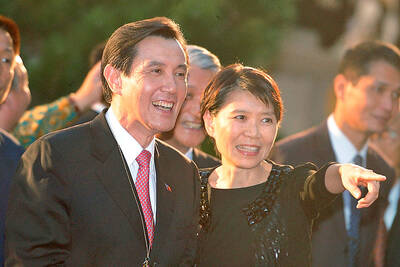
Former president Ma Ying-jeou (馬英九) yesterday expressed “shock and regret” over a statement issued by his wife without his consent, and rejected her assertion that his eldest sister, Ma Yi-nan (馬以南), would manage his medical care or act as his spokesperson amid an ongoing embezzlement probe into his foundation. Ma Ying-jeou in a statement said he was shocked by a statement by his wife, Chou Mei-ching (周美青), regarding his affairs. Ma Yi-nan “must not” be in charge of his healthcare and other personal affairs, nor can she be allowed to represent the Ma family, the former president said. He said he was also


 RSS
RSS