


Plans by three companies to build solid recovered-fuel (SRF) power plants in Taoyuan are back on track, despite objections from locals, after the Ministry of Economic Affairs overruled a municipal government order to cancel the projects.
In a directive issued on Thursday last week, the ministry overturned Taoyuan’s decision in March to revoke permits for the plants because of problems discovered with the companies’ applications, paving the way for Cleanaway Co, Taiwan Cube Energy Co and Li Jiang Development Co to proceed with their plans to build SRF plants in Taoyuan Technology Industrial Park (桃園科技園區) in Guanyin District (觀音).
The ministry issued the order after an appeal by Cleanaway against the city’s decision.
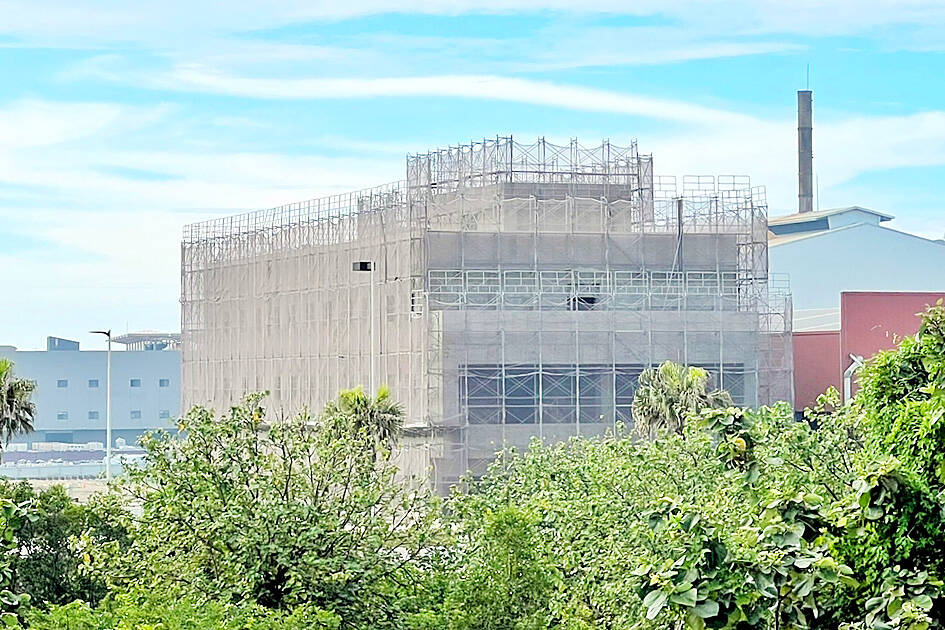
Photo courtesy of a reader via CNA
Taoyuan Mayor Simon Chang (張善政) on Sunday said that the ministry’s decision was regrettable and added that Taoyuan would carefully monitor the steps the companies have to follow to build the plants to protect residents’ health.
The controversy dates to late 2020, when the ministry held meetings to discuss construction of “renewable energy” plants in the park and the requirements companies would have to meet.
Among them was a requirement to set up an SRF plant and receive recommendation letters from the ministry.
The three companies received recommendations between late 2020 and the middle of 2022, and Taoyuan approved their applications within months, with the final one just days before Chang took office in late December 2022.
However, in November last year, about two months before the presidential and legislative elections in January, the ministry rescinded the recommendation letters.
In March, Chang canceled the approvals it had granted on the grounds that without the ministry’s recommendation, the applications to construct the three SRF plants were incomplete.
However, the ministry revoked the city’s decision, saying that the recommendation requirement was merely an advisory and not legally binding.
The city did not provide a legal basis for invalidating its previous permits, the ministry said.
Local leaders and residents were quoted by Chinese-language media as saying that the central government had handled the matter poorly.
Guanyin residents were considering a protest in Taipei against the ministry’s decision, the reports said.
Taoyuan City Councilor Wu Chin-chang (吳進昌) said that the ministry and the previous Taoyuan mayor, Cheng Wen-tsan (鄭文燦), rescinded the recommendation letters ahead of the Jan. 13 elections for fear of losing votes over the issue.
Guanyin already has the gas-fired Datan Power Plant, which Wu said has caused serious pollution.
Three more SRF plants would only worsen the situation, he said.
KMT Legislator Tu Chuan-chi (涂權吉) said that the ministry had flip-flopped on policy due to political motivations, which exposes its lack of credibility.
SRF is produced by shredding and drying commercial waste such as paper, plastics, textiles and wood.
It generates energy from fuel that might otherwise be incinerated or dumped in landfills.
Advocates say SRFs generate fewer emissions than coal when used to produce electricity, while its high-calorific value allows it to be used in cement kilns to generate power in place of coal.
However, it creates pollutants and might disincentivize recycling.

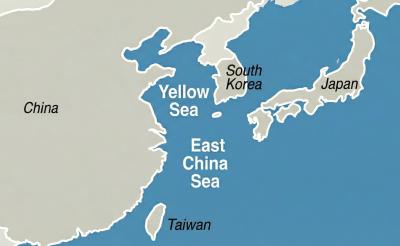
China has reserved offshore airspace in the Yellow Sea and East China Sea from March 27 to May 6, issuing alerts usually used to warn of military exercises, although no such exercises have been announced, the Wall Street Journal (WSJ) reported yesterday. Reserving such a large area for 40 days without explanation is an “unusual step,” as military exercises normally only last a few days, the paper said. These alerts, known as Notice to Air Missions (Notams), “are intended to inform pilots and aviation authorities of temporary airspace hazards or restrictions,” the article said. The airspace reserved in the alert is
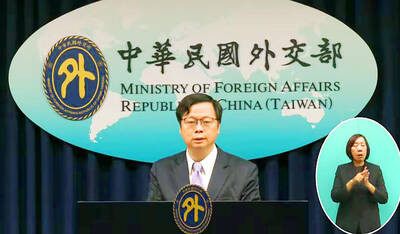
NAMING SPAT: The foreign ministry called on Denmark to propose an acceptable solution to the erroneous nationality used for Taiwanese on residence permits Taiwan has revoked some privileges for Danish diplomatic staff over a Danish permit that lists “Taiwan” as “China,” Eric Huang (黃鈞耀), head of the Ministry of Foreign Affairs’ Department of European Affairs, told a news conference in Taipei yesterday. Reporters asked Huang whether the Danish government had responded to the ministry’s request that it correct the nationality on Danish residence permits of Taiwanese, which has been listed as “China” since 2024. Taiwan’s representative office in Denmark continues to communicate with the Danish government, and the ministry has revoked some privileges previously granted to Danish representatives in Taiwan and would continue to review

More than 6,000 Taiwanese students have participated in exchange programs in China over the past two years, despite the Mainland Affairs Council’s (MAC) “orange light” travel advisory, government records showed. The MAC’s publicly available registry showed that Taiwanese college and university students who went on exchange programs across the Strait numbered 3,592 and 2,966 people respectively. The National Immigration Agency data revealed that 2,296 and 2,551 Chinese students visited Taiwan for study in the same two years. A review of the Web sites of publicly-run universities and colleges showed that Taiwanese higher education institutions continued to recruit students for Chinese educational programs without

A bipartisan group of US senators has introduced a bill to enhance cooperation with Taiwan on drone development and to reduce reliance on supply chains linked to China. The proposed Blue Skies for Taiwan Act of 2026 was introduced by Republican US senators Ted Cruz and John Curtis, and Democratic US senators Jeff Merkley and Andy Kim. The legislation seeks to ease constraints on Taiwan-US cooperation in uncrewed aerial systems (UAS), including dependence on China-sourced components, limited access to capital and regulatory barriers under US export controls, a news release issued by Cruz on Wednesday said. The bill would establish a "Blue UAS


 RSS
RSS