


The Centers for Disease Control (CDC) yesterday advised parents to ask clinics about availability before making an appointment for routine vaccinations, as the agency replaces about 170,000 defective doses of a hepatitis A vaccine.
In late March, the centers received reports that hospitals and clinics had found adhesive residue on some syringes, rubber seals and outer packaging of hepatitis A vaccines, which are part of routine vaccinations for children, CDC Deputy Director-General Tseng Shu-hui (曾淑慧) said.
The CDC reported the situation to the Food and Drug Administration and asked the vaccine company to investigate, Tseng said, adding that the supplier found that the residue resulted from the packaging process and did not affect vaccine quality.
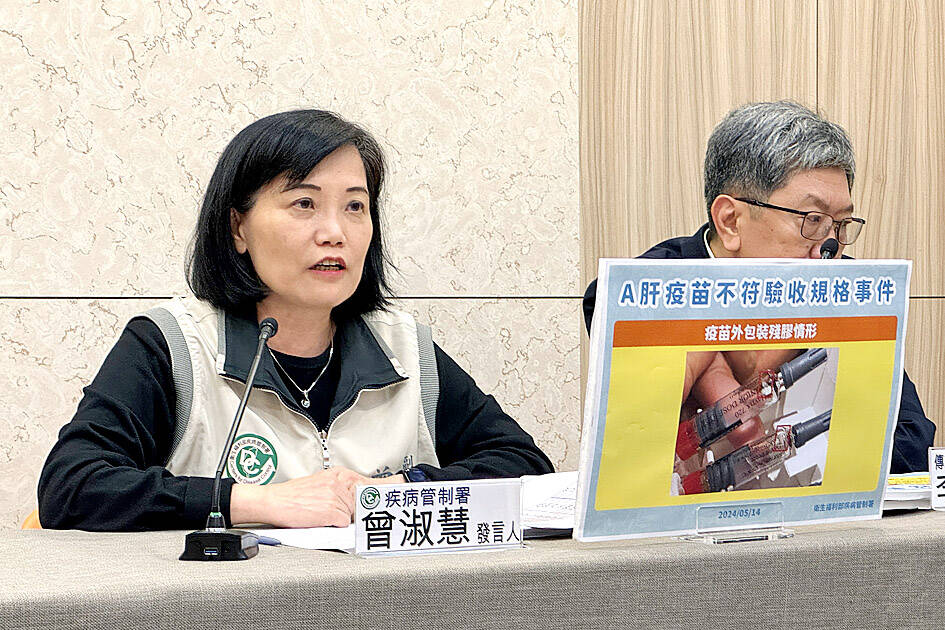
Photo: Chiu Chih-jou, Taipei Times
However, as the products did not meet the standard of the procurement contract, about 170,000 doses have been sealed for return, while the company has promised to change its package design and send new vaccines, she said.
The company plans to send the first batch of replacements at the end of next month.
No one received doses with the adhesive residue, Tseng said.
Supply is expected to return to normal by September, but about 120,000 infants might be affected by the delayed schedule, she said.
Lee Ping-ing (李秉穎), head of the Ministry of Health and Welfare’s Advisory Committee on Immunization Practices, said that infants should get the first dose at 12 to 15 months old, and the second dose at least six months apart.
As the international recommendation is for children to receive the first dose between 12 and 23 months, and the second dose six to 12 months later, children who were originally scheduled to be vaccinated, but cannot do so, can still get vaccinated when the new shots become available, Lee said.
The CDC also advised parents to call their hospital or clinic about hepatitis A vaccine availability before taking their child to get vaccinated.
Lee said the hepatitis A virus is transmitted primarily through contaminated food or water, adding that unvaccinated children and their parents should avoid unboiled water and raw food, and maintain good personal hygiene, especially by washing their hands before handling food or after using the bathroom.
In other news, hospitals reported 17,895 visits for enterovirus infection last week, the highest number for the period in a decade, CDC Epidemic Intelligence Center Director Guo Hung-wei (郭宏偉) said, adding that coxsackie A viruses are still the main circulating viruses.
Enterovirus activity is in the epidemic period and weekly cases continue to rise, Tseng said, adding that the peak is estimated to arrive late this month or early next month.
Last week, 256 classes were suspended due to enterovirus infections, she said.
In addition, Gou said that 246 hospitalized COVID-19 cases were reported last week, slightly higher than the previous week, 69 percent of whom were people aged 65 or older.
One of the cases is a one-year-old boy who was initially suspected of having an enterovirus infection after developing a fever, oral ulcers and blisters on the limbs, CDC physician Lin Yung-ching (林詠青) said.
However, he was rushed to a hospital four days later for convulsions and tested positive for COVID-19, Lin said.
The boy is being treated for COVID-19 and encephalitis in an intensive care unit, and is still suspected to have enterovirus, which he is being tested for, he said.

PRAISE: Japanese visitor Takashi Kubota said the Taiwanese temple architecture images showcased in the AI Art Gallery were the most impressive displays he saw Taiwan does not have an official pavilion at the World Expo in Osaka, Japan, because of its diplomatic predicament, but the government-backed Tech World pavilion is drawing interest with its unique recreations of works by Taiwanese artists. The pavilion features an artificial intelligence (AI)-based art gallery showcasing works of famous Taiwanese artists from the Japanese colonial period using innovative technologies. Among its main simulated displays are Eastern gouache paintings by Chen Chin (陳進), Lin Yu-shan (林玉山) and Kuo Hsueh-hu (郭雪湖), who were the three young Taiwanese painters selected for the East Asian Painting exhibition in 1927. Gouache is a water-based
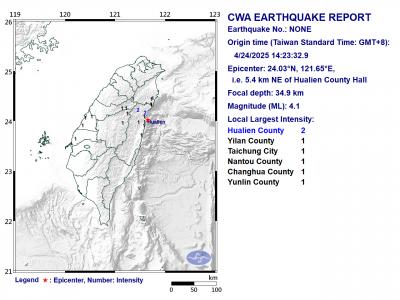
A magnitude 4.1 earthquake struck eastern Taiwan's Hualien County at 2:23pm today, according to the Central Weather Administration (CWA). The epicenter of the temblor was 5.4 kilometers northeast of Hualien County Hall, at a depth of 34.9 km, according to the CWA. The earthquake's intensity, which gauges the actual effect of a temblor, was the highest in Hualien County, where it measured 2 on Taiwan's 7-tier intensity scale. The quake also measured an intensity of 1 in Yilan county, Taichung, Nantou County, Changhua County and Yunlin County, the CWA said. There were no immediate reports of damage or injuries.

OFF-TARGET: More than 30,000 participants were expected to take part in the Games next month, but only 6,550 foreign and 19,400 Taiwanese athletes have registered Taipei city councilors yesterday blasted the organizers of next month’s World Masters Games over sudden timetable and venue changes, which they said have caused thousands of participants to back out of the international sporting event, among other organizational issues. They also cited visa delays and political interference by China as reasons many foreign athletes are requesting refunds for the event, to be held from May 17 to 30. Jointly organized by the Taipei and New Taipei City governments, the games have been rocked by numerous controversies since preparations began in 2020. Taipei City Councilor Lin Yen-feng (林延鳳) said yesterday that new measures by
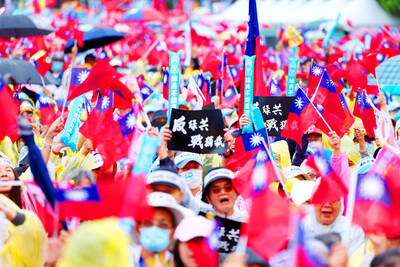
‘WORSE THAN COMMUNISTS’: President William Lai has cracked down on his political enemies and has attempted to exterminate all opposition forces, the chairman said The legislature would motion for a presidential recall after May 20, Chinese Nationalist Party (KMT) Chairman Eric Chu (朱立倫) said yesterday at a protest themed “against green communists and dictatorship” in Taipei. Taiwan is supposed to be a peaceful homeland where people are united, but President William Lai (賴清德) has been polarizing and tearing apart society since his inauguration, Chu said. Lai must show his commitment to his job, otherwise a referendum could be initiated to recall him, he said. Democracy means the rule of the people, not the rule of the Democratic Progressive Party (DPP), but Lai has failed to fulfill his


 RSS
RSS