


On the 20th anniversary of the promulgation of the Gender Equity Education Act (性別平等教育法), Vice President and president-elect William Lai (賴清德) yesterday said creating an environment in which everyone can respect other people’s gender expression, gender identity and sexual orientation is his expectation for a multidiversified Taiwan, and the best way to commemorate “Rose Boy” Yeh Yung-chih (葉永鋕).
On April 20, 2000, Yeh, a senior at Gao Shu Junior High School in Pingtung County, was found lying in a pool of blood on the floor of a school bathroom.
He later died in a hospital.
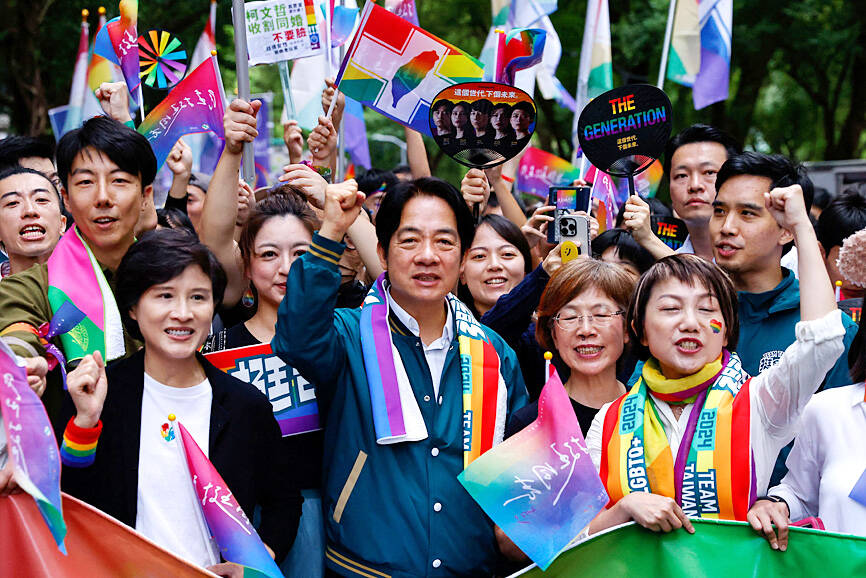
Photo: Ann Wang, Reuters
Yeh reportedly would go to the bathroom during class time instead of during recess to avoid bullying by his classmates over his perceived “effeminate” demeanor.
Yeh’s story inspired a pop song by Jolin Tsai (蔡依林), Womxnly (玫瑰少年, meaning “Rose Boy”) in 2018, which won Song of the Year at the 2019 Golden Melody Awards.
“Have you heard the story of ‘Rose Boy’ Yeh Yung-chih?” Lai wrote on Facebook yesterday, adding that according to Yeh’s mother, Chen Chun-ju (陳君汝), Yeh was an attentive and considerate boy, but was bullied for being “too effeminate.”
To prevent being bullied by schoolmates, he would ask to use the bathroom during class, five minutes before recess, Lai said.
However, on one of those occasions in his senior year of junior-high school, he did not return, Lai wrote.
Yeh’s death brought infinite pain to his family, but also triggered a nationwide discussion on gender equity education, Lai said, adding that the Ministry of Education in 2000 changed its Gender Equality Education Committee to be the Gender Equity Education Committee, and passed the Gender Equity Education Act in 2004.
Yesterday marked the 20th anniversary of the act becoming law and the second Gender Equality Education Day, Lai said.
The government has put a lot of effort into gender equity education in the past few years, hoping to help society — starting with schools — better understand the gender spectrum, he said.
Separately, the Ministry of Education held an opening ceremony for its Gender Equity Education Act 20th Anniversary Exhibition titled “ROOM XX: Everything Stems from a Lavatory” at Huashan 1914 Creative Park in Taipei.
The exhibition, which features the color purple, runs through Sunday next week.
The ceremony was attended by Control Yuan member Fan Sun-lu (范巽綠), Democratic Progressive Party (DPP) Legislator Ariel Chang (張雅琳) and former legislator Yu Mei-nu (尤美女).
Minister of Education Pan Wen-chung (潘文忠) said in a speech that the Gender Equity Education Act has been amended five times in the past two decades, and while it took a long time to get to where it is today, it helps children learn about gender equity while protecting them and expanding the safety net of gender equity to protect children and allow them to grow up safely.
Exhibition curator Lu Ming-Chen (呂明蓁), an assistant professor at National University of Tainan, said that a two-day forum yesterday and today focuses on implementation of the act and its role in school curricula, challenges in education, female leadership and other gender-related discussions.
The discussions would be short, and people who are interested in gender equity issues are welcome to attend, she said.

Considering that most countries issue more than five denominations of banknotes, the central bank has decided to redesign all five denominations, the bank said as it prepares for the first major overhaul of the banknotes in more than 24 years. Central bank Governor Yang Chin-lung (楊金龍) is expected to report to the Legislative Yuan today on the bank’s operations and the redesign’s progress. The bank in a report sent to the legislature ahead of today’s meeting said it had commissioned a survey on the public’s preferences. Survey results showed that NT$100 and NT$1,000 banknotes are the most commonly used, while NT$200 and NT$2,000

The Centers for Disease Control (CDC) yesterday reported the first case of a new COVID-19 subvariant — BA.3.2 — in a 10-year-old Singaporean girl who had a fever upon arrival in Taiwan and tested positive for the disease. The girl left Taiwan on March 20 and the case did not have a direct impact on the local community, it said. The WHO added the BA.3.2 strain to its list of Variants Under Monitoring in December last year, but this was the first imported case of the COVID-19 variant in Taiwan, CDC Deputy Director-General Lin Ming-cheng (林明誠) said. The girl arrived in Taiwan on

South Korea is planning to revise its controversial electronic arrival card, a step Taiwanese officials said prompted them to hold off on planned retaliatory measures, a South Korean media report said yesterday. A Yonhap News Agency report said that the South Korean Ministry of Foreign Affairs is planning to remove the “previous departure place” and “next destination” fields from its e-arrival card system. The plan, reached after interagency consultations, is under review and aims to simplify entry procedures and align the electronic form with the paper version, a South Korean ministry official said. The fields — which appeared only on the electronic form

The Ministry of Foreign Affairs (MOFA) is suspending retaliation measures against South Korea that were set to take effect tomorrow, after Seoul said it is updating its e-arrival system, MOFA said today. The measures were to be a new round of retaliation after Taiwan on March 1 changed South Korea's designation on government-issued alien resident certificates held by South Korean nationals to "South Korea” from the "Republic of Korea," the country’s official name. The move came after months of protests to Seoul over its listing of Taiwan as "China (Taiwan)" in dropdown menus on its new online immigration entry system. MOFA last week


 RSS
RSS