

The Ministry of Foreign Affairs plans to send delegations to member states of the Comprehensive and Progressive Agreement for Trans-Pacific Partnership (CPTPP) later this year to solicit support for Taiwan’s accession to the bloc, the ministry said yesterday.
The focus of this year’s bid would be bolstering cooperation with the supply chain in Canada, this year’s chair of the CPTPP, Department of International Cooperation and Economic Affairs Director-General Vivian Lien (連玉蘋) told a regular news briefing.
Earlier this month, Canadian think tank the Institute for Peace and Diplomacy invited Deputy Minister of Foreign Affairs Kelly Hsieh (謝武樵) to address the Canada-Taiwan Forum on Economic Security, Lien said.
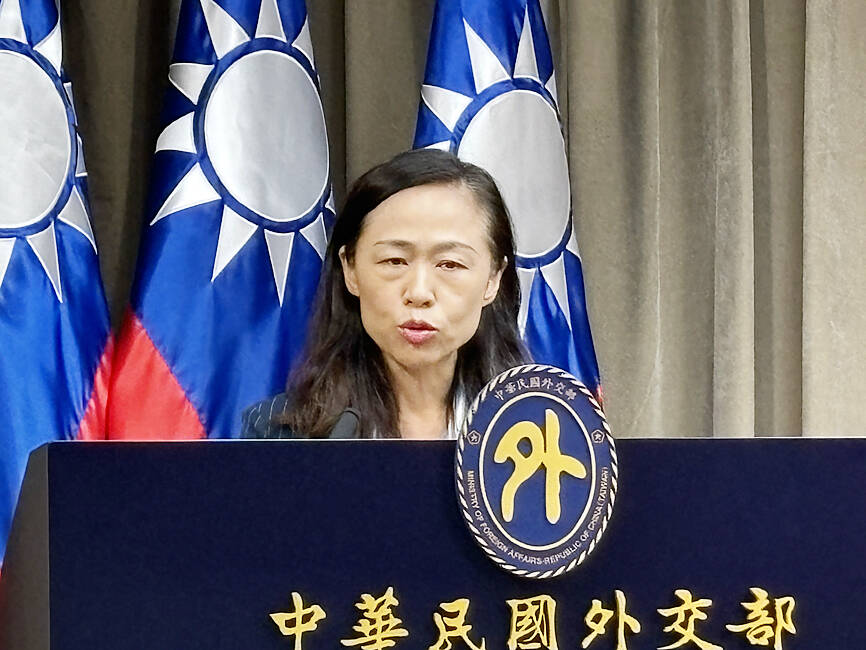
Photo: Yang Yao-ju, Taipei Times
At the forum, several Canadian experts voiced their support for Taiwan’s inclusion in the CPTPP, including Asia Pacific Foundation of Canada president and CEO Jeff Nankivell, the Taipei Economic and Cultural Office in Canada said.
Next month, Taiwan is to hold a seminar with a Canadian think tank on Taiwan-Canada industrial cooperation on clean fuel, renewable energy, and talent cultivation and innovation, working toward creating a mutually beneficial supply chain, Lien said.
Taiwan’s participation in the CPTPP would help enhance the supply chain resilience of CPTPP members as well as ensure regional and global economic security, she said.
Last year, then-CPTPP chair New Zealand articulated the Auckland Principles to govern accession — aspirant members should meet the high standards of the partnership, uphold their commitments of past trade agreements and be likely to obtain a consensus of CPTPP members.
It is hoped that a working group would be formally launched to manage Taiwan’s bid to join the CPTPP, Lien said, adding that until then, the nation is to continue conducting informal consultations with the pact’s members.
Taiwan would also strive to deepen industrial and academic exchanges and cooperation by working with chambers of commerce, think tanks and academic institutions, she said.
All member states recognize Taiwan as an economy that meets high standards, with Japan and the UK publicly expressing their support for Taiwan’s inclusion in the pact, while other members have stated that they welcome new members that meet the entry criteria, she said.
Taiwan is among the six nations that have submitted a request to join the CPTPP, including China.
Addressing the bids of Taipei and Beijing would be Canada’s responsibility and challenge this year, a report published by the Asia Pacific Foundation of Canada said.
While China’s bid might be opposed by members due to its coercive behavior toward Taiwan and “serious shortcomings in its economic readiness,” some might feel reluctant to accept Taiwan without China “to prevent the impression of choosing favorites,” it said.
The report suggested establishing a “strategic partnership” status, a provisional membership, and ensuring it is granted to Taiwan and China at the same time, while outlining “the specific steps each would need to take to achieve full accession,” it said.
Hsieh said in the forum that the applications of Taiwan and China should be processed independently, adding that Taiwan “has prepared ourselves to meet all the high standards of the CPTPP.”

Starbucks Taiwan’s decision to charge for drink customization, which had been free, has sparked consumer backlash, highlighting the challenge of raising prices without making customers feel they are losing value, experts said. Since Oct. 12, customers who order drinks with less or no ice and ask to have the volume topped up with milk or other liquid have been charged an additional NT$15. Topping off drinks without ice was previously free, and disgruntled customers posted photos on social media showing that iced drinks ordered without ice were only half full if the extra NT$15 was not paid. The posts drew tens of thousands
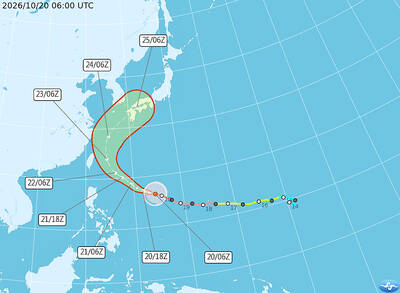
A sea warning for Typhoon Champi might be issued tonight, while the storm’s trajectory would determine whether a land warning is to be issued tomorrow night, the Central Weather Administration (CWA) said yesterday. As of 2pm yesterday, Champi was about 1,536km east-southeast of Taiwan proper’s southernmost point, Oluanpi (鵝鑾鼻), packing maximum sustained winds of 198kph, CWA forecaster Tseng Chao-cheng (曾昭誠) said. The storm was moving west-northwest at 23kph and was expected to strengthen over the next 24 hours before weakening slightly as it approaches cooler waters east of Taiwan, Tseng said. Champi is expected to turn north tomorrow, with the angle of the
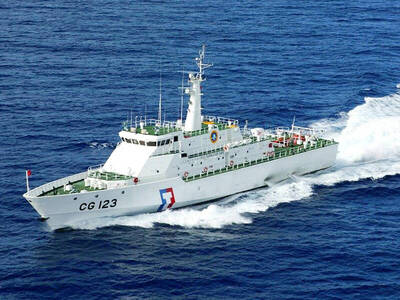
A patrol vessel donated by the Coast Guard Administration (CGA) to the Philippines would not be used in waters near Taiwan or areas where Taiwanese fishing vessels operate, Premier Cho Jung-tai (卓榮泰) said yesterday. The vessel, formerly the CGA's 500-tonne-class Kinmen (金門), was commissioned into the Philippine Coast Guard on Oct. 2. Speaking at the Legislative Yuan, Cho said the Philippines had pledged during the donation process that the vessel would be used only for designated missions and would not operate in waters related to Taiwan. The vessel could even provide assistance to Taiwan if needed, he added. Responding to questions from Chinese
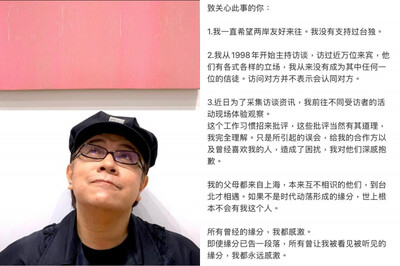
EXPLANATION: Tsai said he attended events featuring various interviewees to observe them firsthand as part of his interview research Television host Kevin Tsai (蔡康永) last night broke his silence over a controversy surrounding his appearance at a campaign event for Democratic Progressive Party Taipei mayoral candidate Puma Shen (沈伯洋), saying he had never supported Taiwan independence. “I have always hoped for friendly cross-strait relations. I have never supported Taiwan independence,” Tsai wrote in a post on the Chinese social media platform Sina Weibo. Tsai, who has hosted television shows in China, attended the opening of Shen’s campaign headquarters on Oct. 4, drawing criticism from Chinese social media users and prompting some Chinese companies to distance themselves from him. China’s Taiwan Affairs Office


 RSS
RSS