


Taiwan’s first conscripts since one-year compulsory military service was reinstated have begun their final evaluations to gauge their competency at the end of their eight weeks of orientation, the army said.
About 200 of the 655 conscripts in the army’s 2,226th conscription cohort on Monday completed their marksmanship evaluation with a pass rate of 95 percent, the 302nd Infantry Brigade was quoted as saying by the state-run Military News Agency.
The brigade, one of the two units stationed at the army’s boot camp in Taichung’s Chenggong Ling (成功嶺) military training camp, said that conscripts who successfully completed the evaluation with a score equal to or higher than the standard would qualify for a recurring NT$10,000 monthly bonus.
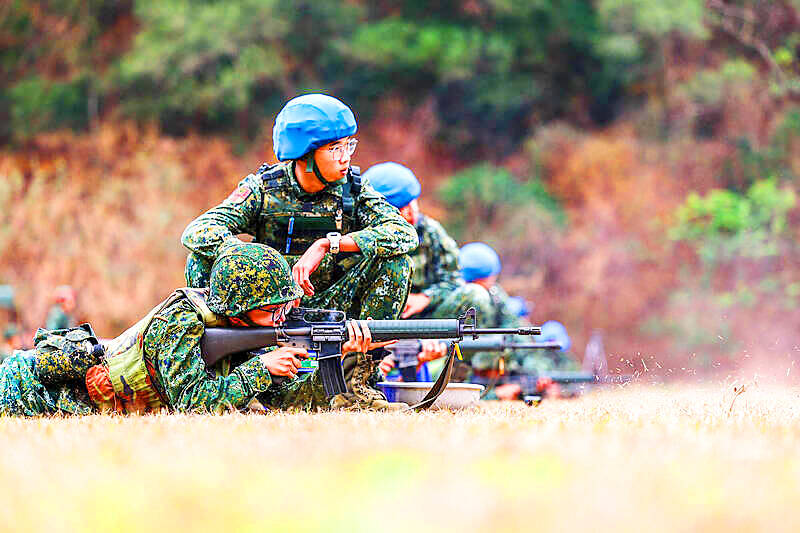
Photo courtesy of the Military News Agency
The five-day evaluation, which is being conducted this week, consists of a marksmanship test, a fitness test and three days of continuous combat drills, it said.
Conscripts who fail would take the test again next week, and those who fail again would receive remedial training, the brigade said.
Marksmanship accounts for 20 percent of a draftee’s grade, more than other evaluation criteria, it said.
The 90-second marksmanship test includes shooting at a target 175m away in an unsupported prone position with a T65K2 service rifle and 18 rounds of ammunition, the brigade said.
Participants need to reload three magazines and handle any malfunction that might occur, it said, adding that the test is structured to examine the draftee’s proficiency, accuracy and performance under pressure.
Taiwan last year restored one-year compulsory military service by presidential decree, requiring men aged 18 to 36 who are not students to serve after receiving eight weeks of training.
The policy change, which came amid increased hostility from Beijing, marked a shift from decades of planning to transform the military into an all-volunteer force.
In other news, Minister of the Directorate-General of Budget, Accounting and Statistics Chu Tzer-ming (朱澤民) yesterday told lawmakers that president-elect William Lai’s (賴清德) plan to build seven submarines all at once is fiscally viable.
Construction of the nation’s first domestically made submarine, the Hai Kun (海鯤), or “Narwhal,” was completed last year.
Chu made the comment after Chinese Nationalist Party (KMT) Legislator Wang Hung-wei (王鴻薇) asked about the plan during a question-and-answer session at the Legislative Yuan.
Lai’s proposal would be a departure from President Tsai Ing-wen’s (蔡英文) plan to build subs in batches of two to three units, which presumably was made to match Taiwan’s industrial and fiscal capabilities, Wang said.
The Hai Kun has not yet been put into operation, she said, adding that allowing more time to check for issues and collect funds would be a more prudent course of action.
Chu said there is “little difference” between building the submarines in one production run or several, and that Lai’s proposal would result in “only a slight increase” to the nation’s fiscal burden.
The changes in the timetable for submarine production would likely require the legislature to pass a special appropriations bill, he said.
Additional reporting by Chen Cheng-yu

PRAISE: Japanese visitor Takashi Kubota said the Taiwanese temple architecture images showcased in the AI Art Gallery were the most impressive displays he saw Taiwan does not have an official pavilion at the World Expo in Osaka, Japan, because of its diplomatic predicament, but the government-backed Tech World pavilion is drawing interest with its unique recreations of works by Taiwanese artists. The pavilion features an artificial intelligence (AI)-based art gallery showcasing works of famous Taiwanese artists from the Japanese colonial period using innovative technologies. Among its main simulated displays are Eastern gouache paintings by Chen Chin (陳進), Lin Yu-shan (林玉山) and Kuo Hsueh-hu (郭雪湖), who were the three young Taiwanese painters selected for the East Asian Painting exhibition in 1927. Gouache is a water-based
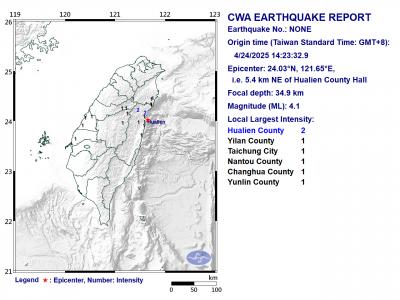
A magnitude 4.1 earthquake struck eastern Taiwan's Hualien County at 2:23pm today, according to the Central Weather Administration (CWA). The epicenter of the temblor was 5.4 kilometers northeast of Hualien County Hall, at a depth of 34.9 km, according to the CWA. The earthquake's intensity, which gauges the actual effect of a temblor, was the highest in Hualien County, where it measured 2 on Taiwan's 7-tier intensity scale. The quake also measured an intensity of 1 in Yilan county, Taichung, Nantou County, Changhua County and Yunlin County, the CWA said. There were no immediate reports of damage or injuries.

OFF-TARGET: More than 30,000 participants were expected to take part in the Games next month, but only 6,550 foreign and 19,400 Taiwanese athletes have registered Taipei city councilors yesterday blasted the organizers of next month’s World Masters Games over sudden timetable and venue changes, which they said have caused thousands of participants to back out of the international sporting event, among other organizational issues. They also cited visa delays and political interference by China as reasons many foreign athletes are requesting refunds for the event, to be held from May 17 to 30. Jointly organized by the Taipei and New Taipei City governments, the games have been rocked by numerous controversies since preparations began in 2020. Taipei City Councilor Lin Yen-feng (林延鳳) said yesterday that new measures by
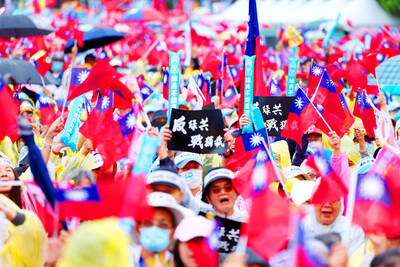
‘WORSE THAN COMMUNISTS’: President William Lai has cracked down on his political enemies and has attempted to exterminate all opposition forces, the chairman said The legislature would motion for a presidential recall after May 20, Chinese Nationalist Party (KMT) Chairman Eric Chu (朱立倫) said yesterday at a protest themed “against green communists and dictatorship” in Taipei. Taiwan is supposed to be a peaceful homeland where people are united, but President William Lai (賴清德) has been polarizing and tearing apart society since his inauguration, Chu said. Lai must show his commitment to his job, otherwise a referendum could be initiated to recall him, he said. Democracy means the rule of the people, not the rule of the Democratic Progressive Party (DPP), but Lai has failed to fulfill his


 RSS
RSS