


Vice Premier Cheng Wen-tsan (鄭文燦) on Friday said the Ministry of Health and Welfare (MOHW) should complete its inspection and testing of ingredients and food products containing Sudan III, an industrial dye banned in food in Taiwan, in a week and tainted products should be removed from shelves by the end of the month.
Since a food company in Yunlin County was reported to have used chili powder containing the potential carcinogenic Sudan III in late January, 22 batches of imported chili pepper — 21 batches from China and one from Vietnam — have been found to contain the dye and dozens of food products have been removed from shelves as of Thursday.
After an interministerial meeting on Friday, Cheng said he has asked the MOHW to complete its inspection and testing on the batches of identified food products that have used Sudan III-tainted ingredients within a week.
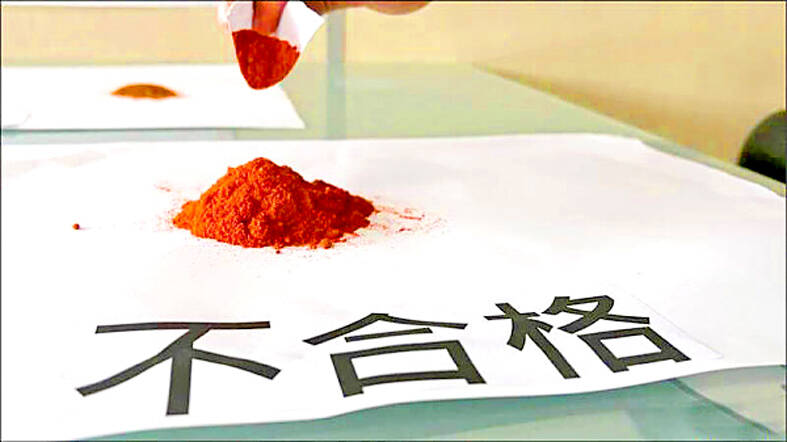
Photo: Chang Tsung-chiu, Taipei Times
The products that are found to contain the dye should be removed from shelves by the end of the month, Cheng added.
The Cabinet in a news release said the meeting concluded that following the Food and Drug Administration’s (FDA) publicizing the tainted batches of chili powder on its Web site, it would request local governments to supervise food companies and restaurants known to have used the chili powder to test their food products and report the results.
Local governments are also asked to not only remove the tainted chili powder, but also food products that have used the illegal powder, it said.
The Ministry of Education has requested local governments to order schools to suspend the use of chili pepper and curry powder in school lunches, and it would respect local governments’ ban on other related items, it said.
The Cabinet said it has requested the MOHW to establish a more effective real-time food-safety case reporting and sharing mechanism to update local health departments accurately so that they can respond promptly.
It also requested the MOHW to expand testing capacity by increasing the number of facilities and workforce.
Cheng expressed gratitude to the Ministry of Justice for initiating a communication platform to coordinate the crackdown on criminal activities related to food safety.
Minister of Justice Tsai Ching-hsiang (蔡清祥) on Friday said he instructed the High Prosecutors’ Office to request all district prosecutors’ offices to adopt stricter principles in investigating relevant cases and asked the Administrative Enforcement Agency to work closely with local health departments so that fines are collected promptly.
Separately, the Tainan City Government yesterday said it would launch a “Sudan III-free label” for import companies to place on products that have passed batch-by-batch border inspections so that restaurants and retailers can use a sign stating: “This store does not use Sudan III-tainted spices.”
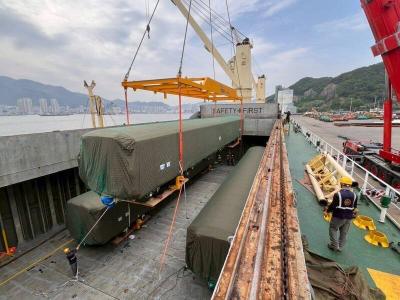
The first of 10 new high-capacity trains purchased from South Korea’s Hyundai Rotem arrived at the Port of Taipei yesterday to meet the demands of an expanding metro network, Taipei Rapid Transit Corp (TRTC) said yesterday. The train completed a three-day, 1,200km voyage from the Port of Masan in South Korea, the company said. Costing NT$590 million (US$18.79 million) each, the new six-carriage trains feature a redesigned interior based on "human-centric" transportation concepts, TRTC said. The design utilizes continuous longitudinal seating to widen the aisles and optimize passenger flow, while also upgrading passenger information displays and driving control systems for a more comfortable
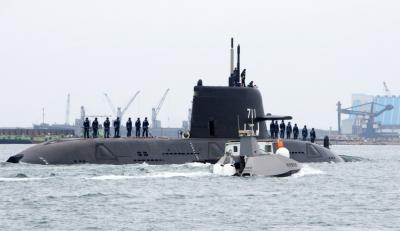
Taiwan's first indigenous defense submarine, the SS-711 Hai Kun (海鯤, or Narwhal), departed for its 13th sea trial at 7am today, marking its seventh submerged test, with delivery to the navy scheduled for July. The outing also marked its first sea deployment since President William Lai (賴清德) boarded the submarine for an inspection on March 19, drawing a crowd of military enthusiasts who gathered to show support. The submarine this morning departed port accompanied by CSBC Corp’s Endeavor Manta (奮進魔鬼魚號) uncrewed surface vessel and a navy M109 assault boat. Amid public interest in key milestones such as torpedo-launching operations and overnight submerged trials,
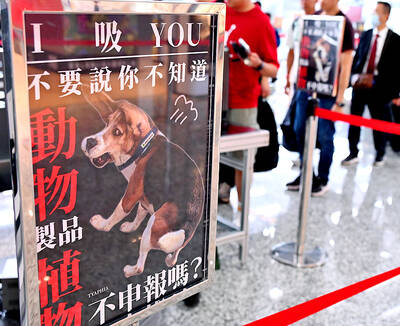
Quarantine awareness posters at Taiwan Taoyuan International Airport have gone viral for their use of wordplay. Issued by the airport branch of the Animal and Plant Health Inspection Agency, the posters feature sniffer dogs making a range of facial expressions, paired with advisory messages built around homophones. “We update the messages for holidays and campaign needs, periodically refreshing materials to attract people’s attention,” quarantine officials said. “The aim is to use the dogs’ appeal to draw focus to quarantine regulations.” A Japanese traveler visiting Taiwan has posted a photo on X of a poster showing a quarantine dog with a
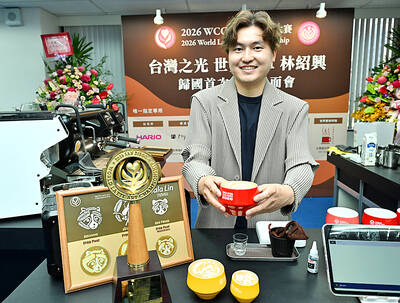
Taiwan’s coffee community has launched a “one-person-one-e-mail” campaign, calling for people to send a protest-e-mail to the World Coffee Championships (WCC) urging it to redesignate Taiwanese competitors as from “Taiwan,” rather than “Chinese Taipei.” The call followed sudden action last week after the WCC changed all references to Taiwanese competitors from “Taiwan” to “Chinese Taipei,” including recent World Latte Art champion Bala (林紹興), who won the World Latte Art Championship in San Diego earlier this month. When Bala received the trophy, he was referred to as representing Taiwan, as well as in the announcement on the WCC’s Web site, until it


 RSS
RSS