


The ubiquitous nature of online messaging has made handwritten letters all but disappear, and the number of stamp collectors has more than halved over the past decade, Chunghwa Post said.
Ten years ago there were 31,000 long-term subscribers to Chunghwa Post’s stamp-collecting program, but today there are only 15,000 subscribers, the company said.
“In the past, there were not so many recreational activities for young people, and stamp collecting was considered a fun way to make friends,” Chunghwa Post Philately Division head Cheng Li-hua (鄭麗華) said. “Nowadays, everyone has a smartphone and there are video games and other forms of entertainment.”
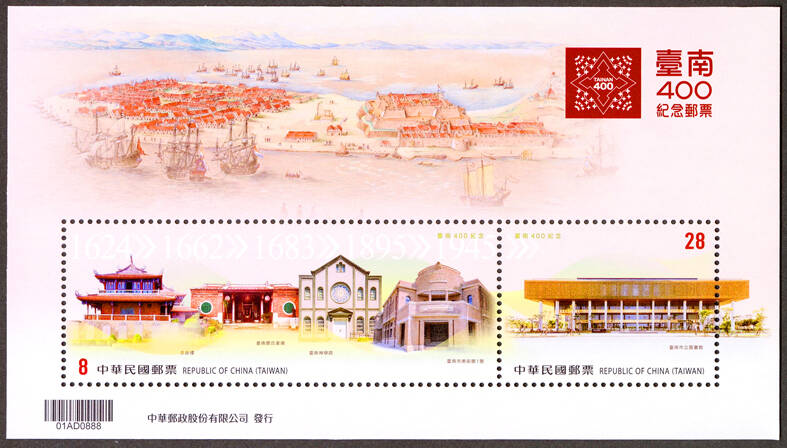
Photo courtesy of Chunghwa Post
Describing stamps as “the nation’s business card,” Cheng said Chunghwa Post hopes to find innovative ways to make young people interested in stamp collecting again.
The company sends stamps to subscribers every time it issues new editions, and sends color test stamps and cards to subscribers every Lunar New Year, she added.
Cheng said that stamp collecting could be introduced to elementary-school students as a fun extracurricular activity, and the company could send its printed stamp-collectors’ newspaper, Oriental Stamp News (東方郵報), to classrooms for students’ reference.
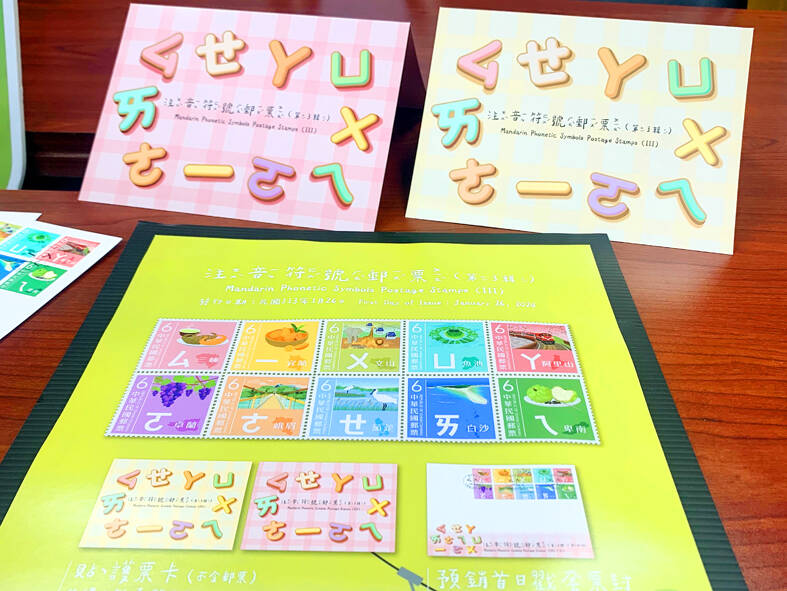
Photo courtesy of Chunghwa Post
Teachers could also be provided with courses on stamp collecting during summer vacations, and local stamp-collecting experts could be invited to speak in classrooms, she said.
Stamps are divided into three categories: those commonly used as postage; commemorative stamps used to mark special events; and special themed stamps, she said.
“Before the 1970s, the Republic of China [ROC] commonly issued stamps featuring the national flag, the head of state, National Palace Museum and Taiwan’s abundant fruits,” she said. “The main reason for using these images was that, in the early days, authorities wanted to promote the country through stamps.”
Sending letters with those stamps to other countries allowed people elsewhere to become familiarized with Taiwan and its president, and the ROC flag, she said.
“Later, the themes of Taiwan’s stamps gradually diversified to include things like Taiwan’s indigenous animals and local festivals,” she added.
Other ideas that the postal company was exploring to make stamps interesting for young people include making themed stamps with cartoon characters by local artists or international companies such as Peanuts and Sanrio, Chunghwa Post secretary-general Yang Su-chu (楊素珠) said.
Stamp-collecting enthusiast Hsu Yao-fang (許耀方) is more optimistic about the future.
Hsu said that despite decreased interest, stamp collecting was still profitable.
Younger people are less interested in stamp collecting than before, but there are still many older collectors, he said.
However, with the Internet making information on stamps more transparent, profits for trading stamps has decreased, and the business might not be sustainable in the long term, he said.
“In the 1990s there was massive speculation on stamp prices, and many people collected stamps as a form of investment,” a collector surnamed Yang (楊) said. “If someone bought stamps in the 1970s and 1980s and sold them in the 1990s, they would probably have made a fortune.”
However, following the growing interest in stamps at the time and the large circulation volume of stamps issued by Chunghwa Post, the market subsequently collapsed, he said, adding that only a few stamps issued since the 1990s have experienced value increases.
One avid collector named Hsiao Shih-cheng (蕭士誠) recalled once traveling the world to look for stamps related to dentistry, and said that many younger collectors today in Taiwan, Japan and South Korea — where stamp collecting was once hugely popular — do not stick with the hobby for very long.
“It will only be old people collecting stamps in the future, but as long as the post office continues to issue stamps, there will always be people who collect them,” he said. “People who are keen on collecting stamps do not think of it as an investment, but rather as a pastime with a goal. If you get into it as an investment, you will not stick with it.”

Considering that most countries issue more than five denominations of banknotes, the central bank has decided to redesign all five denominations, the bank said as it prepares for the first major overhaul of the banknotes in more than 24 years. Central bank Governor Yang Chin-lung (楊金龍) is expected to report to the Legislative Yuan today on the bank’s operations and the redesign’s progress. The bank in a report sent to the legislature ahead of today’s meeting said it had commissioned a survey on the public’s preferences. Survey results showed that NT$100 and NT$1,000 banknotes are the most commonly used, while NT$200 and NT$2,000

The Centers for Disease Control (CDC) yesterday reported the first case of a new COVID-19 subvariant — BA.3.2 — in a 10-year-old Singaporean girl who had a fever upon arrival in Taiwan and tested positive for the disease. The girl left Taiwan on March 20 and the case did not have a direct impact on the local community, it said. The WHO added the BA.3.2 strain to its list of Variants Under Monitoring in December last year, but this was the first imported case of the COVID-19 variant in Taiwan, CDC Deputy Director-General Lin Ming-cheng (林明誠) said. The girl arrived in Taiwan on

South Korea is planning to revise its controversial electronic arrival card, a step Taiwanese officials said prompted them to hold off on planned retaliatory measures, a South Korean media report said yesterday. A Yonhap News Agency report said that the South Korean Ministry of Foreign Affairs is planning to remove the “previous departure place” and “next destination” fields from its e-arrival card system. The plan, reached after interagency consultations, is under review and aims to simplify entry procedures and align the electronic form with the paper version, a South Korean ministry official said. The fields — which appeared only on the electronic form

The Ministry of Foreign Affairs (MOFA) is suspending retaliation measures against South Korea that were set to take effect tomorrow, after Seoul said it is updating its e-arrival system, MOFA said today. The measures were to be a new round of retaliation after Taiwan on March 1 changed South Korea's designation on government-issued alien resident certificates held by South Korean nationals to "South Korea” from the "Republic of Korea," the country’s official name. The move came after months of protests to Seoul over its listing of Taiwan as "China (Taiwan)" in dropdown menus on its new online immigration entry system. MOFA last week


 RSS
RSS