


Taiwan-France and Taiwan-Poland inter-parliamentary amity associations were established yesterday to bolster ties between Taiwanese lawmakers and their counterparts in the two European countries.
The joint launch ceremony was attended by Democratic Progressive Party Legislator Michelle Lin (林楚茵), who was elected chairwoman of the two associations, Deputy Minister of Foreign Affairs Kelly Wu (謝武樵), Polish Office in Taipei Director Cyryl Jacek Kozaczewski, French Office in Taipei Director Franck Paris and other lawmakers.
“The amity associations are the first two set up by the new legislature. The exchanges among lawmakers, as well in the private sector, will allow the world to see Taiwan. It is our hope that we can build on the foundation of the past in this new legislature,” Lin said. “The policy of Taiwan standing on the side of the free world is not going to change.”
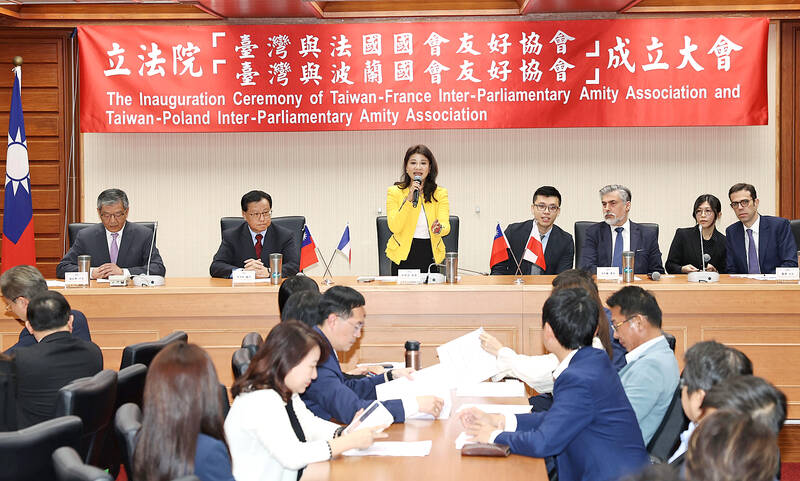
Photo: CNA
Representative to France Francois Wu (吳志中) said in a prerecorded speech that the French parliament’s support for Taiwan has been “unprecedented.”
There are now 57 members in the France-Taiwan Parliamentary Friendship Group, the second-largest friendship group that the French Senate has with a parliament in Asia, Wu said.
In 2021, the French parliament unanimously passed a resolution to support Taiwan’s meaningful participation in the international community, Wu said.
Last year, the French parliament also defended freedom of navigation in the Taiwan Strait by passing the Military Programming Law, he said, adding that it recently criticized China for unilaterally changing the M503 flight route.
Paris said the world was deeply impressed by Taiwan’s elections last month, and that it is of the utmost importance that Taiwan presents a positive image to the international community.
“Taiwan and France must work together to continue democratic values. French parliamentary members and Taiwanese legislators should visit each other so Taiwan’s experiences and values can be shared,” Paris said.
France and Poland are like-minded democratic allies and important trade partners to Taiwan, Hsieh said, adding that Taiwan should continue to deepen ties with both countries in technology and innovation.
Taiwan’s donation of masks to Poland and Poland’s donation of COVID-19 vaccines served as an example of well-established parliamentary diplomacy, and similar exchanges would occur with other European nations, Hsieh said.
Kozaczewski said partnerships among different parliaments are particularly crucial at this difficult time.
“Poland continues to assist and accommodate Ukrainians who fled the Russia-Ukraine war. We thank Taiwan [for its] support in the humanitarian efforts, and hope that Taiwan and Poland bolster partnerships in trade and the semiconductor industry,” Kozaczewski said.
DPP legislators Jean Kuo (郭昱晴), Rosalia Wu (吳思瑤) and Chen Kuan-ting (陳冠廷) were elected as deputy chairs of Taiwan-France Inter-parliamentary Amity Association, while World Taiwanese Chambers of Commerce president Huang Hsing-te (黃行德) is to serve as the association’s honorary consultant.
DPP legislators Huang Jie (黃捷), Hsu Chih-chieh (許智傑) and Hung Sun-han (洪申翰) are to serve as deputy chairs of the Taiwan-Poland Inter-parliamentary Amity Association, while former DPP legislator Lin Ching-yi (林靜儀) is to be the association’s honorary chairwoman.

Fast food chain McDonald's is to raise prices by up to NT$5 on some products at its restaurants across Taiwan, starting on Wednesday next week, the company announced today. The prices of all extra value meals and sharing boxes are to increase by NT$5, while breakfast combos and creamy corn soup would go up by NT$3, the company said in a statement. The price of the main items of those meals, if ordered individually, would remain the same. Meanwhile, the price of a medium-sized lemon iced tea and hot cappuccino would rise by NT$3, extra dipping sauces for chicken nuggets would go up

Yangmingshan National Park’s Qingtiangang (擎天崗) nature area has gone viral after a park livestream camera observed a couple in the throes of intimate congress, which was broadcast live on YouTube, drawing large late-night crowds and sparking a backlash over noise, bright lights and disruption to wildlife habitat. The area’s livestream footage appeared to show a couple engaging in sexual activity on a picnic table in the park on Friday last week, with the uncensored footage streamed publicly online. The footage quickly spread across social media, prompting a tide of visitors to travel to the site to “check in” and recreate the

Carrefour Taiwan is to begin using a new name from the start of July, but it cannot divulge the name until then, the chairman of the supermarket chain's parent company said today. President Chain Store Co chairman Lo Chih-hsien (羅智先) was asked by reporters after a shareholders' meeting to confirm whether the company has settled on a new name for the supermarket brand. In March, the government-registered name of two Carrefour Taiwan branches was quietly changed to "Le Chia Kang" (樂家康) in Chinese, raising speculation that has been selected as the name. Lo said that because of local regulations and contractual obligations, the

GROUNDED: A KMT lawmaker proposed eliminating drone development programs and freezing funding for counterdrone systems, despite China’s adoption of the technology China has deployed attack drones at air bases near the Taiwan Strait in a strategy aimed at overwhelming Taiwan’s air defense systems through saturation attacks, the Mainland Affairs Council (MAC) said. The council’s latest quarterly report on China said that satellite imagery and open-source intelligence indicate that the Chinese People’s Liberation Army (PLA) had converted retired J-6 fighter jets into J-6W drones, which the PLA has stationed at six air bases near Taiwan, five in China’s Fujian Province and one in Guangdong Province. The report cited J. Michael Dahm, a senior fellow at the US-based Mitchell Institute, as saying that China has


 RSS
RSS