


A record eight Chinese balloons were detected around Taiwan on Friday, with two flying directly over the nation, the Ministry of National Defense (MND) said yesterday.
The balloons were spotted on Lunar New Year’s Eve at altitudes of 4,572m to 11,582m, it said.
The first one was seen on Friday morning and the last one early in the evening, the ministry said in its daily report on Chinese military activities.
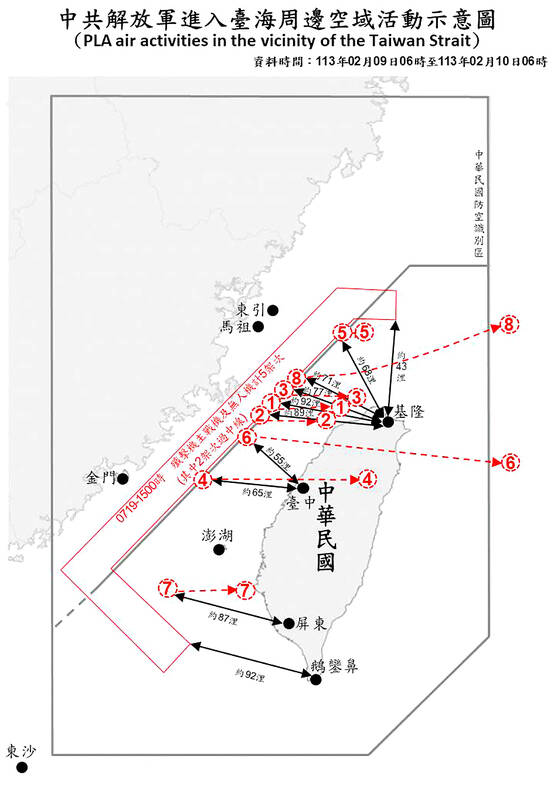
Photo courtesy of the Ministry of National Defense
Two crossed the northern part of Taiwan, a map provided by the ministry showed. The others approached the coast before vanishing, although one flew over the sea to the north of Taiwan.
The Chinese government has repeatedly brushed off Taiwanese concerns about the balloons, saying they are weather balloons and should not be hyped up for political reasons.
The potential for China to use balloons for spying became a global issue in February last year when the US shot down what it said was a Chinese surveillance balloon.
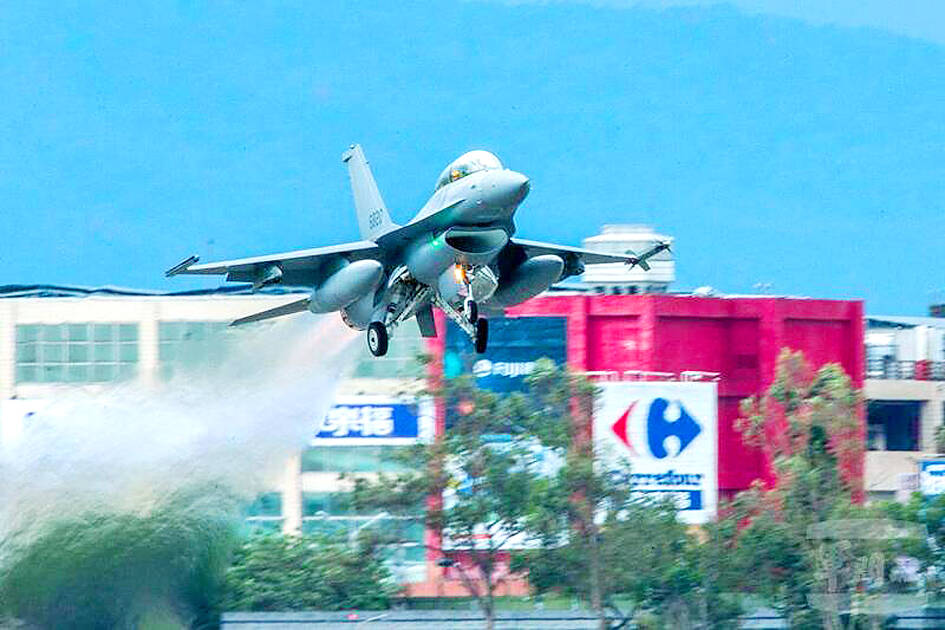
Photo courtesy of the Military News Agency
Beijing said the balloon was a civilian aircraft that accidentally drifted astray.
China has ramped up military pressure against Taiwan in recent years, deploying warplanes and naval vessels on a nearly daily basis.
Since the presidential and legislative elections on Jan. 13, the largest Chinese incursions included 33 Chinese warplanes detected around Taiwan.
The largest number of warplanes China has sent during a 24-hour window came in September last year, when Taiwan recorded 103 Chinese aircraft around the nation.
Despite the Lunar New Year holiday, Taiwan’s air force remains on high alert, and its fighter jets and anti-air missiles are ready for deployment at a moment’s notice to defend the nation, the state-run Military News Agency said in a report yesterday.
The report highlighted the role of the defensive wing of fighters assigned to Penghu, known as taskforce Tian Jyu (天駒), or “Sky Stallion.”
The task force is on round-the-clock alert to scramble fighter jets and intercept foreign incursions, the report said.
The task force must be combat-ready when it takes off from Penghu, a First Tactical Fighter Wing major surnamed Wu (吳) was quoted as saying.
“Every second counts for the air force,” he said.
The distance from Magong Air Force Base to the median line of the Taiwan Strait is very short, putting pilots under tremendous pressure as they have very little time to prepare when needed, Wu said.
Still, the pilots are trained to handle such situations and are ready to deal with all types of harassment tactics, enabling them to keep calm and observe procedure and protocol when intercepting jets from the Chinese People’s Liberation Army Air Force, Wu said.
The median line serves as an unofficial barrier between Taiwan and China which Chinese planes now regularly fly over.
The units operating the anti-air batteries are also on alert throughout the Lunar New Year holiday, Wu said, adding that these units have been drilled and know where to go and prime the Tien Kung (天弓), or “Sky Bow,” anti-air missiles for possible launch.
The anti-air missile unit’s deputy commander, a Technical Sergeant surnamed Chang (張), said he had witnessed many challenges during his time with the military and has come to understand that serving in the military involves sacrifice.
The anti-air units carry out regular training and maintenance and are on the alert for any possible situation, he said.
He also thanked his family for their understanding and support, as “there are no holidays for the anti-air units.”
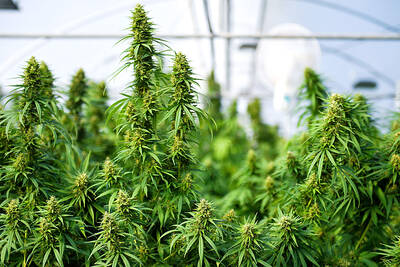
REASONS FOR TRAVEL: An assistant professor said that proposed amendments to penalize drivers if they used drugs overseas would not deter people from traveling People who operate a motor vehicle under the influence of marijuana would have their driver’s license revoked, even if they used the substance while overseas, the Ministry of Transportation and Communications said yesterday, citing proposed amendments to the Road Traffic Management and Penalty Act (道路交通管理處罰條例). The amendments would also authorize the government to revoke the licenses of people determined to have used Category 1 or Category 2 narcotics, even if they were not operating a vehicle while under the influence of drugs, as well as ban them from taking the license test for three years, the ministry said. People aged 18 or

GLOBALGIVING: ‘ Caving to external pressure is not acceptable for an organization that has cultivated justice reform and human rights for 30 years,’ one NGO said A slew of non-government organizations (NGOs) have withdrawn from the GlobalGiving fundraising platform after it announced it would use “Chinese Taipei” instead of “Taiwan” from next month. The Taiwan Good Rice Association wrote on Facebook on Friday that it was informed on April 28 via a teleconference call of the change, which was made because the platform wanted to operate in China. Taiwan Good Rice is to terminate all cooperative relationships with GlobalGiving in response to the platform’s “unilateral and non-negotiable” decision to remove references to Taiwan, the NGO said. “Taiwan is in the official name of Taiwan Good Rice Association and the

HEAVY WEATHER: Typhoon Jangmi is due to crash straight into the Ryukyus as airlines look to shift flights to larger aircraft or cancel flights to Okinawa entirely Taiwan’s international air carriers announced flight adjustments over the weekend as Typhoon Jangmi is forecast to hit the Ryukyu Islands today and tomorrow. The Central Weather Administration (CWA) upgraded Jangmi from a tropical storm to a typhoon at 8am yesterday, with the eye located 580km south of Naha city. It was moving north at 19kph. Today, China Airlines’ CI-120, CI-121, CI-122 and CI-123 flights between Taoyuan and Naha, Okinawa, have been canceled as well as CI-132 and CI-133 between Kaohsiung and Naha. EVA Air’s BR-112, BR-113, BR-186 and BR-185 flights between Taoyuan and Naha are also canceled. Low-cost carrier Tigerair Taiwan canceled IT-230,
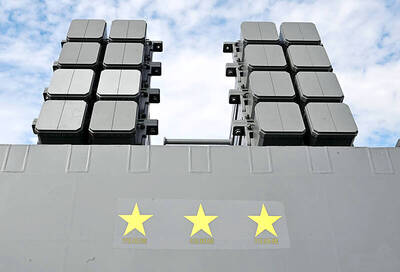
UPGRADE: The Kang Ding-class frigate is replacing its Chaparall missiles with Tien Chien II and Hua Yang VLS, which would provide it with long-range, 360° air defense Taiwan plans to produce 1,200 to 1,376 Hai Chien II missiles (海劍二, Sea Sword II) — also known as TC-2N — to serve as the standard air defense system of the navy’s surface combatant fleet, a source said yesterday. Last week, the Hai Chien II, the naval version of the Tien Kung II missile (天劍二, Sky Sword II), completed a live-fire test in waters off the National Chungshan Institute of Science and Technology’s Jiupeng facility (九鵬) in Pingtung County’s Manjhou Township (滿州). The MIM72 Chaparral and other dated air defense missiles that currently arm Taiwanese ships have inadequate range to combat Chinese


 RSS
RSS