

People with cardiovascular disease should be on the lookout for signs of stroke or heart attack as temperatures are expected to drop during the Lunar New Year holiday, the Health Promotion Administration (HPA) said yesterday.
As the Central Weather Administration forecast the arrival of a continental cold mass, which is to bring temperatures down across the nation this week, the HPA said that the cold weather could cause blood vessels to constrict, increasing blood pressure, as more pressure is needed to push blood through narrowed veins and arteries.
STAY WARM
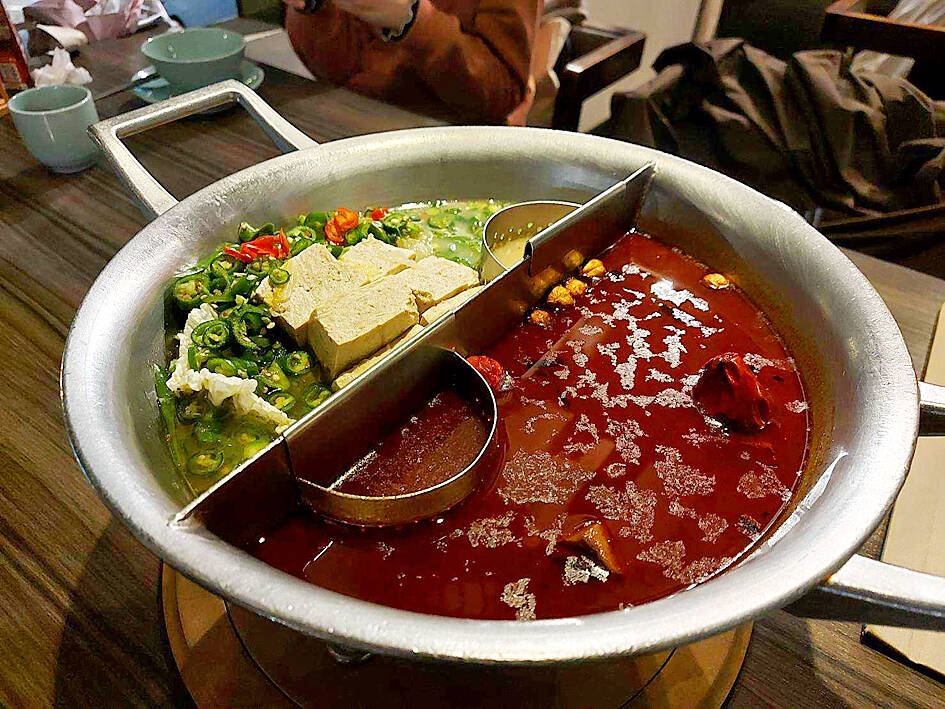
Photo: CNA
Elevated blood pressure can increase the risk of acute cardiovascular events, such as a stroke, so people should wear warm clothing, including a hat, gloves and a mask when outdoors, it said.
WARNING SIGNS
People with the “three highs” — high blood pressure, blood sugar and blood cholesterol levels — should track their health, and those with cardiovascular disease should especially watch for signs of stroke, it said.
The signs of stroke or heart attack include sudden chest pain or discomfort, shortness of breath, difficulty speaking, numbness or weakness in the face, an arm or a leg, especially on one side, it said.
People should immediately call 119 for an ambulance in the critical “golden hour” of a heart attack or stroke for better treatment outcomes, it added.
Elderly people and people with cardiovascular disease should consult with their doctor before entering hot baths or hot springs in cold weather, and keep in mind six points, the HPA said.
WAIT AFTER EATING
First, avoid taking a hot bath shortly after a meal, especially if they drank an alcoholic beverage or ate spicy food, and wait at least one-and-a-half to two hours after drinking or eating before entering the water.
Second, enjoy a hot spring with friends, who can quickly get help in case of an emergency.
Third, drink plenty of water before and after taking a hot bath.
Fourth, keep the water temperature at 40°C or lower, and avoid alternating between hot and cold baths.
Fifth, do not stay in the hot water for more than 15 minutes at a time.
Last, slowly stand before leaving the hot water, as the high temperatures cause blood vessels to dilate, which lowers blood pressure and can lead to dizziness and fainting, the HPA said.
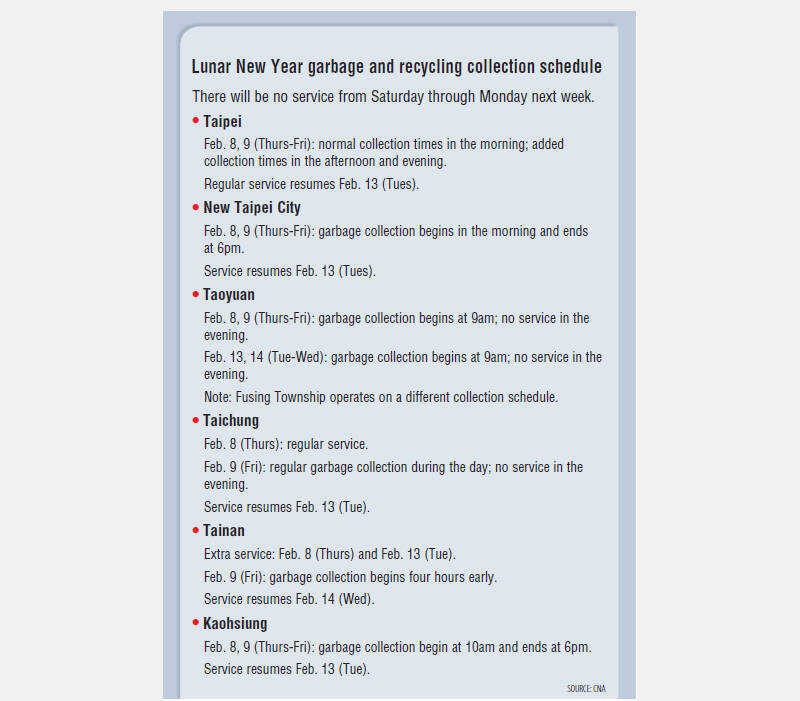
Lunar New Year garbage and recycling collection schedule
There will be no service from Saturday through Monday next week.
Taipei
Feb. 8, 9 (Thurs-Fri): normal collection times in the morning; added collection times in the afternoon and evening.
Regular service resumes Feb. 13 (Tues).
New Taipei City
Feb. 8, 9 (Thurs-Fri): garbage collection begins in the morning and ends at 6pm.
Service resumes Feb. 13 (Tues).
Taoyuan
Feb. 8, 9 (Thurs-Fri): garbage collection begins at 9am; no service in the evening.
Feb. 13, 14 (Tue-Wed): garbage collection begins at 9am; no service in the evening.
Note: Fusing Township operates on a different collection schedule.
Taichung
Feb. 8 (Thurs): regular service.
Feb. 9 (Fri): regular garbage collection during the day; no service in the evening.
Service resumes Feb. 13 (Tue).
Tainan
Extra service: Feb. 8 (Thurs) and Feb. 13 (Tue).
Feb. 9 (Fri): garbage collection begins four hours early.
Service resumes Feb. 14 (Wed).
Kaohsiung
Feb. 8, 9 (Thurs-Fri): garbage collection begin at 10am and ends at 6pm.
Service resumes Feb. 13 (Tue).
source: CNA
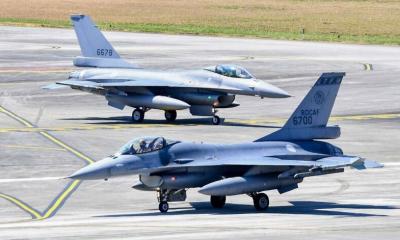
The first two F-16V Block 70 jets Taiwan purchased from the US were spotted unexpectedly turning back after departing from Hawaii yesterday, potentially further delaying delivery of the aircraft. Taiwan has purchased 66 of the F-16 C/D Block 70 jets to be deployed at Chihhang Air Base (志航基地) in Taitung County and operated by the air force's 7th Tactical Fighter Wing to defend Taiwan’s eastern region. Two single-seat jets, bearing serial No. 6727 and 6728, were spotted taking off from Hickam Field in Hawaii yesterday, observers said. Based on the precedent set during the delivery of Taiwan's older F-16 Block 20s, the new

Taiwan’s growing defense preparations might be sending a stronger signal to the US than to Beijing, highlighting the need for Taipei to tailor its deterrence efforts to different audiences, a US security academic said yesterday. Stanford University Freeman Spogli Institute for International Studies fellow Oriana Skylar Mastro made the comment during a Taipei Security Dialogue panel examining lessons Taiwan could draw from the wars in Ukraine and the Middle East. Mastro said she was impressed by Taiwan’s increased defense spending, emphasis on asymmetric capabilities and efforts to prepare society for conflict, but questioned whom those initiatives were influencing. She said when she asked
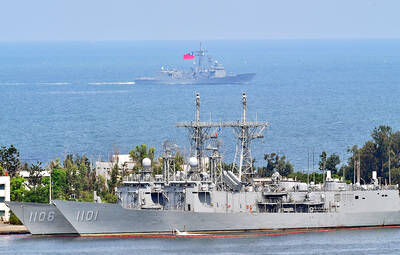
SIZE MATTERS: Large ships are politically attractive as visible symbols of national defense, but small surface combatants are more likely to survive an initial strike Taiwan needs to restructure its naval fleet from focusing on large warships, which are “sitting ducks” for China’s advanced tracking technology, to smaller, stealthy corvettes that are harder to detect but retain sufficient firepower to deter a Chinese invasion, a Taiwanese academic and a former US military commander said in an article published on Friday in the journal Foreign Affairs. Taiwan does not need a fleet capable of competing with the Chinese navy for traditional control of the Taiwan Strait, but rather “sea denial” capabilities that would prevent China from freely using the waterway, Taiwanese aerospace and security expert Holmes Liao
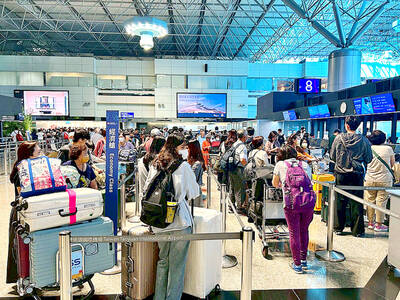
EVA Airways Corp is to raise excess baggage fees and revise other international baggage charges beginning on Sept. 29, citing higher fuel prices and rising global operating costs amid economic and geopolitical pressures. The changes would apply to international flights with travel dates on or after Sept. 29, the Taiwanese carrier said in a statement on its Web site. The revised baggage policy covers excess baggage, prepaid excess baggage, overweight and oversized baggage fees. It also covers updated pricing rules, and fees for transporting pets and sports equipment. Under the new rates, excess baggage fees would increase by between US$20 and US$90 per


 RSS
RSS