


Tigerair Taiwan yesterday announced that its year-end bonus for employees would be an average of 10.8 months of pay this year, the highest among all Taiwanese airlines, after its workers’ union complained last week that their salary increase is the lowest among all Taiwanese airlines.
“After I explained to the board members what we accomplished last year and our plans for the next 10 years, the board agreed that… the year-end bonus for employees would be an average of 10.8 months salary,” Tigerair Taiwan Ltd (台灣虎航) chairman Kevin Chen (陳漢銘) said.
“The highest bonus an employee could receive is 14 months salary,” he added.

Photo: Ting Yi, Taipei Times
Meanwhile, the salary increase for employees would be 11.48 percent on average this year, while the food allowance would increase by 12 percent, Chen said, adding that the year-end bonus was already in the employees’ bank accounts by the time the news was announced.
The union on Thursday accused Taiwan’s only budget airline of overworking their employees. Although each employee is said to have earned the airline NT$1.67 million (US$53,500) last year, the union said that the airline’s salary increase among workers is the lowest compared with China Airlines, EVA Airways and Starlux Airlines.
After the airline made the announcement, the union said on Facebook: “Our voices have been heard, and the company responded to our petitions!”
“We thank the union’s board and members, as well as other workers’ unions for their efforts and support. We also thank Tigerair Taiwan and the executives who assisted us in building better and more pleasant labor relations,” the union said.
The nation’s only budget
airline is celebrating its 10th anniversary this year. Today, it is to launch a new route to Fukushima, which would become its 19th route to Japan.
Chen yesterday said it is expanding its flight network by launching new flights to Japan, China and Southeast Asia.
Aside from Fukushima, the airline is considering launching new flights to Japan’s Tottori, Shizuoka, Oita and Miyazaki, as well as Shimane Prefecture, Chen said.
“We are paying much closer attention to our flight services to Japan, which account for more than 80 percent of our revenue,” Chen said.
Passengers who apply for a new passport for the first time would be given a discount on
airfare to Japan, Chen said.
Regarding China, the airline is gauging the possibility of launching flights to Tianjin, Wuxi, Fuzhou, Xiamen and Zhangjiajie, he added.
This summer, the airline is to launch flights to Hong Kong, he said, adding: “In the initial phase, we would fly two flights to Hong Kong per day, with one departing from Taipei and the other from Kaohsiung.”
The airline is also evaluating the feasibility of launching flights to Haiphong City in Vietnam and Angkor Wat in Cambodia, Chen said.
The airline is increasing flights to Phuket in Thailand this year, Chen said, adding that Tigerair Taiwan remains the sole carrier to the island from Taiwan.

More than half of the bamboo vipers captured in Tainan in the past few years were found in the city’s Sinhua District (新化), while other districts had smaller catches or none at all. Every year, Tainan captures about 6,000 snakes which have made their way into people’s homes. Of the six major venomous snakes in Taiwan, the cobra, the many-banded krait, the brown-spotted pit viper and the bamboo viper are the most frequently captured. The high concentration of bamboo vipers captured in Sinhua District is puzzling. Tainan Agriculture Bureau Forestry and Nature Conservation Division head Chu Chien-ming (朱健明) earlier this week said that the
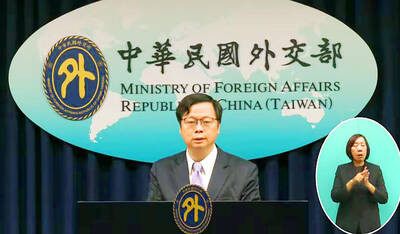
NAMING SPAT: The foreign ministry called on Denmark to propose an acceptable solution to the erroneous nationality used for Taiwanese on residence permits Taiwan has revoked some privileges for Danish diplomatic staff over a Danish permit that lists “Taiwan” as “China,” Eric Huang (黃鈞耀), head of the Ministry of Foreign Affairs’ Department of European Affairs, told a news conference in Taipei yesterday. Reporters asked Huang whether the Danish government had responded to the ministry’s request that it correct the nationality on Danish residence permits of Taiwanese, which has been listed as “China” since 2024. Taiwan’s representative office in Denmark continues to communicate with the Danish government, and the ministry has revoked some privileges previously granted to Danish representatives in Taiwan and would continue to review
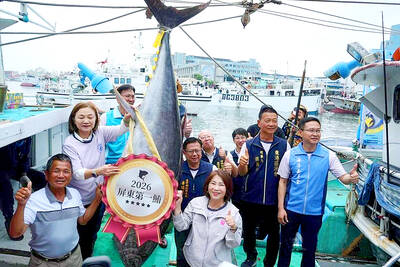
The first bluefin tuna of the season, brought to shore in Pingtung County and weighing 190kg, was yesterday auctioned for NT$10,600 (US$333.5) per kilogram, setting a record high for the local market. The auction was held at the fish market in Donggang Fishing Harbor, where the Siaoliouciou Island-registered fishing vessel Fu Yu Ching No. 2 delivered the “Pingtung First Tuna” it had caught for bidding. Bidding was intense, and the tuna was ultimately jointly purchased by a local restaurant and a local company for NT$10,600 per kilogram — NT$300 ,more than last year — for a total of NT$2.014 million. The 67-year-old skipper
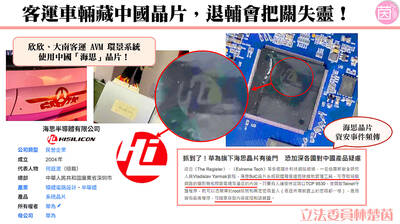
BREACH OF CONTRACT: The bus operators would seek compensation and have demanded that the manufacturer replace the chips with ones that meet regulations Two bus operators found to be using buses with China-made chips are to demand that the original manufacturers replace the systems and provide compensation for breach of contract, the Veterans Affairs Council said yesterday. Democratic Progressive Party Legislator Michelle Lin (林楚茵) yesterday said that Da Nan Bus Co and Shin-Shin Bus Co Ltd have fielded a total of 82 buses that are using Chinese chips. The bus models were made by Tron-E, while the systems provider was CYE Electronics, Lin said. Lin alleged that the buses were using chips manufactured by Huawei subsidiary HiSilicon Co, which presents a national security risk if the


 RSS
RSS