


All political parties should take up dialogue and not confrontation, Democratic Progressive Party (DPP) caucus whip Ker Chien-ming (柯建銘) said yesterday.
Saying that no party has a majority in the new legislature following Saturday’s legislative elections, Ker urged lawmakers to use wisdom to revolve disputes, as otherwise there would likely be more political wrangling.
In Saturday’s legislative elections, the DPP secured 51 seats in the 113-seat legislature, the Chinese Nationalist Party (KMT) 52, and the Taiwan People’s Party (TPP) eight. Another two seats were won by independents aligned with the KMT.
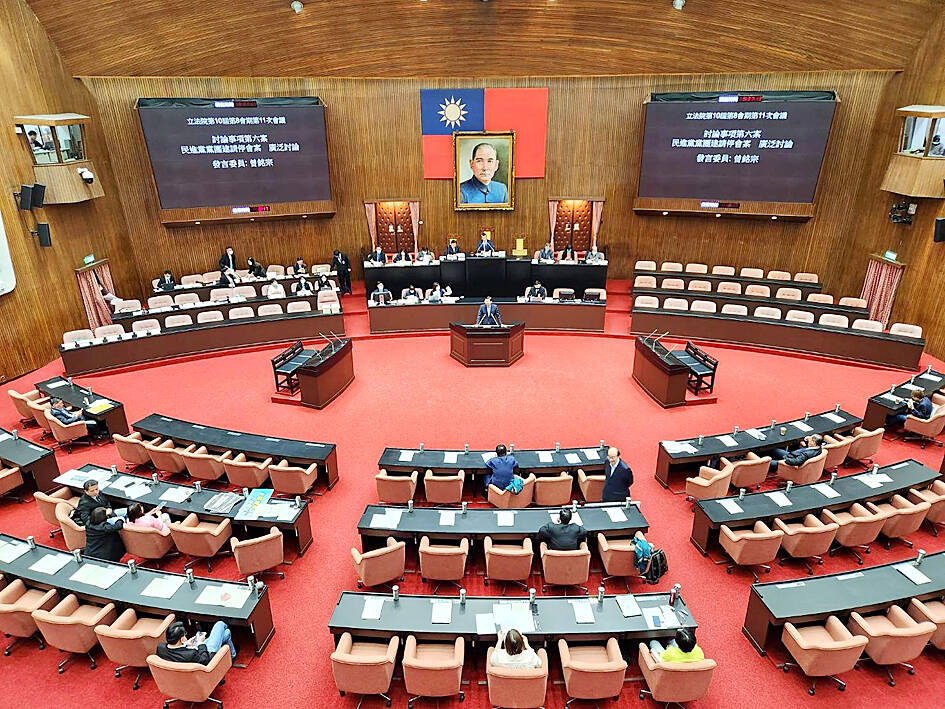
Photo: Taipei Times file
“The incoming DPP government has to face a new legislature dominated by opposition parties. However, this is not new, since our party has experienced this situation in the past. Although there will be disagreements, just as before, we will work on negotiating and resolving disputes one by one, and for parties to take up dialogue instead of confrontation in the coming legislative term,” Ker said.
Ker confirmed that Legislative Speaker You Si-kun of the DPP would seek to retain the position. You and Ker were placed in seventh and ninth spots respectively on the legislators-at-large list, of which the DPP won 13 seats based on the political party ballots.
“There are many new challenges in the legislature, and so we must impose party discipline to ensure unity for the DPP legislative caucus,” Ker said. “But we will have internal discussions to seek cooperation and forge alliances with other party members.”
The DPP and KMT have expressed willingness to work with the TPP to combine forces to push past a majority, reportedly offering the position of deputy speaker in exchange, which could be taken up by either former Taipei deputy mayor Vivian Huang (黃珊珊) or former New Power Party legislator Huang Kuo-chang (黃國昌), both taking seats as the TPP’s legislator-at-large nominees.
The KMT has planned for former Kaohsiung mayor Han Kuo-yu (韓國瑜), who holds the first spot in the KMT’s legislator-at-large list, to contest the speakership position, and is likely to nominate Legislator-at-large Ko Chih-en (柯志恩) to take up the party’s seat for deputy speaker.
Voting by legislators is to take place on Feb. 1 at the start of the new legislative term, and a secret ballot will be held to select the speaker and deputy speaker positions.

More than half of the bamboo vipers captured in Tainan in the past few years were found in the city’s Sinhua District (新化), while other districts had smaller catches or none at all. Every year, Tainan captures about 6,000 snakes which have made their way into people’s homes. Of the six major venomous snakes in Taiwan, the cobra, the many-banded krait, the brown-spotted pit viper and the bamboo viper are the most frequently captured. The high concentration of bamboo vipers captured in Sinhua District is puzzling. Tainan Agriculture Bureau Forestry and Nature Conservation Division head Chu Chien-ming (朱健明) earlier this week said that the

NAMING SPAT: The foreign ministry called on Denmark to propose an acceptable solution to the erroneous nationality used for Taiwanese on residence permits Taiwan has revoked some privileges for Danish diplomatic staff over a Danish permit that lists “Taiwan” as “China,” Eric Huang (黃鈞耀), head of the Ministry of Foreign Affairs’ Department of European Affairs, told a news conference in Taipei yesterday. Reporters asked Huang whether the Danish government had responded to the ministry’s request that it correct the nationality on Danish residence permits of Taiwanese, which has been listed as “China” since 2024. Taiwan’s representative office in Denmark continues to communicate with the Danish government, and the ministry has revoked some privileges previously granted to Danish representatives in Taiwan and would continue to review
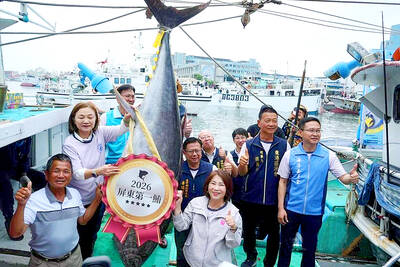
The first bluefin tuna of the season, brought to shore in Pingtung County and weighing 190kg, was yesterday auctioned for NT$10,600 (US$333.5) per kilogram, setting a record high for the local market. The auction was held at the fish market in Donggang Fishing Harbor, where the Siaoliouciou Island-registered fishing vessel Fu Yu Ching No. 2 delivered the “Pingtung First Tuna” it had caught for bidding. Bidding was intense, and the tuna was ultimately jointly purchased by a local restaurant and a local company for NT$10,600 per kilogram — NT$300 ,more than last year — for a total of NT$2.014 million. The 67-year-old skipper

China has reserved offshore airspace over the Yellow Sea and East China Sea from March 27 to May 6, issuing alerts that are usually used to warn of military exercises, although no such exercises have been announced, the Wall Street Journal (WSJ) reported on Sunday. Reserving such a large area for 40 days without explanation is an “unusual step,” as military exercises normally only last a few days, the paper said. The alerts, known as notice to air missions (NOTAMs), “are intended to inform pilots and aviation authorities of temporary airspace hazards or restrictions,” the article said. The airspace reserved in the alert


 RSS
RSS