


The Taiwan People’s Party (TPP) yesterday said it has expelled Ma Chih-wei (馬治薇), a former spokeswoman for its Taoyuan chapter, for contravening ethics rules and damaging the party’s reputation, after she was on Friday was investigated and detained for allegedly receiving campaign donations in the form of cryptocurrency from China.
Ma, an independent legislative candidate in Taoyuan, is also the first candidate to be put under pre-trial detention in the run-up to Saturday’s presidential and legislative elections.
The TPP yesterday afternoon issued a statement saying that as Ma is suspected of contravening the Anti-Infiltration Act (反滲透法) and has been detained, the party’s central review committee determined to she had contravened the party’s ethics rules and seriously damaged the party’s reputation, so it expelled her.
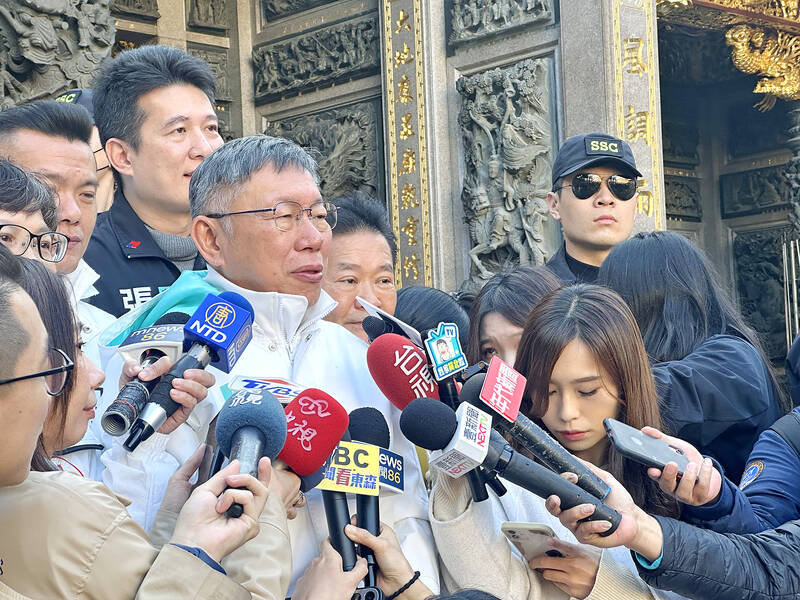
Photo: CNA
It said that Ma had originally sought the party’s nomination as a legislative candidate, but as the party’s selection mechanism had concerns about her associations with China, it did not nominate her and later dismissed her from her duties in its Taoyuan chapter.
TPP Chairman and presidential candidate Ko Wen-je (柯文哲) said that Ma had applied to run as a legislator, but failed to pass the TPP central review committee’s voting because they found she has close relations with China.
Ma later announced her candidacy as an independent, he said.
“We are still looking into the matter,” he added.
Regarding why he stood with Ma at a recent campaign event and took a photograph with her, Ko said it was impossible for him to know everyone’s background, and as his canvassing itinerary is open to the public, he cannot avoid anyone standing near him unless there is a security threat.
In response to the controversy, Ma’s campaign office issued a statement yesterday denying the claims that she is involved in any illegal activities that would harm Taiwan.
"Ma Chih-wei loves Taiwan and is an innocent young person," the statement said.
Separately, Taiwan Statebuilding Party Chairperson Wang Hsing-huan (王興煥) yesterday said Ko often “denies” or “plays dumb” when faced with controversies, and that Ma’s case might only be the tip of the iceberg.
As Ko previously made a remark that “China wants me to run for president,” he should disclose the political donations that the TPP received as soon as possible, Wang said.
As the case showed how China is using cryptocurrencies to fund candidates in Taiwan to interfere the election, there might be more methods of cash transfer that have not been revealed, he said, adding that receiving donations through online livestreaming is also attracting attention, and that the TPP should also publicize the donations it received through its livestreaming programs.
Additional reporting by Lin Che-yuan

NATIONAL SECURITY: Authorities are working to confirm the identities of the military personnel involved and investigating possible illegal conduct and regulatory violations Authorities are probing possible national security implications after Kinmen police and immigration officers on Sunday found a Chinese woman allegedly posing as a tourist while engaging in prostitution involving more than 10 military personnel. The woman, surnamed Chen (陳), has since been deported, authorities said, adding that investigators are still working to confirm the identities of those implicated, as the records only listed code names and aliases. The case stemmed from a report received by the Kinmen District Prosecutors’ Office on Friday last week from the Jinhu Precinct of the Kinmen County Police Bureau. On Sunday, police, along with the National Immigration

REASONS FOR TRAVEL: An assistant professor said that proposed amendments to penalize drivers if they used drugs overseas would not deter people from traveling People who operate a motor vehicle under the influence of marijuana would have their driver’s license revoked, even if they used the substance while overseas, the Ministry of Transportation and Communications said yesterday, citing proposed amendments to the Road Traffic Management and Penalty Act (道路交通管理處罰條例). The amendments would also authorize the government to revoke the licenses of people determined to have used Category 1 or Category 2 narcotics, even if they were not operating a vehicle while under the influence of drugs, as well as ban them from taking the license test for three years, the ministry said. People aged 18 or

GLOBALGIVING: ‘ Caving to external pressure is not acceptable for an organization that has cultivated justice reform and human rights for 30 years,’ one NGO said A slew of non-government organizations (NGOs) have withdrawn from the GlobalGiving fundraising platform after it announced it would use “Chinese Taipei” instead of “Taiwan” from next month. The Taiwan Good Rice Association wrote on Facebook on Friday that it was informed on April 28 via a teleconference call of the change, which was made because the platform wanted to operate in China. Taiwan Good Rice is to terminate all cooperative relationships with GlobalGiving in response to the platform’s “unilateral and non-negotiable” decision to remove references to Taiwan, the NGO said. “Taiwan is in the official name of Taiwan Good Rice Association and the

HEAVY WEATHER: Typhoon Jangmi is due to crash straight into the Ryukyus as airlines look to shift flights to larger aircraft or cancel flights to Okinawa entirely Taiwan’s international air carriers announced flight adjustments over the weekend as Typhoon Jangmi is forecast to hit the Ryukyu Islands today and tomorrow. The Central Weather Administration (CWA) upgraded Jangmi from a tropical storm to a typhoon at 8am yesterday, with the eye located 580km south of Naha city. It was moving north at 19kph. Today, China Airlines’ CI-120, CI-121, CI-122 and CI-123 flights between Taoyuan and Naha, Okinawa, have been canceled as well as CI-132 and CI-133 between Kaohsiung and Naha. EVA Air’s BR-112, BR-113, BR-186 and BR-185 flights between Taoyuan and Naha are also canceled. Low-cost carrier Tigerair Taiwan canceled IT-230,


 RSS
RSS