


Taiwan aims to produce its first domestically developed quantum computer by 2027, the National Science and Technology Council (NSTC) said yesterday.
Quantum computing is the most anticipated next-stage development for raw computational power, said Luo Meng-fan (羅夢凡), head of the NSTC’s Department of Natural Sciences and Sustainable Development.
The council has been working with the Ministry of Economic Affairs, Academia Sinica and other research organizations to realize a five-year, NT$8 billion (US$258.86 million) quantum technology plan that began in 2022, it said.
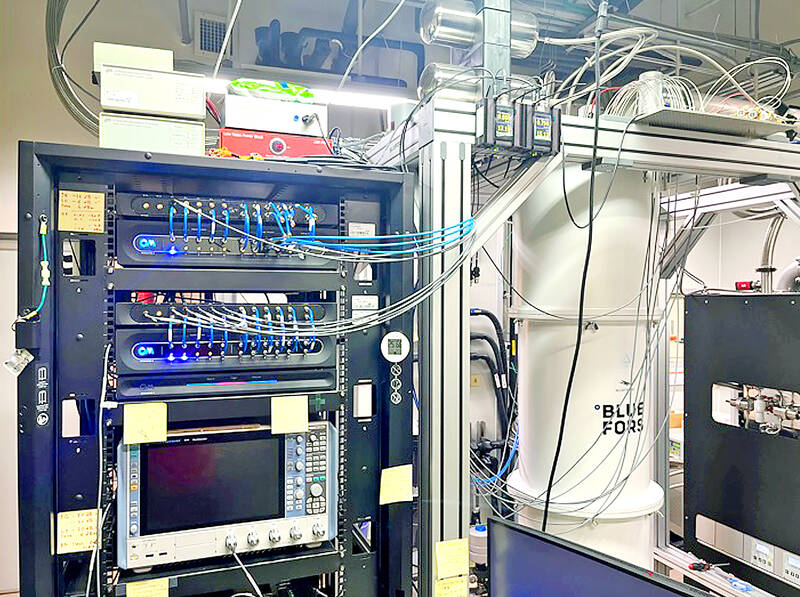
Photo courtesy of Chen Chi-tung, Institute of Physics, Academia Sinica
A Google study published in July last year showed how a random circuit sampling task that would have taken a classical supercomputer 47 years to complete was finished in just 6.18 seconds on the latest version of its Sycamore processor, which had been boosted to 70 quantum bit (qubits), Luo said.
In quantum computing, a random circuit sample task tests quantum computer performance by running random circuits and evaluating its capabilities and efficiency in solving complex problems.
With such powerful computational capabilities, security experts have warned that one day — dubbed “Q Day” — quantum computers would be able to crack codes protecting digital data, Luo said.
Measures to counter such development include quantum cryptography, such as quantum key distribution, he said.
However, quantum computers are still affected by high error rates, he said, adding that the technology needs another six years of research and development to reach maturity, when it could make a global impact.
That is why it is crucial for Taiwan to develop quantum computers to retain a foothold in critical technologies, he said.
The NSTC’s collaboration with academia and other sectors would flesh out the component supply chain for building quantum computers and shorten the time necessary when transitioning the supply chain for commercial purposes, Luo said.
Taiwan is not alone in rushing to develop quantum computers, he said.
Taiwanese researchers are in talks with Finnish quantum computing hardware company IQM to establish testing platforms in Taiwan, he said.
Four cloud software computational platforms are utilizing the quantum cloud computation services offered by IBM, Amazon and other international companies, he added.
Academia Sinica is to provide some of its newly developed 5-qubit chips for trials at research facilities later this month, said Lee Chau-hwang (李超煌), executive secretary of the institute’s Central Academic Advisory Committee.
Taiwan has only started developing quantum chipsets, but is closely monitoring increasing chipset yield rates, Lee said.
“Yield rates are key for mass production,” he said.

ANOTHER EMERGES: The CWA yesterday said this year’s fourth storm of the typhoon season had formed in the South China Sea, but was not expected to affect Taiwan Tropical Storm Gaemi has intensified slightly as it heads toward Taiwan, where it is expected to affect the country in the coming days, the Central Weather Administration (CWA) said yesterday. As of 8am yesterday, the 120km-radius storm was 800km southeast of Oluanpi (鵝鑾鼻), Taiwan’s southernmost tip, moving at 9kph northwest, the agency said. A sea warning for Gaemi could be issued tonight at the earliest, it said, adding that the storm is projected to be closest to Taiwan on Wednesday or Thursday. Gaemi’s potential effect on Taiwan remains unclear, as that would depend on its direction, radius and intensity, forecasters said. Former Weather Forecast

As COVID-19 cases in Japan have been increasing for 10 consecutive weeks, people should get vaccinated before visiting the nation, the Centers for Disease Control (CDC) said. The centers reported 773 hospitalizations and 124 deaths related to COVID-19 in Taiwan last week. CDC Epidemic Intelligence Center Director Guo Hung-wei (郭宏偉) on Tuesday said the number of weekly COVID-19 cases reported in Japan has been increasing since mid-May and surpassed 55,000 cases from July 8 to July 14. The average number of COVID-19 patients at Japan’s healthcare facilities that week was also 1.39 times that of the week before and KP.3 is the dominant

The Chinese Communist Party’s (CCP) working group for Taiwan-related policies is likely to be upgraded to a committee-level body, a report commissioned by the Mainland Affairs Council (MAC) said. As Chinese President Xi Jinping (習近平) is increasingly likely to upgrade the CCP’s Central Leading Group for Taiwan Affairs, Taiwanese authorities should prepare by researching Xi and the CCP, the report said. At the third plenary session of the 20th Central Committee of the CCP, which ended on Thursday last week, the party set a target of 2029 for the completion of some tasks, meaning that Xi is likely preparing to

US-CHINA TRADE DISPUTE: Despite Beijing’s offer of preferential treatment, the lure of China has dimmed as Taiwanese and international investors move out Japan and the US have become the favored destinations for Taiwanese graduates as China’s attraction has waned over the years, the Ministry of Labor said. According to the ministry’s latest income and employment advisory published this month, 3,215 Taiwanese university graduates from the class of 2020 went to Japan, surpassing for the first time the 2,881 graduates who went to China. A total of 2,300 graduates from the class of 2021 went to the US, compared with the 2,262 who went to China, the document showed. The trend continued for the class of 2023, of whom 1,460 went to Japan, 1,334 went to


 RSS
RSS