


Taiwan People’s Party (TPP) Chairman and presidential candidate Ko Wen-je (柯文哲) yesterday said he might file a lawsuit against people who continue to claim that industrial or construction waste is buried in the farmland he co-owns in Hsinchu City.
Ko last week confirmed he co-purchased farmland in Hsinchu in 2008, which is in a designated special agriculture zone. After it was revealed that the farmland had been illegally leased to a tour bus company and used as a parking lot, Ko arranged for an excavator to start digging up the asphalt and concrete and restore it to farmland.
However, city councilors who were at the site during the operation on Friday lasy week took photographs of the soil and objects that were dug up from the land, including suspected bricks and iron rods, and questioned if there was industrial or construction waste illegally dumped in the land.
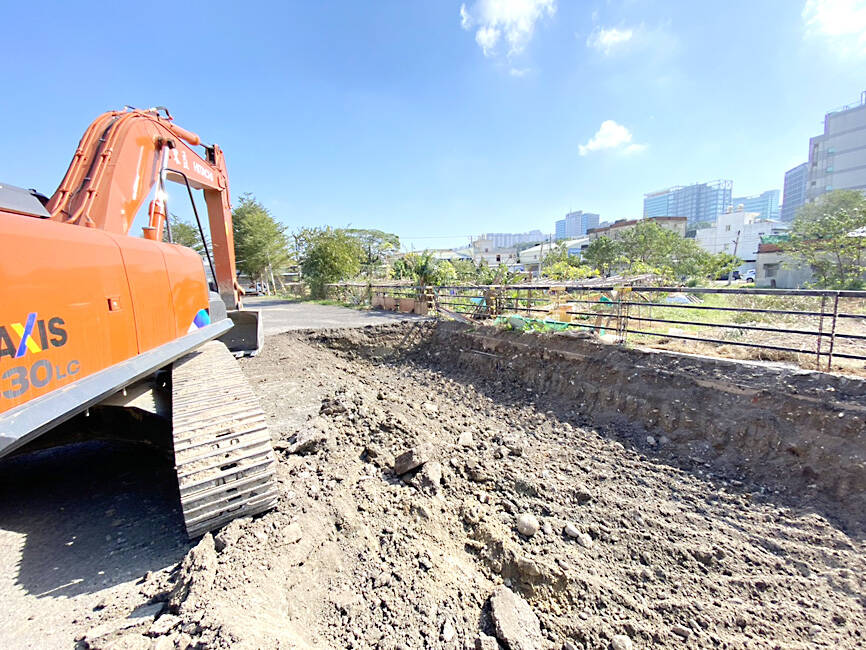
Photo: CNA
Ko, on his campaign’s online broadcasting channel KP TV on Sunday night, said the farmland he co-owned had already been paved with asphalt when his father purchased it in September 2008, so they “definitely had not paved it with asphalt for lease after buying it.”
He added that he does not dare say he never makes mistakes, but the most important thing is to reflect and improve.
Ko said that as the asphalt and concrete are being removed, the Hsinchu City Bureau of Environmental Protection’s on-site inspection also said it found no business waste buried in it, so if political pundits or paid online trolls continue to blabber about waste being buried, then “be careful, we will sue you.”
When asked for comment, Hsinchu Mayor Ann Kao (高虹安) yesterday said that specialists say the objects that were dug up are “construction residue,” and that the central government’s explanation letter states that if the objects can be recycled and reused, then they are not construction waste.
Separately, a campaign truck promoting Ko’s candidacy got stuck driving through the historic Hengchun Old City Walls’ west gate in Pingtung County on Sunday evening, as the driver had allegedly misjudged the height of the gate.
The Pingtung County Police Bureau said it received a report about the incident at about 6pm on Sunday, and police officers were sent to assist the driver in releasing air from the tires and removing the truck from under the gate, and that no one was injured.
TPP Pingtung chapter head Lin Yu-hsien (林育先) yesterday said that the party would cooperate with an investigation into the incident, but noted that the truck was owned and operated by a supporter and not by the campaign office.
The police bureau’s Hengchun precinct yesterday said that the driver would be requested to make a statement, while any damage to the historic monument would be inspected by the Pingtung County Cultural Affairs Department and investigated by the Pingtung District Prosecutors’ Office.
According to the Cultural Heritage Preservation Act, offenders who have destroyed or damaged a historic monument face a fine of between NT$500,000 to NT$20 million (US$16,057 and US$642,261), or a prison term of six months to five years, a local government official said.

Considering that most countries issue more than five denominations of banknotes, the central bank has decided to redesign all five denominations, the bank said as it prepares for the first major overhaul of the banknotes in more than 24 years. Central bank Governor Yang Chin-lung (楊金龍) is expected to report to the Legislative Yuan today on the bank’s operations and the redesign’s progress. The bank in a report sent to the legislature ahead of today’s meeting said it had commissioned a survey on the public’s preferences. Survey results showed that NT$100 and NT$1,000 banknotes are the most commonly used, while NT$200 and NT$2,000

The Centers for Disease Control (CDC) yesterday reported the first case of a new COVID-19 subvariant — BA.3.2 — in a 10-year-old Singaporean girl who had a fever upon arrival in Taiwan and tested positive for the disease. The girl left Taiwan on March 20 and the case did not have a direct impact on the local community, it said. The WHO added the BA.3.2 strain to its list of Variants Under Monitoring in December last year, but this was the first imported case of the COVID-19 variant in Taiwan, CDC Deputy Director-General Lin Ming-cheng (林明誠) said. The girl arrived in Taiwan on

South Korea is planning to revise its controversial electronic arrival card, a step Taiwanese officials said prompted them to hold off on planned retaliatory measures, a South Korean media report said yesterday. A Yonhap News Agency report said that the South Korean Ministry of Foreign Affairs is planning to remove the “previous departure place” and “next destination” fields from its e-arrival card system. The plan, reached after interagency consultations, is under review and aims to simplify entry procedures and align the electronic form with the paper version, a South Korean ministry official said. The fields — which appeared only on the electronic form

The Ministry of Foreign Affairs (MOFA) is suspending retaliation measures against South Korea that were set to take effect tomorrow, after Seoul said it is updating its e-arrival system, MOFA said today. The measures were to be a new round of retaliation after Taiwan on March 1 changed South Korea's designation on government-issued alien resident certificates held by South Korean nationals to "South Korea” from the "Republic of Korea," the country’s official name. The move came after months of protests to Seoul over its listing of Taiwan as "China (Taiwan)" in dropdown menus on its new online immigration entry system. MOFA last week


 RSS
RSS