


It is important to safeguard “Taiwanese values” and stay the course to continue advances in national development over the past eight years, President Tsai Ing-wen (蔡英文) said yesterday at election campaign events in central Taiwan, calling on voters not to regress back to the old path under Chinese Nationalist Party (KMT) rule.
International ratings agencies in their 2016 assessments said that Taiwan lacked basic infrastructure and public utility systems in certain sectors, impeding economic development, she said as she stumped for Democratic Progressive Party (DPP) legislative candidate Hsieh Chih-chung (謝志忠) in Taichung.
Her government provided a special budget the following year for basic infrastructure projects throughout Taiwan of about NT$800 billion (US$25.59 billion at today’s exchange rate) over eight years, or at about NT$100 billion per year, with the Forward-looking Infrastructure Development Program, she said, adding that enhancing public works at the basic level boosted economic growth in following years.
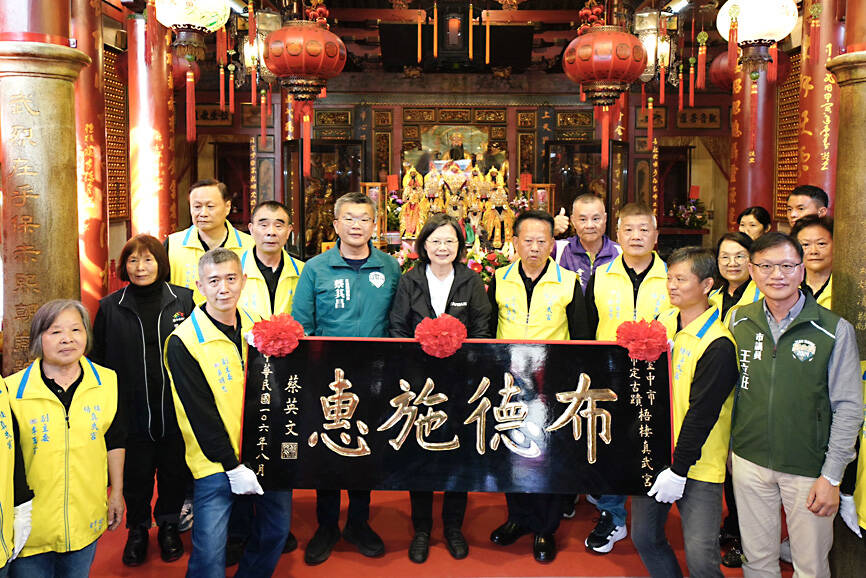
Photo: Chang Hsuan-tse, Taipei Times
“When we introduced the bills to implement it [the infrastructure program], the opposition parties fought against it for weeks. It was finally approved, but lawmakers deliberated and voted on motions for 24 hours straight, and had to guard against interruptions and delaying tactics,” she added.
Tsai appeared on behalf of Vice President William Lai (賴清德), as the DPP’s presidential nominee was reportedly spending a few days with advisers to prepare for an upcoming television debate.
“It was only through strong support by DPP lawmakers that the program was approved, thereby improving our basic infrastructure to accommodate new systems and supply utilities that have enabled Taiwan to climb to sixth place in worldwide competitiveness,” she said. “We are a small country with population of 23 million, yet we can achieve such a high level of strength and economic competitiveness.”
“This was not an easy achievement, and is all due to collective efforts of our citizens and our strong national resiliency. We have done it because Taiwan is an exceptional country with an outstanding groups of citizens,” Tsai said.
She then called on people to stay the course, and to choose the best leadership in Lai and his running mate, former representative to the US Hsiao Bi-khim (蕭美琴), as both have played integral roles in these achievements.
“So let’s keep on the right path... This election will decide Taiwan’s future; which road will people choose?” Tsai said.
Earlier in the day, Tsai attended events in Taichung organized by DPP Legislator Ho Hsin-chun (何欣純).
In her address, she said that the world previously did not see Taiwan as an essential part of international trade, “but now foreign countries see that Taiwan is irreplaceable. It means that our Taiwanese values must be defended.”
Tsai denied charges by the KMT that construction projects would leave debt for future generations, saying that “in reality, we are investing for the future. There will be no debt for our children.”
“I am known as the president who has repaid the most national debt at about NT$800 billion, and will pay back another NT$100 billion next year. My administration has the lowest debt-holding ratio,” she said.
“When I began my first presidential term in 2016, our debt-to-GDP ratio was 33 percent. As of last month, we reduced it to 27 percent, which is the lowest in our history,” Tsai added.

AGING: While Japan has 22 submarines, Taiwan only operates four, two of which were commissioned by the US in 1945 and 1946, and transferred to Taiwan in 1973 Taiwan would need at least 12 submarines to reach modern fleet capabilities, CSBC Corp, Taiwan chairman Chen Cheng-hung (陳政宏) said in an interview broadcast on Friday, citing a US assessment. CSBC is testing the nation’s first indigenous defense submarine, the Hai Kun (海鯤, Narwhal), which is scheduled to be delivered to the navy next month or in July. The Hai Kun has completed torpedo-firing tests and is scheduled to undergo overnight sea trials, Chen said on an SET TV military affairs program. Taiwan would require at least 12 submarines to establish a modern submarine force after assessing the nation’s operational environment and defense

Yangmingshan National Park authorities yesterday urged visitors to respect public spaces and obey the law after a couple was caught on a camera livestream having sex at the park’s Qingtiangang (擎天崗) earlier in the day. The Shilin Police Precinct in Taipei said it has identified a suspect and his vehicle registration number, and would summon him for questioning. The case would be handled in accordance with public indecency charges, it added. The couple entered the park at about 11pm on Thursday and began fooling around by 1am yesterday, the police said, adding that the two were unaware of the park’s all-day live
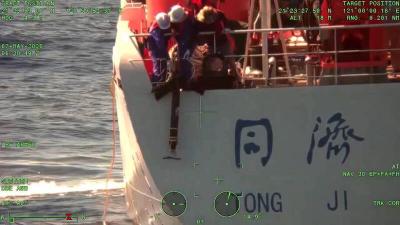
The coast guard today said that it had disrupted "illegal" operations by a Chinese research ship in waters close to the nation and driven it away, part of what Taipei sees a provocative pattern of China's stepped up maritime activities. The coast guard said that it on Thursday last week detected the Chinese ship Tongji (同濟號), which was commissioned only last year, 29 nautical miles (54km) southeast of the southern tip of Taiwan, although just outside restricted waters. The ship was observed lowering ropes into the water, suspected to be the deployment of scientific instruments for "illegal" survey operations, and the coast

A former soldier and an active-duty army officer were yesterday indicted for allegedly selling classified military training materials to a Chinese intelligence operative for a total of NT$79,440. The Taipei District Prosecutors’ Office indicted Chen Tai-yin (陳泰尹) and Lee Chun-ta (李俊達) for contravening the National Security Act (國家安全法) and the Anti-Corruption Act (貪污治罪條例). Chen left the military in September 2013 after serving alongside then-staff sergeant Lee, now an army lieutenant, at the 21st Artillery Command of the army’s Sixth Corps from 2011 to 2013, according to the indictment. Chen met a Chinese intelligence operative identified as “Wang” (王) through a friend in November


 RSS
RSS