


New Taipei City Mayor Hou You-yi (侯友宜), the Chinese Nationalist Party’s (KMT) presidential candidate, yesterday apologized to German Marshall Fund Indo-Pacific Program managing director Bonnie Glaser for featuring her in a picture that was shown while he presented his national defense and foreign policy on Monday.
Glaser posted on X a photograph Hou used in his presentation, in which she appeared happy to meet with him. She then tagged both the KMT and Hou, saying: “Please do not use my photo or my statements in ways that suggest I have endorsed Mayor Hou. I have not.”
“We used pictures of US political experts we met during our trip to the US as background, which led to misunderstandings. I would like to apologize to Glaser, and we will quickly make adjustments,” Hou told reporters on the sidelines of a news conference at his campaign headquarters in New Taipei City yesterday morning.
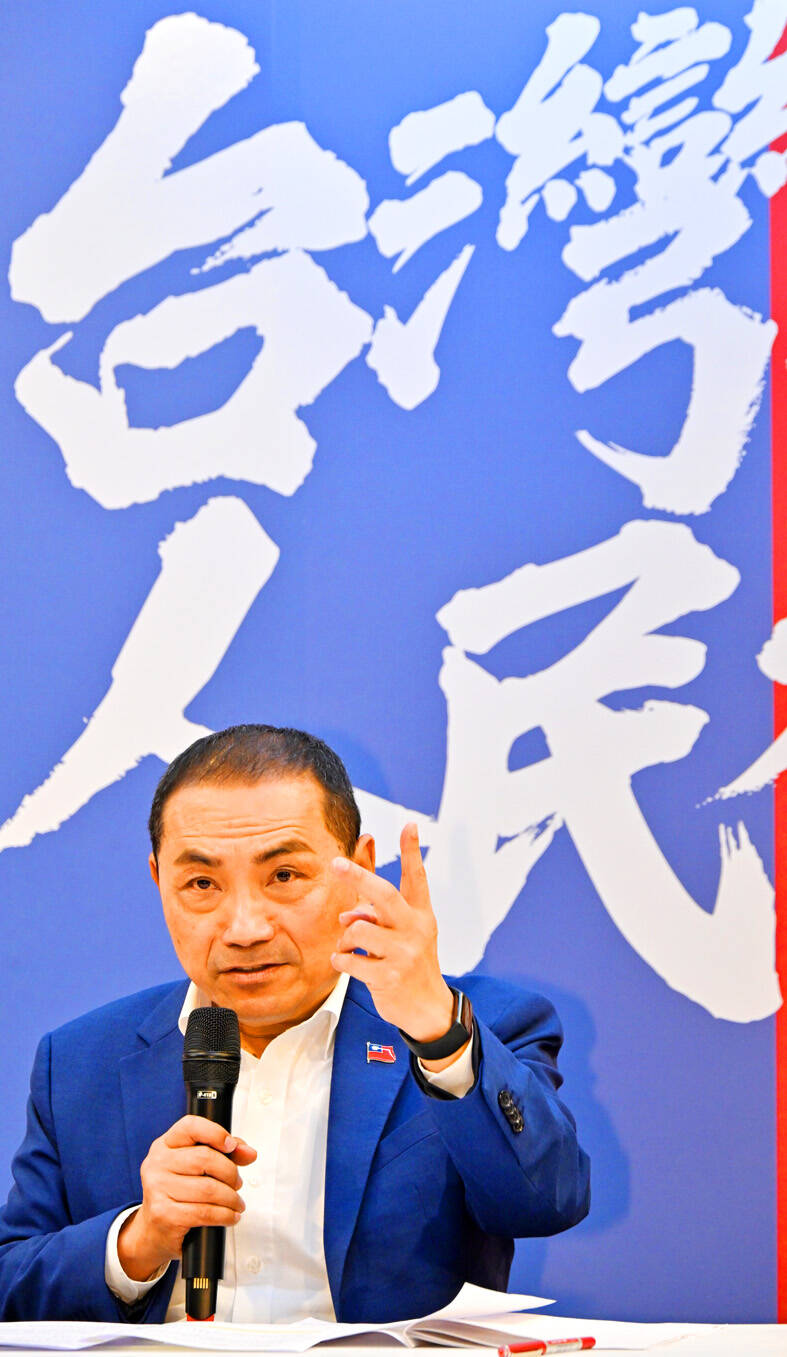
Photo: Liu Hsin-de, Taipei Times
“We respect Glaser and are glad to have met her during the trip to the US,” he said.
KMT Legislator Lee De-wei (李德維), who is also the deputy secretary-general of the KMT caucus, told reporters that Glaser might be overly concerned about the message that the picture could convey.
“Everyone knows that Glaser leans toward the Democratic Progressive Party (DPP) and there is no way that she would support Hou,” Lee said.
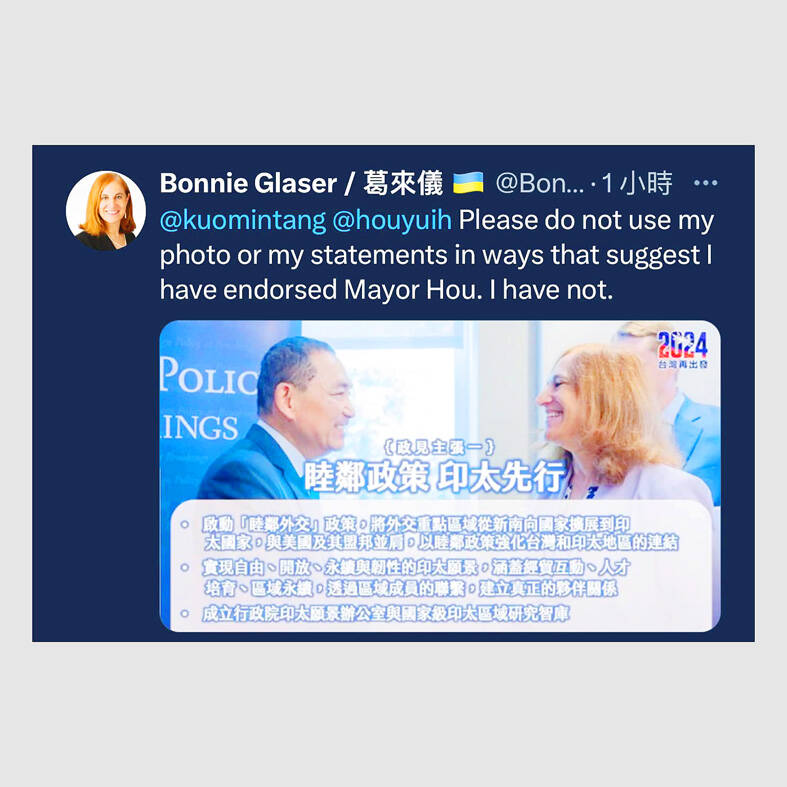
Photo: screen grab from Bonnie Glaser’s X account
The DPP accused Hou of imitating the party’s national defense and foreign policies, adding that most of what he proposed has already been accomplished by the current government.
In response, Hou accused the DPP of showing neither heart nor strength in foreign policy.
“My national defense policy is to prepare for war, but not to provoke. The DPP claims that it is prepared for war, but it continues to provoke with its agenda of supporting Taiwanese independence... We nominated former deputy minister of national defense Chen Yeong-kang (陳永康) as a legislator-at-large, while Lai nominated Kuma Academy cofounder Puma Shen (沈伯洋). The comparison clearly shows which party pays more attention to national defense issues,” Hou said.
Hou also criticized Legislative Speaker You Si-kun (游錫?) for saying the classic legalist concepts of “integrity” and “shame” were the result of monarchial thinking when You was asked about a controversy over curriculum guidelines implemented in schools since 2019.
“Loyalty, filial piety, benevolence, trustworthiness, peace, propriety, justice and integrity are virtues that we teach our children. It has nothing to do with a monarchy or feudal system,” he said.
Japan and South Korea are both democratic nations that have incorporated moral education in the school curriculum, Hou said.
“Confucian philosophy does not conflict with democratic ideals, and the DPP should not replace moral education with its political ideologies,” he said.

The Ministry of Finance this afternoon announced the winning numbers for the March-April uniform invoice lottery. The winning number for the NT$10 million (US$318,060) special prize is 19531471, and the winning number for the NT$2 million grand prize is 85941329. Three numbers were drawn for the NT$200,000 first prize: 07225810, 20231230 and 83518781. Those with receipts matching the last seven digits of any of the first-prize numbers will win the NT$40,000 second prize, while those matching the last six digits will win the NT$10,000 third prize. Those whose receipts match the last five digits of the first-prize numbers can claim the NT$4,000 fourth prize,

SIX SUBSIDIES: The monthly allowance for older farmers is to increase to NT$10,000, and NT$5,000 is to be given to homemakers under the national pension system, Lai said The government is to implement major welfare policies for disadvantaged groups, including raising the monthly allowance for older farmers to NT$10,000 and providing homemakers with NT$5,000 per month, President William Lai (賴清德) said yesterday. Lai made the remarks during a visit to Wangling Temple in Chiayi County, saying that the planned increases were being introduced amid economic growth and an increase in tax revenue. Touting a policy, in which the government plans to provide a monthly allowance of NT$5,000 for every child under the age of 18 in a bid to address Taiwan’s low birthrate, Lai said that if received for the
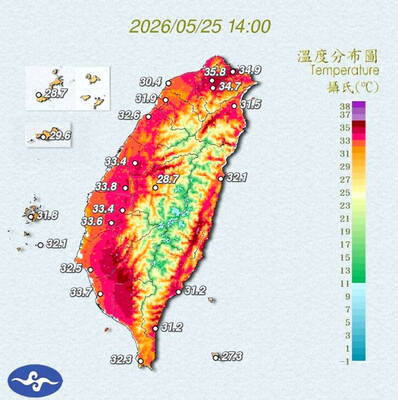
STAY COOL: The HPA recommended that people stay hydrated, use air-conditioning or fans while indoors, wear loose-fitting clothes and walk in the shade while outdoors Employers must implement measures such as installing cooling equipment, and providing drinking water and rest breaks for outdoor workers starting from Monday next week, the Taipei Department of Labor said on Sunday. Employers who fail to comply could face fines of NT$30,000 to NT$300,000 under the Occupational Safety and Health Act (職業安全衛生法), the department said. Businesses in Taipei employing fewer than 100 workers, as well as registered self-employed workers with labor insurance coverage, could receive on-site assessments and guidance from occupational safety consultants to help them apply for central government subsidies to implement or improve heat-protection measures, it said. Under the Ministry of

NATIONAL SECURITY: Authorities are working to confirm the identities of the military personnel involved and investigating possible illegal conduct and regulatory violations Authorities are probing possible national security implications after Kinmen police and immigration officers on Sunday found a Chinese woman allegedly posing as a tourist while engaging in prostitution involving more than 10 military personnel. The woman, surnamed Chen (陳), has since been deported, authorities said, adding that investigators are still working to confirm the identities of those implicated, as the records only listed code names and aliases. The case stemmed from a report received by the Kinmen District Prosecutors’ Office on Friday last week from the Jinhu Precinct of the Kinmen County Police Bureau. On Sunday, police, along with the National Immigration


 RSS
RSS