


The Ministry of Culture yesterday announced an updated scheme to encourage young people to watch Taiwanese films using Young Adult Culture Vouchers.
The ministry launched the voucher initiative in June, providing 1,200 “culture points” — equivalent to NT$1,200 — to young adults aged 18 to 21 to encourage them to see Taiwanese movies, watch live performances, buy books, visit museums and buy cultural and creative products.
The points have been registered by 770,000 people so far and 620 million points have been used, the ministry said yesterday, adding that 48 percent of the points were used at bookstores and in the publishing industry.
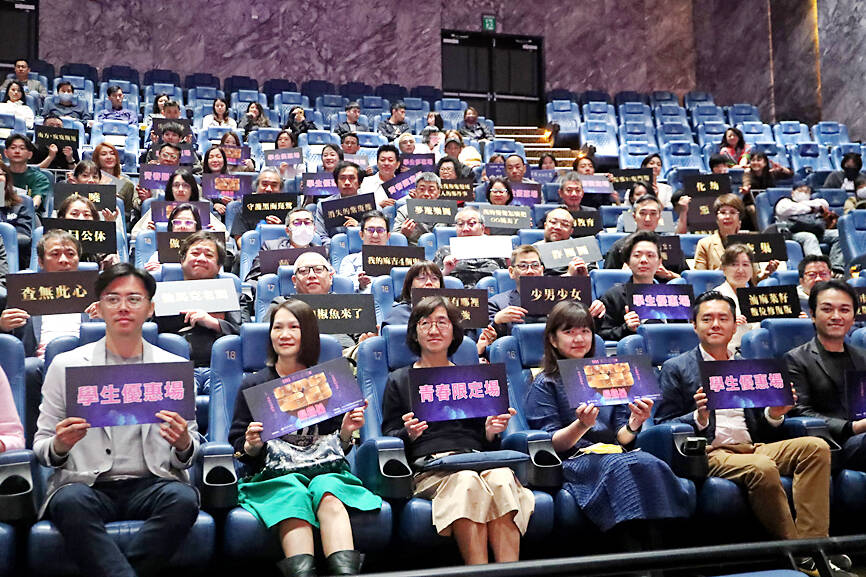
Photo: CNA
To catch up with the boom of Taiwanese films beginning in September, the ministry introduced a new scheme on Sept. 16 to offer an extra 100 points for each of the group members when they all use the points to watch a Taiwanese film.
The scheme has now been further expanded after the 60th Golden Horse Awards ceremony on Saturday generated great enthusiasm for Taiwanese productions.
An extra 100 points are to be given to those who use over 350 points to watch a Taiwanese film with other people, the ministry said, adding that the scheme would last until Feb. 29 next year.
The box office income of Taiwanese films so far this year, the first year after the COVID-19 pandemic, has exceeded NT$1.1 billion (US$34.94 million), which is not only higher than the NT$604 million last year, but also higher than the NT$702 million in 2019, when the pandemic barely started, it said.
Separately, grant applications for translating works by Taiwanese authors and creating medium to long comics are to open on Friday, the ministry said.
The ministry is to step up efforts to promote translations of Taiwanese authors’ works and the creation of comics, which have great potential for adaptation into TV dramas and cross-domain applications, it said on Thursday.
The Books From Taiwan program, launched in 2014, has sold the copyrights of 506 books to international publishers; the Grant for the Publication of Taiwanese Works in Translation, started in 2020, has supported the translation of 205 books, it said.
Starting next year, the Books From Taiwan program is to select 220 books per year, up from 60, providing translation samples and introductions to attract international publishers, it said.
The program is to provide full translations of all the comics being selected and 20 from other categories, including fiction, non-fiction and children’s books, it said.
Since its establishment in 2017, the grant for comics has supported the production of approximately 700 comic books and journals, many of which have gone on to win awards in Taiwan and abroad, it said.
Most comics by Taiwanese creators are single volumes or in a series of less than three volumes, as the market size for comics is limited, it said.
Therefore, the ministry is to launch a subsidy program to support the creation of comics that consist of three to five volumes, it said, adding that the program is to provide up to NT$7 million over three years per application.
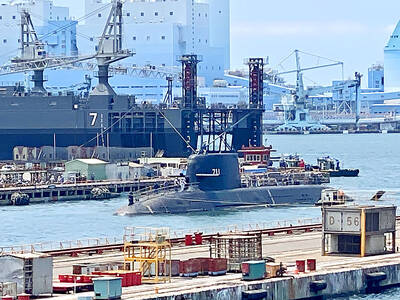
AGING: While Japan has 22 submarines, Taiwan only operates four, two of which were commissioned by the US in 1945 and 1946, and transferred to Taiwan in 1973 Taiwan would need at least 12 submarines to reach modern fleet capabilities, CSBC Corp, Taiwan chairman Chen Cheng-hung (陳政宏) said in an interview broadcast on Friday, citing a US assessment. CSBC is testing the nation’s first indigenous defense submarine, the Hai Kun (海鯤, Narwhal), which is scheduled to be delivered to the navy next month or in July. The Hai Kun has completed torpedo-firing tests and is scheduled to undergo overnight sea trials, Chen said on an SET TV military affairs program. Taiwan would require at least 12 submarines to establish a modern submarine force after assessing the nation’s operational environment and defense

A white king snake that frightened passengers and caused a stir on a Taipei MRT train on Friday evening has been claimed by its owner, who would be fined, Taipei Rapid Transit Corp (TRTC) said yesterday. A person on Threads posted that he thought he was lucky to find an empty row of seats on Friday after boarding a train on the Bannan (Blue) Line, only to spot a white snake with black stripes after sitting down. Startled, he jumped up, he wrote, describing the encounter as “terrifying.” “Taipei’s rat control plan: Release snakes on the metro,” one person wrote in reply, referring
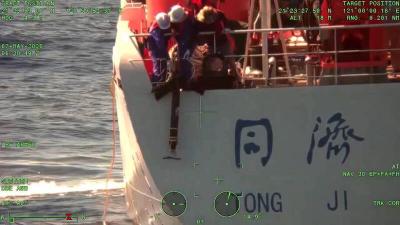
The coast guard today said that it had disrupted "illegal" operations by a Chinese research ship in waters close to the nation and driven it away, part of what Taipei sees a provocative pattern of China's stepped up maritime activities. The coast guard said that it on Thursday last week detected the Chinese ship Tongji (同濟號), which was commissioned only last year, 29 nautical miles (54km) southeast of the southern tip of Taiwan, although just outside restricted waters. The ship was observed lowering ropes into the water, suspected to be the deployment of scientific instruments for "illegal" survey operations, and the coast
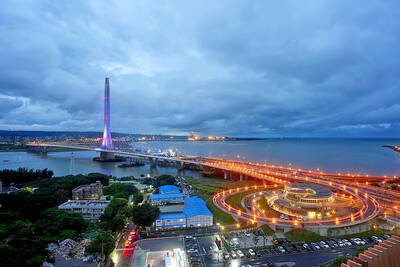
An inauguration ceremony was held yesterday for the Danjiang Bridge, the world’s longest single-mast asymmetric cable-stayed bridge, ahead of its official opening to traffic on Tuesday, marking a major milestone after nearly three decades of planning and construction. At the ceremony in New Taipei City attended by President William Lai (賴清德), Premier Cho Jung-tai (卓榮泰), Minister of Transportation and Communications Chen Shih-kai (陳世凱) and New Taipei City Mayor Hou Yu-ih (侯友宜), the bridge was hailed as both an engineering landmark and a long-awaited regional transport link connecting Tamsui (淡水) and Bali (八里)


 RSS
RSS