


Taiwan is able to make its contributions known to the world, despite being excluded from the UN system, Conference of NGOs in Consultative Relationship with the UN (CoNGO) president Liberato Bautista said at the non-governmental organizations (NGO) Leaders’ Forum yesterday.
The forum, which was held in Taipei by the Ministry of Foreign Affairs for the fourth year, is “a vital platform for exchanging opinions, sharing policies and most importantly, strengthening partnerships between government, NGOs and global civil society,” Deputy Minister of Foreign Affairs Tien Chung-kwang (田中光) said in his opening remarks.
Taiwan is a force for good in the world and has long championed universal values shared by participants, such as peace, democracy, freedom, human rights and gender equality, he said.
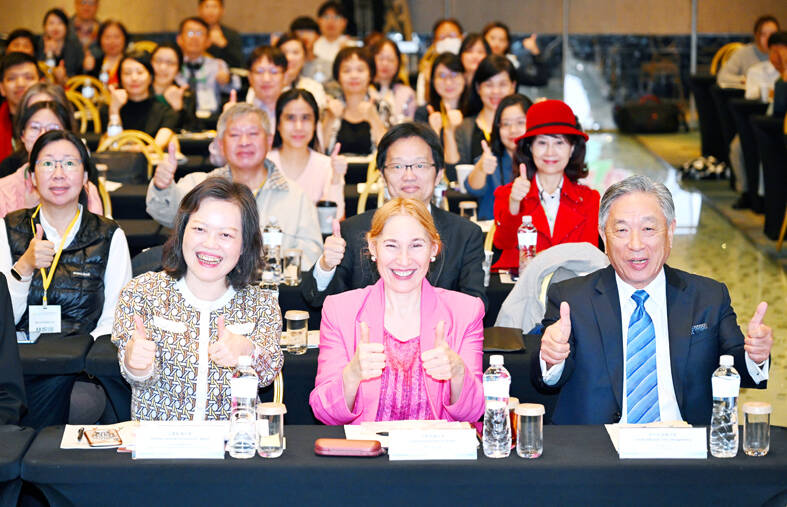
Photo: Liao Chen-huei, Taipei Times
NGOs play an increasingly important role in today’s world, he said, citing examples of Taiwanese NGOs launching donation campaigns to help Ukraine and participating in disaster response and recovery efforts after a massive earthquake struck Turkey and Syria in February.
Tien hoped the forum could help forge a partnership between the public sector and civil society to address global challenges.
Bautista thanked Taiwan’s government and NGOs for engaging in dialogue and cooperation to pursue the UN’s Sustainable Development Goals.
CoNGO, which has consultative status granted by the UN Economic and Social Council, is dedicated to encouraging NGOs around the world to cooperate with governments and the UN to pursue universal and global public goods and ensuring that no one is left behind, he said.
Asked how Taiwan could join such an effort as it is excluded from the UN system, Bautista said that he considered it “a political process that the Taiwanese people must decide for themselves.”
While physical access to the UN building and venues is not unimportant, access to its substantive agenda “is far more lasting,” he said.
For instance, Taiwan is able to share its good public health practices with the international community, letting the world know that the nation participates in the pursuit of common public good, which is in itself an achievement, he said.
When NGOs assert their own voice and agency, it could empower civil society and support the government’s efforts or push the government to do more in pursuit of the global public good, he said.
He encouraged Taiwanese not to be bound by the fact that Taiwan is not yet a member of the UN, but to “speak your voice” while the moment has yet to arrive.
International Federation of Women in Legal Careers vice president Denise Scotto praised Taiwan as the Asian leader in gender equality.
President Tsai Ing-wen (蔡英文), as well as former New Zealand prime minister Jacinda Ardern, demonstrated leadership to safeguard the health of their people during the COVID-19 pandemic, she said.
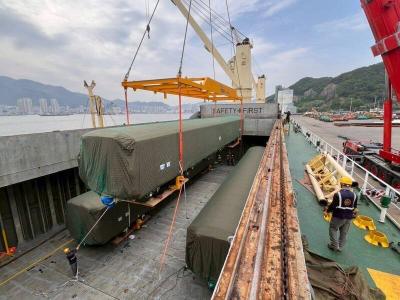
The first of 10 new high-capacity trains purchased from South Korea’s Hyundai Rotem arrived at the Port of Taipei yesterday to meet the demands of an expanding metro network, Taipei Rapid Transit Corp (TRTC) said yesterday. The train completed a three-day, 1,200km voyage from the Port of Masan in South Korea, the company said. Costing NT$590 million (US$18.79 million) each, the new six-carriage trains feature a redesigned interior based on "human-centric" transportation concepts, TRTC said. The design utilizes continuous longitudinal seating to widen the aisles and optimize passenger flow, while also upgrading passenger information displays and driving control systems for a more comfortable
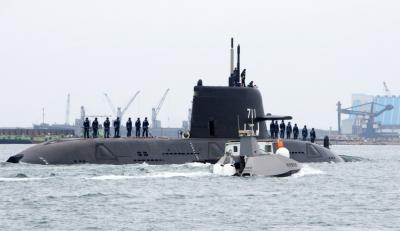
Taiwan's first indigenous defense submarine, the SS-711 Hai Kun (海鯤, or Narwhal), departed for its 13th sea trial at 7am today, marking its seventh submerged test, with delivery to the navy scheduled for July. The outing also marked its first sea deployment since President William Lai (賴清德) boarded the submarine for an inspection on March 19, drawing a crowd of military enthusiasts who gathered to show support. The submarine this morning departed port accompanied by CSBC Corp’s Endeavor Manta (奮進魔鬼魚號) uncrewed surface vessel and a navy M109 assault boat. Amid public interest in key milestones such as torpedo-launching operations and overnight submerged trials,
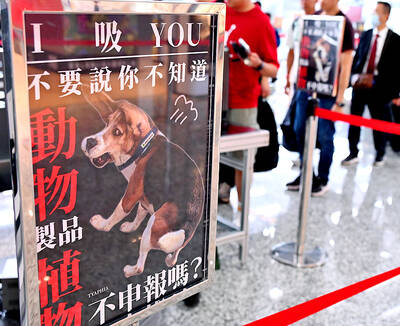
Quarantine awareness posters at Taiwan Taoyuan International Airport have gone viral for their use of wordplay. Issued by the airport branch of the Animal and Plant Health Inspection Agency, the posters feature sniffer dogs making a range of facial expressions, paired with advisory messages built around homophones. “We update the messages for holidays and campaign needs, periodically refreshing materials to attract people’s attention,” quarantine officials said. “The aim is to use the dogs’ appeal to draw focus to quarantine regulations.” A Japanese traveler visiting Taiwan has posted a photo on X of a poster showing a quarantine dog with a
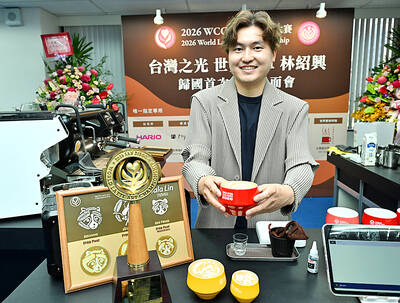
Taiwan’s coffee community has launched a “one-person-one-e-mail” campaign, calling for people to send a protest-e-mail to the World Coffee Championships (WCC) urging it to redesignate Taiwanese competitors as from “Taiwan,” rather than “Chinese Taipei.” The call followed sudden action last week after the WCC changed all references to Taiwanese competitors from “Taiwan” to “Chinese Taipei,” including recent World Latte Art champion Bala (林紹興), who won the World Latte Art Championship in San Diego earlier this month. When Bala received the trophy, he was referred to as representing Taiwan, as well as in the announcement on the WCC’s Web site, until it


 RSS
RSS