


Pro-independence civic groups gathered in Kaohsiung yesterday accusing the Chinese Nationalist Party (KMT) and Taiwan People’s Party (TPP) of “colluding” with the Chinese Communist Party (CCP) to undermine Taiwan’s sovereignty, after the KMT and TPP on Wednesday agreed to cooperate in the January election.
“The KMT and TPP Chairman Ko Wen-je (柯文哲) are joining forces to urge voters to oust the Democratic Progressive Party (DPP),” former Taiwan South Society chairman Weng Ming-jang (翁銘章) said.
“However, these two parties are concealing their follow-up statement, which is ‘to help install the CCP to rule in Taiwan,’” he said. “We are seeing very clearly that China is making moves behind the scenes to subvert our democratic election.”
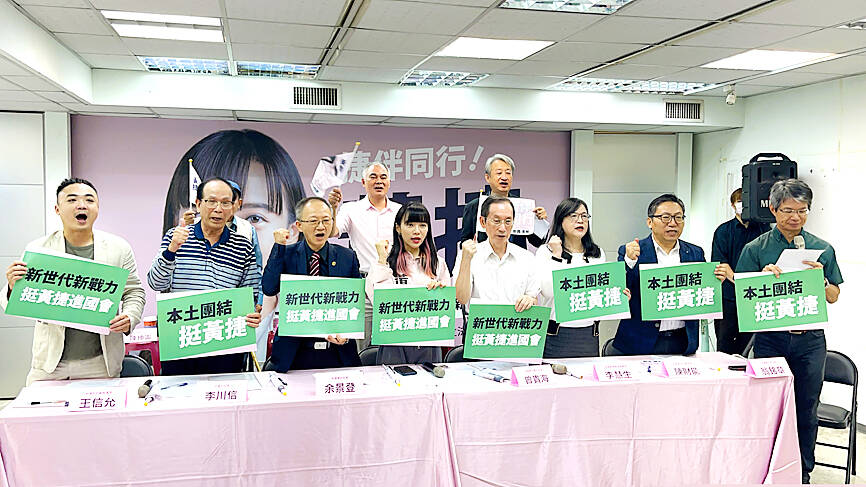
Photo: Hsu Li-chuan, Taipei Times
With the “blue-white” coalition forming, “the presidential contest has become a one-on-one showdown,” Taiwan South Society founder Tseng Kuei-hai (曾貴海) said.
The KMT and the TPP talk about needing to change the government because the DPP has been in power for too long, but President Tsai Ing-wei (蔡英文) has said that many countries around the world still want to work with a DPP government, Tseng said.
Ko compromised with the KMT and would compromise next time with Chinese President Xi Jinping (習近平), Kaohsiung City Councilor Chang Po-yang (張博洋) of the Taiwan Statebuilding Party said.
Ko might give many reasons for his actions, but in practical terms, he is selling out his party and his supporters, Chang said, adding that “next time he could sell out the people of Taiwan to China.”
Separately, DPP Legislator Hung Sun-han (洪申翰) denounced the opposition coalition as a “dark conspiracy,” as only a few principal figures remained at the negotiation table without their aides on Wednesday.
“Nobody really knows how they came up with the final agreement,” Hung said. “Ko later said that he is conducting an experiment to see if a ‘blue-white cooperation’ could work.”
“This is very frightening. Can Taiwanese bet the nation’s future on such an absurd experiment?” Hung said.
Earlier on Wednesday, Ko said that he still “hates” the KMT, despite their agreement.
“I’m in a bad mood,” Ko said at a campaign event. “I hate the KMT, but I hate the DPP even more.”
In a TV interview after, Ko said that concerns about risks of a conflict with China convinced him to make the agreement, adding that “war is not impossible in Taiwan” and that the deal surprised his aides.
Additional reporting by Bloomberg

Considering that most countries issue more than five denominations of banknotes, the central bank has decided to redesign all five denominations, the bank said as it prepares for the first major overhaul of the banknotes in more than 24 years. Central bank Governor Yang Chin-lung (楊金龍) is expected to report to the Legislative Yuan today on the bank’s operations and the redesign’s progress. The bank in a report sent to the legislature ahead of today’s meeting said it had commissioned a survey on the public’s preferences. Survey results showed that NT$100 and NT$1,000 banknotes are the most commonly used, while NT$200 and NT$2,000

The Centers for Disease Control (CDC) yesterday reported the first case of a new COVID-19 subvariant — BA.3.2 — in a 10-year-old Singaporean girl who had a fever upon arrival in Taiwan and tested positive for the disease. The girl left Taiwan on March 20 and the case did not have a direct impact on the local community, it said. The WHO added the BA.3.2 strain to its list of Variants Under Monitoring in December last year, but this was the first imported case of the COVID-19 variant in Taiwan, CDC Deputy Director-General Lin Ming-cheng (林明誠) said. The girl arrived in Taiwan on

South Korea is planning to revise its controversial electronic arrival card, a step Taiwanese officials said prompted them to hold off on planned retaliatory measures, a South Korean media report said yesterday. A Yonhap News Agency report said that the South Korean Ministry of Foreign Affairs is planning to remove the “previous departure place” and “next destination” fields from its e-arrival card system. The plan, reached after interagency consultations, is under review and aims to simplify entry procedures and align the electronic form with the paper version, a South Korean ministry official said. The fields — which appeared only on the electronic form

The Ministry of Foreign Affairs (MOFA) is suspending retaliation measures against South Korea that were set to take effect tomorrow, after Seoul said it is updating its e-arrival system, MOFA said today. The measures were to be a new round of retaliation after Taiwan on March 1 changed South Korea's designation on government-issued alien resident certificates held by South Korean nationals to "South Korea” from the "Republic of Korea," the country’s official name. The move came after months of protests to Seoul over its listing of Taiwan as "China (Taiwan)" in dropdown menus on its new online immigration entry system. MOFA last week


 RSS
RSS