


The Taiwanese Association of Andrology (TAA) yesterday encouraged men to seek professional medical attention for andrological issues, adding that getting a proper diagnosis and treatment could help improve their life quality and sometimes also reveal other underlying health conditions.
Raising public awareness of men’s health issues, the TAA yesterday held a seminar in Taipei with several doctors giving public education talks on men’s health issues, while offering a free testosterone blood test and body composition analysis for attendees.
TAA president Tsai Wei-kung (蔡維恭), a urologist at Mackay Memorial Hospital in Taipei, said that a Health and Promotion Administration survey suggested that men on average have a shorter life span and poorer management of obesity and the “three highs” — high blood pressure, blood lipids and blood sugar — than women, but more men than women believe they are healthy.

Photo courtesy of the Taiwanese Association of Andrology
Three important indicators of men’s health issues include testosterone levels, prostate health issues and hardness of penile erections, and these are often also the warning signs for other underlying health conditions, he said.
A study has suggested that in patients with erectile dysfunction, about 29 percent of study participants also have diabetes, 33 percent have hypertension, 27 percent have a testosterone deficiency and about 50 percent have hyperlipidemia, Tsai said, adding that they also have increased risks of cardiovascular disease and strokes.
Taipei Veterans General Hospital physician Huang I-shen (黃奕燊) said after age 30, men’s testosterone levels might decline by 1 to 2 percent per year, and a testosterone deficiency could cause reduced sex drive, fatigue, insomnia and other symptoms that affect quality of life.
TAA deputy secretary-general Lee Wei-chang (李威昌), a urologist at New Taipei Municipal Tucheng Hospital, said erectile dysfunction is linked to several cardiovascular diseases and have the same risk factors, so the association encourages people to seek professional medical attention as early as possible.
The association said its survey found that over half of patients with erectile dysfunction had first sought solutions on their own, such as adjusting their diet or exercising, while many also tried supplements or medicine purchased on their own; less than 20 percent sought professional medical assistance.
TAA secretary-general Chang Yi-kai, a urologist at National Taiwan University Hospital, said sometimes men with andrological issues have come to the outpatient clinic, but were embarrassed and reluctant to state their problems until a female nurse left the room temporarily, but he encourages men to seek medical assistance and assured them that healthcare workers would respect every patient and keep their health conditions confidential.
Hsu Chih-chen (許志呈), a urologist at the Ministry of Health and Welfare’s Taipei Hospital, said that apart from getting medical attention as early as possible, getting sufficient sleep, gaining muscle and losing fat, and managing stress are also ways to improve andrological health.

NATIONAL SECURITY: Authorities are working to confirm the identities of the military personnel involved and investigating possible illegal conduct and regulatory violations Authorities are probing possible national security implications after Kinmen police and immigration officers on Sunday found a Chinese woman allegedly posing as a tourist while engaging in prostitution involving more than 10 military personnel. The woman, surnamed Chen (陳), has since been deported, authorities said, adding that investigators are still working to confirm the identities of those implicated, as the records only listed code names and aliases. The case stemmed from a report received by the Kinmen District Prosecutors’ Office on Friday last week from the Jinhu Precinct of the Kinmen County Police Bureau. On Sunday, police, along with the National Immigration
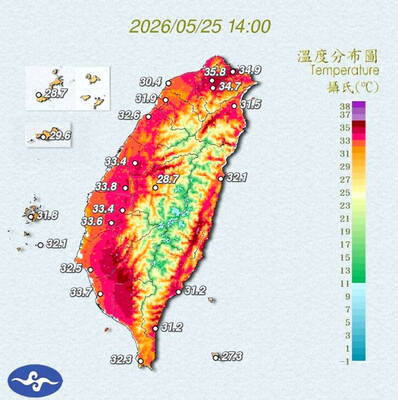
STAY COOL: The HPA recommended that people stay hydrated, use air-conditioning or fans while indoors, wear loose-fitting clothes and walk in the shade while outdoors Employers must implement measures such as installing cooling equipment, and providing drinking water and rest breaks for outdoor workers starting from Monday next week, the Taipei Department of Labor said on Sunday. Employers who fail to comply could face fines of NT$30,000 to NT$300,000 under the Occupational Safety and Health Act (職業安全衛生法), the department said. Businesses in Taipei employing fewer than 100 workers, as well as registered self-employed workers with labor insurance coverage, could receive on-site assessments and guidance from occupational safety consultants to help them apply for central government subsidies to implement or improve heat-protection measures, it said. Under the Ministry of

GLOBALGIVING: ‘ Caving to external pressure is not acceptable for an organization that has cultivated justice reform and human rights for 30 years,’ one NGO said A slew of non-government organizations (NGOs) have withdrawn from the GlobalGiving fundraising platform after it announced it would use “Chinese Taipei” instead of “Taiwan” from next month. The Taiwan Good Rice Association wrote on Facebook on Friday that it was informed on April 28 via a teleconference call of the change, which was made because the platform wanted to operate in China. Taiwan Good Rice is to terminate all cooperative relationships with GlobalGiving in response to the platform’s “unilateral and non-negotiable” decision to remove references to Taiwan, the NGO said. “Taiwan is in the official name of Taiwan Good Rice Association and the

Chinese Nationalist Party (KMT) Chairwoman Cheng Li-wun (鄭麗文) yesterday briefed her party’s Central Standing Committee regarding her scheduled visit to the US between Monday next week and June 16, saying that her purpose would be to persuade the US that the Republic of China (ROC) Constitution was a “one China” constitution that would foster stable and peaceful cross-strait relations. The ROC Constitution is the most important defense for all Taiwanese citizens, as it upholds our democracy and has contributed to our robust economy, which aligns with international and US interests, she said. “We would not be troublemakers and drag the US under,”


 RSS
RSS