


Vice President William Lai (賴清德) yesterday accused the Chinese Nationalist Party (KMT) and Taiwan People’s Party (TPP) of making empty campaign promises, adding that their partnership would have little bearing on his campaign for president.
Lai, the Democratic Progressive Party’s presidential candidate, made the remarks after attending the opening ceremony of the Association for Star Alliance Pilots (ASAP) executive board meeting in Taipei. It was the first time the association has held the event in Taiwan.
“Since I launched my campaign for president, I have been responsibly presenting my policies for the country’s future. People have also seen the attempts of the KMT and TPP. The reason that they are talking about a partnership is because neither the KMT nor the TPP represent mainstream public opinion,” Lai said, adding that it seems as if they are “uniting with a secondary enemy to attack their main nemesis.”
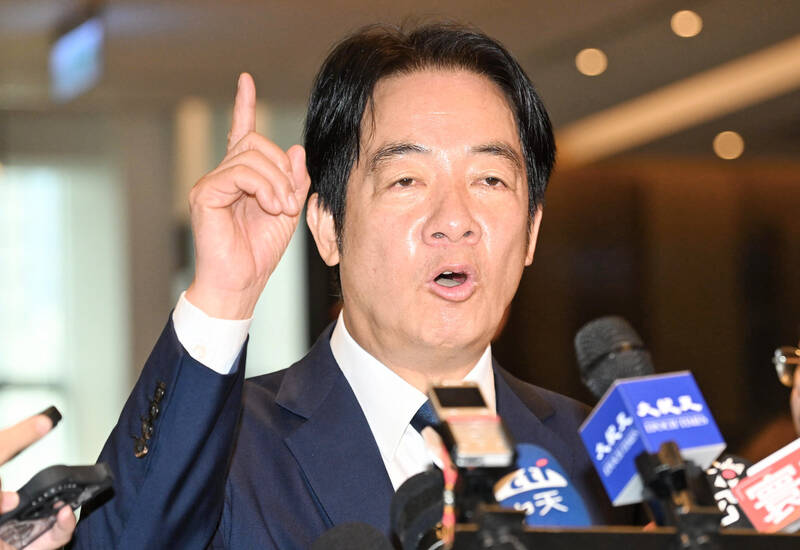
Photo: Chang Chia-ming, Taipei Times
“As for the consensus they reached on Monday, I only have one word for it: ‘empty.’ It will not have any effect on the presidential campaign,” he said.
The KMT and TPP on Monday also agreed that the president should give the state of the nation address and listen to suggestions from lawmakers.
Lai yesterday said that the Act Governing the Legislative Yuan’s Power (立法院職權行使法) already allows the president to give such an address, but they can only do so with the legislature’s approval.
“Although the mechanism has existed for a while, no president has been invited to brief legislators, because lawmakers have never agreed on such a proposal in their negotiations,” he said.
Ko has criticized the insurance schemes available for farmers, saying they are like huge cash bonuses.
“I want to ask which farmers’ insurance scheme he plans to annul: farmers’ health insurance or agricultural insurance? Does he want to cancel farmers’ health insurance?” Lai asked. “If he did not talk about the policy, people would not notice that he is so clueless about national politics.”
Lai told the ASAP meeting that, aside from producing more than 90 percent of the world’s high-end chips, Taiwan also has a civil aeronautics industry that has grown into a trillion-dollar business.
Ninety percent of the aeronautics components used in commercial flights around the world are from Taiwan, he said.
“Building on this foundation, Taiwan would continue to be a reliable partner in the global supply chain, making us more closely connected with the international community,” Lai said.
In 2019, approximately 40.3 million commercial flights were operated by domestic and international airlines every year, with global passenger volume reaching 4.5 billion, he said.
“With the COVID-19 pandemic subsiding, we are glad to see a resumption of air transportation, and that demand for air travel is increasing. The International Air Transport Association estimated that the global aviation industry would fully return to pre-COVID-19 levels by 2025. We believe that pilots will continue to play a key role in contributing to global innovation and prosperity,” Lai said.
Deputy Minister of Foreign Affairs Tien Chung-kuang (田中光) said it is urgent that Taiwan join the International Civil Aviation Organization (ICAO), which has made creating a “seamless sky” and promoting aviation safety its main missions.
“The Taipei Flight Information Region is one of the busiest airspaces in East Asia. In 2019, the region provided services to 1.85 million controlled flights and 722 million passengers departing or transiting through Taiwan,” Tien said. “Therefore, there is no doubt that Taiwan’s meaningful participation in ICAO is key to ensuring global aviation safety and security.”
“By sharing timely information and expertise, Taiwan’s Civil Aviation Administration’s participation in ICAO would definitely contribute to mitigating aviation risks... Excluding Taiwan has a negative impact on integration of the Asia-Pacific region, which is a priority in recovering from the pandemic,” Tien said.
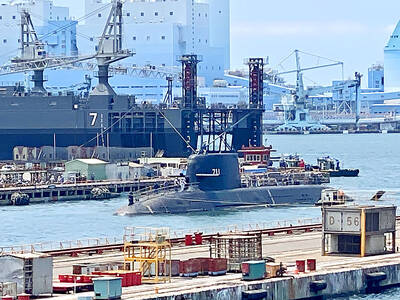
AGING: While Japan has 22 submarines, Taiwan only operates four, two of which were commissioned by the US in 1945 and 1946, and transferred to Taiwan in 1973 Taiwan would need at least 12 submarines to reach modern fleet capabilities, CSBC Corp, Taiwan chairman Chen Cheng-hung (陳政宏) said in an interview broadcast on Friday, citing a US assessment. CSBC is testing the nation’s first indigenous defense submarine, the Hai Kun (海鯤, Narwhal), which is scheduled to be delivered to the navy next month or in July. The Hai Kun has completed torpedo-firing tests and is scheduled to undergo overnight sea trials, Chen said on an SET TV military affairs program. Taiwan would require at least 12 submarines to establish a modern submarine force after assessing the nation’s operational environment and defense
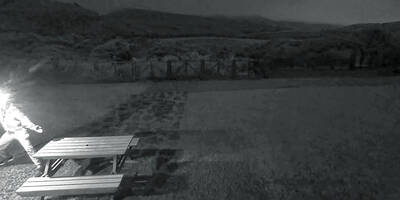
Yangmingshan National Park authorities yesterday urged visitors to respect public spaces and obey the law after a couple was caught on a camera livestream having sex at the park’s Qingtiangang (擎天崗) earlier in the day. The Shilin Police Precinct in Taipei said it has identified a suspect and his vehicle registration number, and would summon him for questioning. The case would be handled in accordance with public indecency charges, it added. The couple entered the park at about 11pm on Thursday and began fooling around by 1am yesterday, the police said, adding that the two were unaware of the park’s all-day live
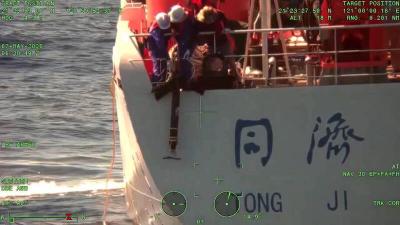
The coast guard today said that it had disrupted "illegal" operations by a Chinese research ship in waters close to the nation and driven it away, part of what Taipei sees a provocative pattern of China's stepped up maritime activities. The coast guard said that it on Thursday last week detected the Chinese ship Tongji (同濟號), which was commissioned only last year, 29 nautical miles (54km) southeast of the southern tip of Taiwan, although just outside restricted waters. The ship was observed lowering ropes into the water, suspected to be the deployment of scientific instruments for "illegal" survey operations, and the coast
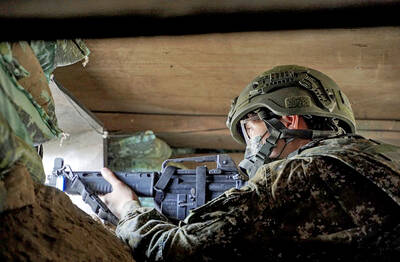
A former soldier and an active-duty army officer were yesterday indicted for allegedly selling classified military training materials to a Chinese intelligence operative for a total of NT$79,440. The Taipei District Prosecutors’ Office indicted Chen Tai-yin (陳泰尹) and Lee Chun-ta (李俊達) for contravening the National Security Act (國家安全法) and the Anti-Corruption Act (貪污治罪條例). Chen left the military in September 2013 after serving alongside then-staff sergeant Lee, now an army lieutenant, at the 21st Artillery Command of the army’s Sixth Corps from 2011 to 2013, according to the indictment. Chen met a Chinese intelligence operative identified as “Wang” (王) through a friend in November


 RSS
RSS