


The Executive Yuan yesterday said it would respect the opinions of experts regarding the best route for a new Taichung MRT line, after Vice President William Lai (賴清德) on Saturday accused the city government run by the Chinese Nationalist Party (KMT) of rerouting the planned Blue Line to benefit the business interests of a powerful political family.
To help resolve the controversy, Premier Chen Chien-jen (陳建仁) received updates from Ministry of Transportation and Communications officials yesterday morning and had asked the Taichung City Government to provide more information on the issue, Executive Yuan spokesman Lin Tze-luen (林子倫) told reporters.
Chen said the plan for the Blue Line must be integrated with the existing Green Line to meet the needs of Taichung commuters, and everyone should respect the input of experts, Lin said.
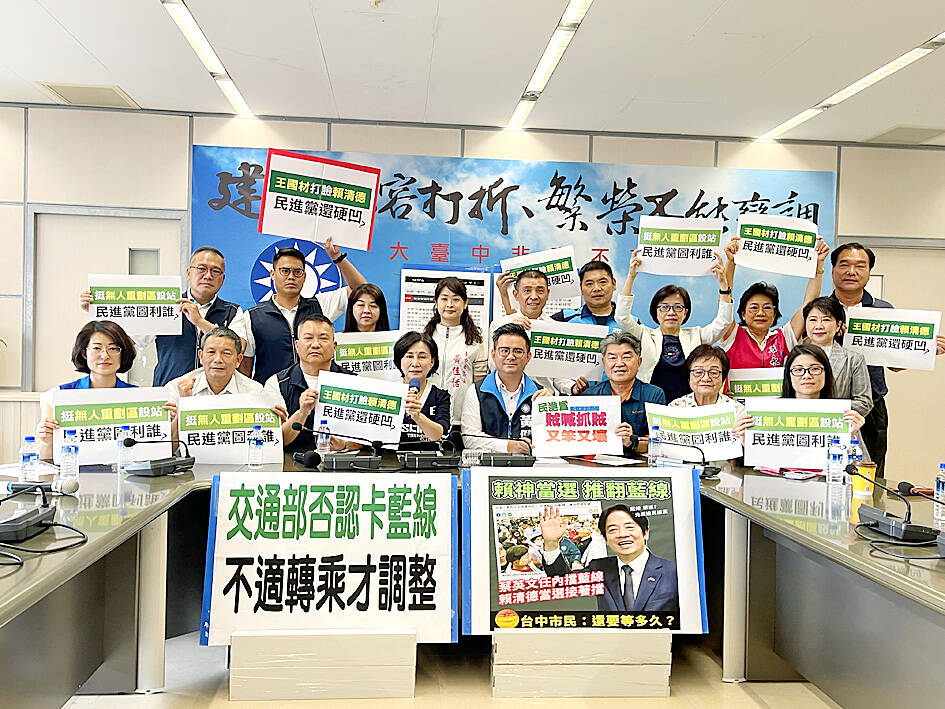
Photo: Su Meng-chuan, Taipei Times
The Taichung City Government’s proposed revisions to the Blue Line — in which the locations of two stations were changed — required further scrutiny, as an evaluation by experts indicated that NT$63.365 billion (US$1.96 billion) more in government funding would be needed, Lin said.
The proposed new route includes an additional 450m of pedestrian walkway to connect to Salu Railway Station, he said, adding that architectural changes to several stations could negatively affect traffic flow.
The city government has been asked to explain the rationale behind the changes before the budget is approved, Lin said, rejecting reports accusing the Executive Yuan of “stalling the new Blue Line.”
Minister of Transportation and Communications Wang Kwo-tsai (王國材) told a legislative session that his ministry did not care if the sites are near properties belonging to influential families, as long as they serve passengers.
“Although I understand there are controversies and the new route will take longer to review, we wish to have it approved soon after making the needed adjustments,” he said.
As the changes have been heavily questioned by lawmakers, input from experts is required, he added.
Earlier, Democratic Progressive Party (DPP) Legislator Lin Ching-yi (林靜儀) told a news conference that the planned Dingping and Zhengying stations would both be in Salu District (沙鹿), close to properties controlled by a powerful local family.
The KMT-led city government has not given reasons for selecting the new sites, nor did it consult with experts when making the changes, she said, accusing it of allowing politics to influence its decisionmaking.
The original budget for the Blue Line under the previous DPP city administration was just more than NT$90 billion, but after Taichung Mayor Lu Shiow-yen (盧秀燕) was elected in 2018, it grew to about NT$160 billion with a delay of more than five years, Lin said.
DPP Legislator Hung Sun-han (洪申翰) said the new stations are close to property controlled by the Yen family, which includes former KMT legislator Yen Kuan-heng (顏寬恒) and his father, Yen Ching-piao (顏清標), who was a KMT legislator and Tachung County Council speaker in the 1990s and has been convicted of corruption, attempted murder and possession of firearms.
Hung accused New Taipei City Mayor Hou You-yi (侯友宜), the KMT’s presidential candidate, of “smearing the DPP,” as Hou said at a rally in Taichung that it was the central DPP government that was stalling the Blue Line.
“It is Lu who colluded with the Yen family to hijack the Blue Line plans, resulting in the delay,” Hung said.
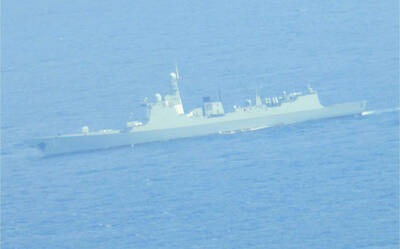
The military has spotted two Chinese warships operating in waters near Penghu County in the Taiwan Strait and sent its own naval and air forces to monitor the vessels, the Ministry of National Defense (MND) said. Beijing sends warships and warplanes into the waters and skies around Taiwan on an almost daily basis, drawing condemnation from Taipei. While the ministry offers daily updates on the locations of Chinese military aircraft, it only rarely gives details of where Chinese warships are operating, generally only when it detects aircraft carriers, as happened last week. A Chinese destroyer and a frigate entered waters to the southwest
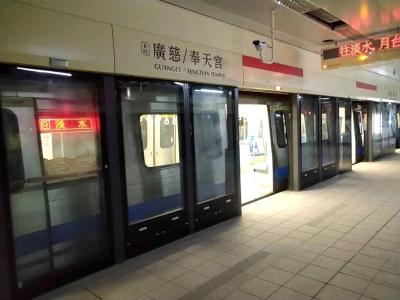
The eastern extension of the Taipei MRT Red Line could begin operations as early as late June, the Taipei Department of Rapid Transit Systems said yesterday. Taipei Rapid Transit Corp said it is considering offering one month of free rides on the new section to mark its opening. Construction progress on the 1.4km extension, which is to run from the current terminal Xiangshan Station to a new eastern terminal, Guangci/Fengtian Temple Station, was 90.6 percent complete by the end of last month, the department said in a report to the Taipei City Council's Transportation Committee. While construction began in October 2016 with an
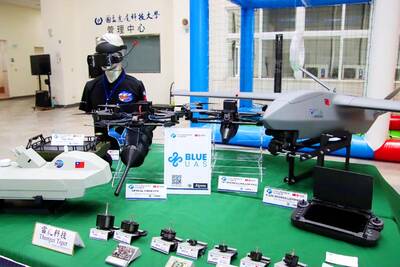
NON-RED SUPPLY: Boosting the nation’s drone industry is becoming increasingly urgent as China’s UAV dominance could become an issue in a crisis, an analyst said Taiwan’s drone exports to Europe grew 41.7-fold from 2024 to last year, with demand from Ukraine’s fight against Russian aggression the most likely driver of growth, a study showed. The Institute for Democracy, Society and Emerging Technology (DSET) in a statement on Wednesday said it found that many of Taiwan’s uncrewed aerial vehicle (UAV) sales were from Poland and the Czech Republic. These countries likely transferred the drones to Ukraine to aid it in its fight against the Russian invasion that started in 2022, it said. Despite the gains, Taiwan is not the dominant drone exporter to these markets, ranking second and fourth

Japanese Prime Minister Sanae Takaichi’s comment last year on Tokyo’s potential reaction to a Taiwan-China conflict has forced Beijing to rewrite its invasion plans, a retired Japanese general said. Takaichi told the Diet on Nov. 7 last year that a Chinese naval blockade or military attack on Taiwan could constitute a “survival-threatening situation” for Japan, potentially allowing Tokyo to exercise its right to collective self-defense. Former Japan Ground Self-Defense Force general Kiyofumi Ogawa said in a recent speech that the remark has been interpreted as meaning Japan could intervene in the early stages of a Taiwan Strait conflict, undermining China’s previous assumptions


 RSS
RSS